This Blog Is For Sharing & Participation
I welcome all and any comments, feedback, suggestions, etc.
“For Your Salvation”
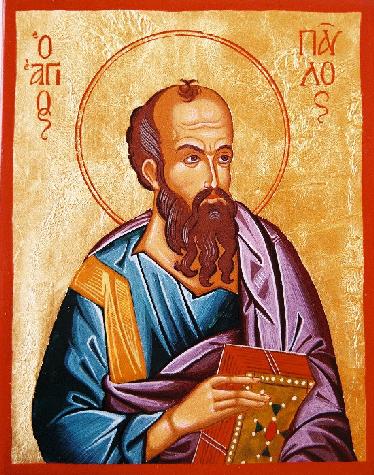 One of the phrases in the letters of St Paul that I have frequently read is the phrase, “for your salvation.” In the same context are the phrases, “for your sanctification” and, “for your edification.” I believe that the majority of these phrases are found in the letters to the Corinthian believers. But what does that phrase mean? Just to make sure that no one thinks I believe myself to have the answer, I will say that as I study Orthodoxy more and more, I believe I have an inkling as to what it might mean. I generally run this stuff by my Priest during our discussions, and if I am way off, he lets me know. When I am more or less in the ball park, he gives me the nod (so to speak). But to any that read this and find my comments to be way off, please let me know in the comments. Or even if I’m not WAY off, then let me know to what degree I am missing it. Or just leave any comment at all. (Sorry, my attempt at humor via blog)
Based on what I wrote in my last post, I think my understanding of the nature of salvation helps me to make sense of these words of St Paul.
Salvation, as I understood it before, involved being made alive by God based on the merits of Christ, and His atoning death on the cross, followed by the hope of the Resurrection. As I mentioned in my last post, being born-again puts us in a right standing with God, and we are “accounted” righteous. This means Christ’s righteousness is given to me, regardless of what I have done, because I believe in Him. It’s a personal transaction that is independent of others. With this as my understanding of salvation, St Paul’s words really make no sense. What I mean is this: if it’s about what Jesus did for me, then how can anyone else claim to have a part in that. Even the words edification and sanctification, in this context (as I once understood it) can only be that you are “encouraged” in your walk, as Jesus does the sanctifying and edifying.
The first time I heard Fr Patrick speak in a homily about his teaching, praying and administering the Holy Mysteries as being for our salvation, I was taken aback. How could this be? But then as I re-read the Scriptures, I came across these phrases over and over again. I thought to myself, there must be something to this, if he keeps saying it (he being St Paul).
As I have gradually begun to understand some of the Orthodox doctrines a bit more, I see that we have more than a transactional position in Christ. We have a living, breathing communion with Him that is not a solo mission, but is in fact a communion with all believers as well. His incarnation is the focal point of our communion with Him. His death and resurrection has broken the power that death and sin have over us, and makes us able to partake in that communion. Just as our participating in the sacraments is a mystical participation in and union with Christ, so it is with others. Just as Christ prayed in John chapter 17, we are one in Him, and in Him we are one with each other. I don’t know how it works, I just know that it’s true. As we participate in His life, we are participating in one another’s life.
Just as Cornelius’ belief and baptism, in the Book of Acts saved him, he also saved his “whole household”. This is especially true for us parents, as we are leaders of “the domestic church” e.i. our children. If St Paul as a spiritual father to those he started Churches among, were effected by the things he taught, prayed and did, how much more are our physical children effected? We have some kind of effect on one another. And this is the result of a life of communion with one another. This can have both a positive and negative effect.
So when I hear St Paul’s words to the Corinthians: “This is for your salvation…” I hear him say, “This saves you because we participate in a common life in Christ.” “This is to help build you up, which is my joy as your spiritual father.” “This will have it’s work of making you more like Christ, because this salvation is the healing of your souls.”
I can’t remember in which epistle this comes from, but essentially it says something to the effect that we are one another’s and are Christ’s and He is God’s (the Father). If we are so united, then how can we not effect one another’s salvation? This doesn’t mean “Effect whether or not you go to heaven”, but this conveys the idea, “We are on this journey together. Here, let me help you, and at some point you may help me.” I like that. What a gift, and what a joy.
Does Baptism Save?
 I had to edit this slightly the day after I published it.
I was at a memorial today at my old church today. My wife and I attended there for the first several years of our marriage. The memorial was led by a friend of mine, who was also the grandson of woman whose memorial it was. He was one of the youth when my wife and I first began to help with the youth group. He is now the assistant pastor of a church in Germany. Interestingly, he serves with the same man who was the youth pastor when he was a kid.
The memorial was for a family friend of our who died at age 82, of some sudden illness. She was the grandmother and mother of a family that we consider to be like family to us. A wonderful person who is very difficult to forget, even if you met her but once. As the videos of pictures were played, and family memories were shared, my friend shared how he had baptized his grandma upon her request, just a few years ago. There was a video collage of the pictures taken that day to go with the story. In the Evangelical circles, baptisms are done impromptu many times. I believe this comes from examples like those found in Acts, as with the baptism of the Ethiopian eunuch. As my friend recounted the event, he said the famous line that precedes an Evangelical Baptism: “Baptism is an outward sign of an inward grace. Baptism didn’t save her.” For the first time, these two sentences (which I have heard dozens of times) made the hair on my neck stand up.
I don’t say this to judge my friend, his sermon, or anyone that agrees with his theological statement. I used to believe the same thing myself, without a second thought. As a matter of fact, this time last year, I had that same feeling when I first heard the words “Most Holy Theotokos, save us.” (Just for the record, I no longer get that feeling) I understand what is meant when Evangelicals say someone is “saved”. I am also beginning to understand the difference between that understanding of salvation, and the Orthodox view of our journey toward salvation, and our synergistic participation in it. Let me explain… that would take too long… let me sum up what I understood in that moment, at the memorial service.
I realized that if salvation really is being made alive, being given a “right standing before God” that can now never be changed, no matter what, because of what Christ did on the cross in atoning for our sins, then no, baptism doesn’t “save” you. As Father Stephen points out in His blog on Icons in a Literal World, the Evangelical view of salvation is not really much different than a secular view, because its view of world events sees meaning in such a narrow way. I have come to understand that such a world view is less shaped by true Christian thought, than by secular views throughout Protestantism’s history.
On the other hand, if salvation is the healing of the whole person and the process of making us partakers of the divine nature (making us more like Jesus) through participating in the Life of Christ, then yes, baptism does save us. Its meaning is more than a symbolic act that represents an inner reality, a nice thing we do which has no real significance to our salvation. In a mystery, we are participating in the death, burial and resurrection of our God and Savior Jesus Christ. We are in a sense participating in His baptism as well. It’s not just His righteous life being merited to me, it’s a union with the Savior that transcends time. As Father Stephen also points out, the events of Jesus’ life are not confined to the period of history in which they occurred, they reach backwards into the past, and forward into the future. And we participate in them, in a mystery. All to prepare us to become “partakers of the divine nature” as St Peter points out in his letters.
One other thing that struck me, was the realization that the Cross not only works forward into the future, but also reaches back to the beginning. I read this in George S. Gabriel’s book on the Theotokos. He speaks about the fact that every major event recorded in the Old Testament was the Cross at work in the lives of those saints. This idea blew my mind. If the Cross works in such a powerful way, then the whole life in Christ must somehow work this way in our lives as we participate in the Holy Mysteries of the Church. I have yet to participate in the mysteries of the Church, but as I learn more and more about their significance on our lives, the more I long for that day to come.
I have come to learn that salvation encompasses so much more, and is so much bigger than I ever thought before. This salvation keeps getting bigger and bigger each day. This is what I love about the Orthodox Church and its faithful passing down of the Apostolic Tradition. I used to say, “It’s not a religion, it’s a relationship.” in regards to my faith in Christ. In Orthodoxy, I have found that to be more a reality than I ever experienced before, and not just as a trite quip to say when evangelizing someone. This is the living, transforming faith that has real “Height, Depth, Length and Width… the Love of God”. Thank God for His Mysteries we participate in, in the Church.
There’s Something About Mary…

On the theme of the Theotokos and the Dormition Feast, I would like to share an old facebook message I exchanged with an Orthodox convert from August 11th 2009 (almost exactly one year ago). As you will read from the reply, I had issues with the Orthodox veneration of Mary. This was his gracious reply”
Dear Jeremiah,
I grew up in Tennessee, the son of a Southern Baptist pastor. I wasn’t entirely wedded to the denomination, and often visited other churches with friends, mostly Presbyterian. Yet, during the ages of 18 and 22, I more or less stopped going to church, though I never quit believing in God and his unique revelation in Christ; I always prayed. I came into the Orthodox Church soon after I turned 23, on Dec.13, 2001.
The issues you mentioned (in particular, the role of Mary) were certainly things I wrestled with. Truth to be told, I was still wrestling with them when I converted (and sometimes still do). Yet, along the way I received some good advice which I will pass on to you. Simply put, a priest told me: convert to Orthodoxy for Christ, not for any other reason. When you investigate the Church, always remember that everything is about Christ, and Him crucified and resurrected according to the Scriptures. If we lose sight of this center, the practices of the Church become disordered, and make little sense.
I say this not to shirk your questions, but simply to place them in the proper context: that of faith in Christ. As you seek to understand more about the Church, never stop praying: “Christ, lead me to You in Your fullness.”
At a certain point, the more I thought about Mary, and the more I looked prayerfully upon icons of her and her Son, the grandeur of her simple words to Gabriel (“Let it be to me according to your word”), and her role in our salvation slowly dawned upon me. As a Protestant, if I ever thought about Mary at all, I generally viewed her as an almost impersonal vessel through which Christ had passed. As my Orthodox faith grew, I began to see her more as a person, just like us (not immaculately conceived), but who had been given a task of paramount importance, and had said, “yes.” Certain biblical figures had always stood out in my mind – Abraham, Noah, Moses, Peter, Paul, for example – as doing something truly unique for all of us, but Mary had never occupied such a role in my own mind. I began to see that what she had done was, in a sense, the lynchpin which held the lives of all these other figures together: she gave birth to the one the prophets proclaimed, whose Gospel Paul preached. Literally, it is through Mary, that our salvation – Christ – has come.
This, of course, doesn’t answer your more specific questions, but I hope it at least indicates to some degree how Orthodox Christians can apply such superlatives to her. In a sense, the Orthodox see Mary as the icon of what we should all do – say yes to Christ in every moment – and she is the one human to have done it perfectly.
You mention that you are troubled by Orthodox prayers which seem to ask Mary to perform our requests. My sense is that this is just a different (perhaps hyperbolic) way of asking Mary to pray for us. It is certainly not the Orthodox teaching that we cannot pray to the Father, but must pray to the saints, who then deliver our prayers to the Father. When I ask for Mary’s prayers, or even if I ask her to pray to God on my behalf, I think of this in two ways, (1) in the same way that I would ask someone whom I particularly respected as a Christian to pray for me; (2) as a way of acknowledging my own frailty before God. Humility is a virtue which the Orthodox particularly prize, and I often think our asking the saints to pray for us is not so much to “get God’s ear,” so to speak, as it is to remind us that we are truly the “least of these.” God hears our prayers, period – even those we don’t know to pray. But by asking the saints to pray for us, we cultivate an awareness of our own place in a much larger body – a body which even death cannot tear asunder.
Regarding prayers which depict Mary as holier than all others, I would think of it this way: rather than viewing Mary as standing at the top of some divinely established pecking order, these prayers simply offer yet another way of depicting for every single Christian what our lives are about: receiving Christ and manifesting him in our words and deeds. And it is significant, I think, that Mary always seems unconcerned with her own holiness. Her concern, in both Scripture and Icon, is to point to Christ.
Coming to terms with the Church’s veneration of Mary, however, takes time. The words I’ve written are in many ways my own continued attempt to come to terms with this. Yet, as with all Orthodox teaching, the conversion must take place in the heart, and the conversion of the heart always happens in prayer. If I could thus recommend one thing, it would be this: get an icon of Christ and the Theotokos (there’s one called “shower of the way” which seems particularly relevant) and for a few minutes every day, sit in front of it and pray, perhaps, “Christ, teach me about Your mother.” Even with this, though, don’t feel like you must rush into it. Conversion to Orthodoxy takes time, and you should feel comfortable taking this at your own pace (or you can think of it as God’s pace, in which a day is like a thousand years 🙂 ).
In Christ,
JeffNot too many months after this, Jeff was ordained a Deacon. AXIOS! I would like to thank Jeff from the bottom of my heart for the part he played in my journey.
My First Dormition Feast
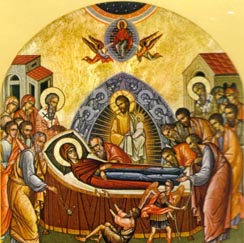 By the title of my last post, you would think this was my second time celebrating (I should put that in quotes) the Dormition Feast. The Sunday following the Dormition was my first time attending Liturgy at St Peter the Apostle Antiochian Orthodox Church, my current parish where I am a catechumen. So I guess this weekend will mark an anniversary of sort for me as well.
I remember the Liturgy mostly for three reasons. One, my daughters were with me, and they made immediate friends their first day. Second was the fact that there were no pews or rows of chairs, only chairs lining the walls, and an open middle. Third was the meal after service. They congregation was thoroughly enjoying having meat and dairy back in their diet.
I was still trying to take all the things I had learned about the Orthodox Church to that point, and whether I could believe it or not. So the meaning of this season was completely lost to me. But this year I have an opportunity to soak it all in. One problem… I have to work. Being a fireman, I work 72 hours straight, and my days are on the weekends, from Saturday through Monday. Thank God my parish has a 6am Liturgy midweek, or I’d be in a hurt-box.
So how am I going to soak in this season? http://www.antiochian.org/sites/antiochian.org/files/aug_15-10_-_complete_dormition_of_the_theotokosu.pdf
The Antiochian Archdiocese website has a wealth of Liturgical Texts in pdf format. My hope is to read these prayers, hymns, kontakion, etc when I have down-time and soak in as much of the Tradition of the Church as I can. I have already heard a great podcast teaching by Fr Thomas Hopko on the Dormition, on Ancient Faith Radio. I pray that I can bask in the wonder of what the Dormition means for the Church and let it continue to transform me. I have been praying that Christ would reveal His Mother to me. She, and all the saints, have been out of my realm of thought as a Protestant most of my life. I now pray to live in the truth of what the fullness of our life in Christ has, in and through the Traditions of the Church, by the Holy Spirit.
St John Damascene Exposition Project

I have a friend who is working on a great project. Here is the project in his words, which can be checked out at: https://sites.google.com/site/ericjamz/the-exposition-project
“I am presently working on a revised English version of The Exact Exposition of the Orthodox Faith by St. John of Damascus. The objective is to present the entire text in accessible, modern English. I plan to index and annotate key passages of the text with commentary from both contemporary and historic theologians and writers. This is not a new translation of the text, but will be a much needed revision and publication, making the ‘Exposition’ accessible to modern readers.
St. John Damascene’s The Exact Exposition of the Orthodox Faith is a summary of the dogmatic writings of the early Church fathers. Our primary goal is to make it available and accessi
ble to the modern reader, while also bringing out the fullest measure of its worth through exemplary annotations and articles.
How Kickstarter Works:
1. I submit the proposal to raise funds for a project, with both a funding goal and an end-date
2. If the plan is accepted, I must meet the funding goal before the end date, or the project will fail, and none of the funds will be made available to me
3. Those who back the project by funding it pledge a certain amount, but their credit cards are not touched unless the funding goal is met by the end date, and not until the end date. If the project fails, all pledges are nil.
4. I am free to offer rewards to backers who pledge certain amounts. In this case, $30 earns the reward of the trade paperback, $65 of the hardback, and so on. This is effectively a way of selling the book in order to fund it through pre-orders.
The primary budget for the production of this historic project is to raise $10,000″
My reason for posting this is to simply help my friend get the word out. The link I gave will also put you in touch with some of Eric’s other projects he has going.
An Anniversary… Of Sorts
 Last Friday, August 6th marked an anniversary of sorts for me. As most who read this blog probably know, August 6th is the day that the Orthodox Church commemorates the Transfiguration of Christ on Mt Tabor. This story is found in Matthew 17: 1-13, Mark 9:2-13 and Luke 9:28-36. One of the verses we sing at the Divine Liturgy and the service the precede and follow it, goes something like this:
“When, O Christ our God, Thou wast transfigured on the mountain, Thou didst reveal Thy glory to Thy Disciples in proportion as they could bear it. Let Thine everlasting light also enlighten us sinners, through the intercessions of the Theotokos, O God Thou Bestower of light, glory to Thee.”
I really like that verse. There is a lot of theology packed into two sentences. If that was all I could remember from the service, I think that would be enough. But I don’t want to get ahead of myself.
The significance of this day to me personally, is that on this day last year I attended the chrismation of the children of my friends Jonathan and Susan at Holy Angels Eastern Catholic Church in San Diego. I had only discovered Orthodoxy a month or two prior to that. I was very motivated to learn all I could, but still very much unsure about whether or not I believed it. It was my second liturgy ever. This time I knew a little more what to expect, and enjoyed it a lot more. One of the things that sticks out in my memory above everything else I saw that evening, was the chrismation itself.
For those of you who are unfamiliar with what a chrismation is, I will tell you what I have learned so far in brief. When a person is received into the Church after the catechism, they are baptized, then chrismated. This is basically a sacrament of the baptism in the Holy Spirit, and of entry into the priesthood of believers spoken of in the first Letter of St Peter. Having been baptized, the person takes off their shoes and is anointed with oil on the forehead, eyelids, nose, ears, lips, hands and feet. The thing that struck me immediately as I watched this was that it reminded me of the anointing of a Levitical Priest in the Old Testament. The anointing I witnessed was, of course, minus the sacrifice and blood prescribed in Leviticus. After this, they received the Eucharist together as a family. It was a beautiful thing I witnessed. I remember thinking that I wanted to experience the Eucharist myself. It was one of the many hooks that the Holy Spirit would begin to draw me to the Church with.
A year later, I find even more significance in this season of the year. A year ago, I had just learned about fasting, this time I am participating in it. This time of year is the season of the Dormition Fast which precedes the commemoration of the Dormition (falling asleep) of the Theotokos, Virgin Mary. Participating in the Church as a catechumen has helped me to soak in more of the importance, beauty and holiness of this season. Last year, I completely missed the real significance of the Transfiguration, but this year I have been able to take a bit of time to ponder the words of the verse above.
A couple of meaningful things happened for me this first week of the Dormition Fast, and Feast of Transfiguration. One was the passing of an elderly friend. She was a long-time friend who was like a grandmother figure (in fact she was the grandmother of some close friends of mine). She passed in the midnight hours following the Feast Day. I thought it interesting that she should enter into eternity the day after we celebrate the momentary glimpse into the coming Kingdom. I was privileged enough to sit by her side for about a hour, a couple days before she passed. She was conscious just long enough for me to say hello, and for her to recognize me and say hi back. It was interesting to participate in an act of obedience to the words of Scripture that exhort us to visit the sick. It was a moment mixed with grief, compassion and hope. I whispered some prayers from the prayer book, and read Psalm 50 (51 in Protestant Bibles). In that short time I got to slow down enough to recognize the presence of God. Nothing as obviously powerful as seeing Christ Transfigured, with Moses and Elijah at His side, but I suppose the uncreated light of Tabor was present, though not visible.
That night, when I got home, I had another meaningful moment with my two older girls. As we always do, bedtime business is followed by evening prayers, and story time. Instead of story time, Hailey (9) and Shea (5) asked questions about the Bible. I don’t remember all of their questions, but I remember thinking how glad I was that they were thinking about spiritual things. They were doing like Mary, and contemplating the things they have heard in their hearts. The trick is to make sure the answers don’t go completely over the head of Shea, but are not too simplistic for Hailey. I have also been trying to ask them more questions to see where their understanding is, and draw out what they know. Just as we were winding down the question time, Hailey told me that since I had started “doing this Orhtodox thing” she has learned a lot. When I asked what she meant, she said that she learned a lot from the Bible stories and such at the Presbyterian Church, but the Orthodox have more details about it. She then told me she was glad we go to the Orthodox Church. As you can imagine, it was a pleasing moment for me to see her embracing the teachings of the Church with such a mature attitude.
That next morning they woke up with me in order to be at 6am Liturgy for the Transfiguration. They had requested to come with me the night before. They never complained once. I take that back. Shea did have a bit of a tummy issue towards the end of the Liturgy, and they were both cold in the Nave, but other than that, they were troopers. Hailey stood with me for nearly the whole thing. The thing that they had both wanted to see was the blessing of the summer fruits. This sprinkling of the fruit with blessed water commemorates the foreshadowing of the Coming Kingdom I mentioned earlier. Any time there is something that involves the sprinkling of water, they love it. And I love sharing those moments with them.
In this short season of preparing for the Falling Asleep of the Theotokos, and the end of the Liturgical Year, it has been nice to take in the blessings surrounding the Feast of the Transfiguration. All of these things are indeed for our salvation.
Society of Biblical Liturature
I would like to share a link with any who might find it interesting:
http://ancientfaith.com/specials/society_of_biblical_literature_interviews
The link will take you to Four interviews and an introduction done by Dr Jeannie Constantinou of Search The Scriptures, a podcast series on Ancient Faith Radio. Her introduction tells you all about her various interviews, so I’ll just say that I thoroughly enjoyed the interviews, and let her give you the details. I found them to be encouraging, inspiring and informative. The interviews are not formal, and not very long, but have a good bit of information packed into a small amount of time. It gave me a lot of things to think about, study, pray over and work towards. If anyone does go to the link, let me know what you think.
Treebeard
 Anybody familiar with the Lord Of The Rings knows the name of Treebeard. He’s the Ent, or Treeherder. His most common phrase to the Hobbits he meets is, “Not so hasty!” The hobbits he met were, of course, Merry and Pippin, the most boisterous of the four hobbits in the Fellowship. Treebeard was, by contrast, slow, methodical and thoughtful in all his words and actions. He was in fact as ancient as the forest of Fangorn itself. He even explains to the hobbits that he IS Fangorn. One of the comments that struck me about how old he must be, was when Legolas the elf (immortal) said that he felt young as he stood in the forest.
I was thinking about what it has been like entering the Orthodox Church from Protestantism. It hasn’t been unlike Merry and Pippin’s encounter with Treebeard. A recent conversation I had with a friend reminded me what a dramatic difference the Apostolic Faith has made, not only in the practices and beliefs of my Christian faith, but in my very mindset.
The person I was speaking with was describing an event they were attending some time ago. In this situation they were thankful for the blessing of being there, which is good, but additionally were wondering what the purpose of them being there was. By that they were wondering if God wanted them to be there in order to do this, that or the other. There is nothing wrong with desiring to be in the middle God’s will. As a matter of fact, it’s one of the many positive things I can acknowledge I have received from the Protestantism I was raised in. But the point I am getting at is that the understanding of “God’s will” is a bit misguided, and with that faulty understanding comes what I remember as a kind of spiritual paranoia. It’s one of the products of the Fundamentalist Evangelical mindset. It creates constant thoughts of “Should I…?” “Am I supposed to…?” “What does God want me to be doing right now?” I never realized how exhausting it was trying to always be “in the will of God.”
Thank God for His Holy Catholic and Apostolic Orthodox Church. Learning to slow down to the pace of life and “phronema” (mindset) of the Orthodox Church has been refreshing. It’s like going from the frantic chaos of escaping a battle, to stopping to take a look around at your surroundings, then soaking it all in (which is how the hobbits come to meet Treebeard). Having begun to learn that God is “everywhere present and fillest all things”, I realize that I can soak in more of life in thankfulness to my loving Creator, and know that I am already in His will at that moment. A few of the things in the prayer of Metropolitan Philaret really stood out to me, after speaking to that friend of mine. In that prayer is a request to God to help me in everything to rely upon His holy will, and also to not forget that all things are sent by Him. What a relief to just be in God’s will, and not worry if I’m in it.
I am not yet fully received into the Church, and therefore do not yet participate in the Holy Mysteries of the Church. I look forward to that day. I have been anxious to have that done, but as my priest reminds me in “entish” fashion, “Not so hasty!” I have come to find that kind of slow, steady and patient catechesis into the Church a refreshing thing. Having said that, I am coming to realize that for an Orthodox Christian, being “in God’s will” is as simple as participation in the Holy Mysteries, obedience to what we already know the Scriptures, Traditions and such tell us we should do as Christians, and enjoy the presence of God “filling all things.” Even with all the Fasts, Feasts, Prayers, etc, there is a kind of simplicity that I can honestly say is lacking in most of Protestantism. I don’t say that to knock anybody, I’m just conveying an observation.
Just as Merry and Pippin were forever changed by their journey into Fangorn Forest, I have been forever changed by the Orthodox Church. I have found that which is fullness, ancient, deep, wide, and high. Yes there is a lot of practices to observe, and things to learn, but there is that peace the comes from relying upon God’s holy will, and not forgetting that all is sent by Him.
A Child’s Musing
 So the other day my oldest daughter Hailey tells me that she wants to sit with my wife and I, and have a conversation about something that has been on her mind. Her tone and posture told me that this was something the she had put a considerable amount of thought into. Hailey is unusually in tune with her feelings about things, and even though she is not confrontational, when she is ready to ask someone to stop doing something, or to do something, she knows exactly how she feels about it, and why the person she is telling should care about her feelings. I say she is unusually in tune because I have never met a kid her age that communicates their feelings that way. She is also very insightful about others. She doesn’t just take their actions at face value, she thinks about why they may be doing or saying something.
To give an example that I believe I have shared before, she asked if the Orthodox veneration of icons constitutes a breaking of the Second Commandment. She asked it without any prompting from anyone else. She asks a lot of questions about the Orthodox Church. I am glad she is a thinker.
Needless to say, I was a bit nervous about the conversation. She is getting to the age when, “You’ll understand when you’re older” is not a sufficient answer to questions about life. Could this end up being “The Talk”? I wasn’t quite ready, but I think my wife and I would make it through it okay.
Unfortunately, it was almost a week before we could have this talk. When she sat us down, she told us that she had been thinking about how the world is kind of like a fairy tale. She started off with the once upon a time being like the beginning (Genesis I’m guessing). Then there is Good and Evil. God is of course good, and Satan is evil. In the end, just like in fairy tales, God will win, and Satan will be cast out. There is a kind of “magic” at work around us all the time (God’s hand). That was it. She just wanted to share her musings with us.
I found it quite precious. To see that she is beginning to see how something she learns about is like “real life” makes me realize she is growing up. She is starting to make the connection between her reflections, and their application to herself and situations. This is where I think the Orthodox Church will be a great teacher. Not only that, but the Holy Mysteries will be the illumination, edification and inspiration of her life. Right now she is in a bit of internal conflict about Orthodoxy, because of the “fun” and friends she has in the Presbyterian Church. She makes some connections between what she sees and hears in Orthodox services, but her emotions are torn. For this conflict I am in prayer for her daily, and would ask that anyone who reads remember her in your prayers. She has chosen St Tatiana of Rome for her patron saint (should she become Orthodox), so I beseech her intercessions for Hailey.
The best part about all this, is the fact that all Hailey’s reflections and musing are still infused with awe and wonder. I find that I actually learn a lot from her and her sisters. God grant me such wonder in my reflections.
In The House Of Tom Bombadil
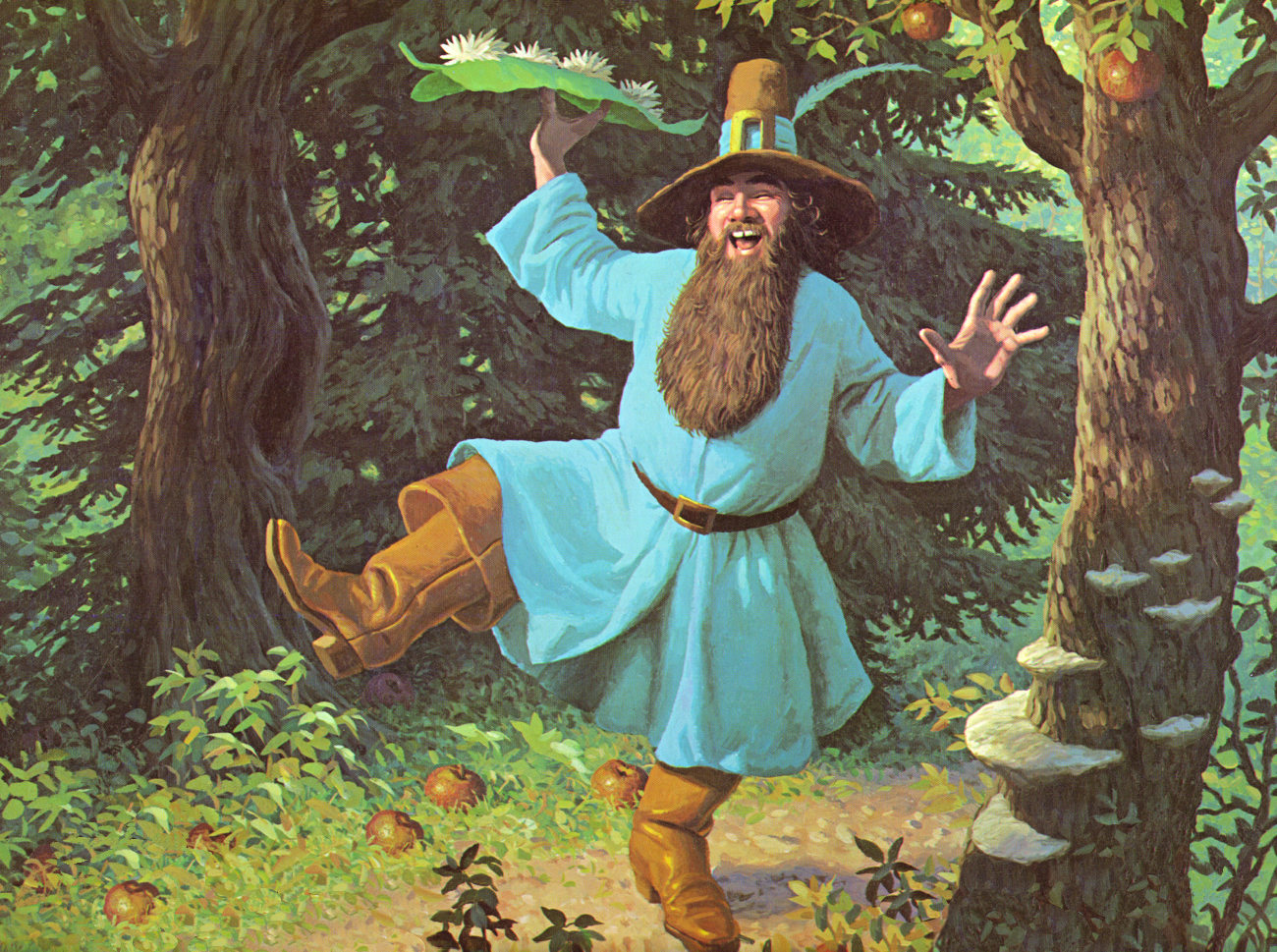 The hobbits grew up just on the other side of a wall that separated them from a forest called The Old Forest. In the middle of the forest was a strange character and his wife. In his house, all the terrors of the conscious woods were unable to come. An entirely unexpected character found in an unexpected place, that you think you know. The hobbits thought they knew all about the Old Forest, but they missed what was right in front of them.
That’s kind of how I felt this past weekend. I went up to a town called Etna, in Northern California, for a family wedding. Years ago I had worked there for a summer, and became fairly familiar with the small town of less than 800 people. This area, known as the Scott Valley, was founded by settlers who came in on covered wagons nearly 150 years ago. They turned a bog into fertile ground for crops. The people made their communities, in which they take pride. Many of them have been here for several generations. Whatever their denomination or belief, they have helped each other without question, and been one another’s support. Nothing much changes here, and probably never will. It wasn’t hard learning to figure out my way around, and I thought I had a good grasp of the local area. What was hidden, just around the corner from me, I recently discovered.
When I first learned about the Eastern Orthodox Church, I saw that some of their materials were printed in Etna. Etna? you mean that little town in the middle of nowhere? Apparently. I recently came in contact with the Convent of Saint Elizabeth Duchess of Russia. This convent was located less than a mile from the camp I spent my summer of 1994 working at. I had no idea it was there. Then again, at the time, I never knew about Orthodoxy. I called and ordered a couple of icons for my daughters, and prayer ropes. During the course of the conversations I got word that the Abbess had blessed a tour of the convent when I came to pick up the items. I was excited about the opportunity to see an actual monastic community. I brought my two older girls, so they could learn something about the way faith is lived out in a monastic type community.
I had a hard time finding the road the Convent was on to start, but once I found it, I couldn’t believe I hadn’t heard about it before. The Convent is hidden from view of the main road, but very easy to see by their neighbors. In a town where people tend to know everything about their neighbors, it’s surprising that someone hadn’t mentioned their presence. I found out that the convent has been there for about 28 years, and the Monastery preceded it by several years. Within the past 10 years, a parish has been established (Sts Cyprian and Justina).
Pulling on to the property, the surrounding woods were nothing out of the ordinary; dry pine needle ground cover under thin trees, and various brush and weeds. One of the nuns came out to answer the bell at the gate. Her name was Mother Justina. Inside the gate was a lush, green, well-kept landscape full of fountains, stones paths and gazebo type areas with icons. A very peaceful environment. After a very short introduction we were shown the Church building where services are held. A very small building, but very beautiful. Mother Justina told us the story of St Elizabeth, whom the convent was named after. Parenthetically, when we came home I found that our icon calender has St Elizabeth’s icon for this month. A great way to remind the girls of our visit.
Mother Justina showed us the various buildings where the mothers make the wares that they sell, in order to sustain their convent financially. They make everything from Icons, Prayer ropes and the like, to vestments and woodwork items. I was informed that all the icons they print, are first painted by their master iconographer (Mother Justina, interestingly enough). Their list of icons is quite impressive. They embroider them, paint and print them. The vestments they sew are very beautiful as well. I did not see their wood shop. I imagine the advent of the internet has been good for monastics that have taken advantage of it. Here is a link to their convent: http://www.conventofsaintelizabeth.org .
As we went from building to building, Mother Justina told us that each structure was built from the ground up by their own hands. Even the stonework that went into building the wall around the convent was done by the nuns. This was quite impressive. We were given a tour of their livestock. They had goats and chickens, and even a pony. We were told that each of the animals was a gift from the surrounding community at various times. They have even been given dogs. One was name Kermit. Kermit the Dog (and I thought nuns didn’t have a sense of humor). The vegetable and fruit garden had a good, healthy yield. Mother Justina said that while their neighbors have very poor water pressure, the convent seems to have abundant supply and pressure. A “small” testimony to the providence of God.
The most impressive story was the one concerning their guest house and prayer chapel, dedicated to St Xenia. The adjoining property was once owned by absent owners who rented it out to tenants who abused it, to say the least. They littered the area with broken vehicles, appliances and general trash. They used drugs, were violent and a general nuisance. The abbess pled with the owners to do something about the tenants, but they would not. Apparently, all they were concerned with was getting rent money. The nuns asked to buy the land, but the owners were not interested. They were eventually forced to evict the tenants for illegal activity, but would not sell. They arbitrated through a realtor, to no avail. They began to offer daily prayers for the property and asked the intercessions of St Xenia. As the weeks went by, nothing changed. On the feast day of St Xenia the realtor called and told the abbess that inexplicably the land owners called, that very morning, and agreed to sell the property to the convent, on the abbess’ terms. I was glad to have my girls present to hear such a miracle done on behalf of God’s people.
The tour ended with the mothers offering the girls a snack and a drink. They were very hospitable and gracious to us. The biggest challenge of the whole tour, was keeping my 5 year old (Shea) from being overly exuberant. She was so enamored with the animals, she would wait just long enough for Mother Justina to be done talking to ask about them. Her main obsession was the pony (of course). Trying to impress on her that we were in a community of people wholly dedicated to prayer and service, and not an amusement park of some kind, was a bit difficult. I was expecting the mothers to be a bit more stern, but they were very kind, gentle and gracious to the age of my daughter. Hailey (9) was her normal, polite self, and she seemed to pick up a lot of the tour.
While the girls were enjoying their snack, Mother Justina told me how she was from Sweden, a country that claims 90% Lutheran, but 80% of them are really atheist. So it is quite a rarity that she should be the daughter of an Orthodox priest. She told us how her father’s village, during WWII, had hidden the Jews from the invading nazis. When a Jewish family was discovered and executed, the rest of the village refused to give the nazis the information they asked for. For this refusal, the kids (one of which was her father) were sent to concentration camps for several years. An amazing story of faith and kindness in the midst of suffering.
The mothers offered to keep us in their prayers, as we did them. I hope to return there again someday with myself and my whole family as Orthodox.
Another discovery was the parish. This was less than 1/2 mile from from the convent. The Church was dedicated to Sts Cyprian and Justina. We celebrated Liturgy with the parish of 10 people on Sunday morning. I was glad to have the whole family their. Quickly though, my wife became distracted by Liana (1) and took her out. After the Liturgy, the priest and others said she was well behaved. Gia thought she was getting too loud, but I knew she was okay, as there were two young ones in the service, who were the children of the priest. I think it was partially due to the fact that my wife is still uncomfortable in Orthodox services. Although our stay was limited to the Liturgy service, due to family obligations, I was joyed to find an Orthodox community tucked away in the midst of cowboy country.
 This is a blog about my journey from Protestantism to the Eastern Orthodox Church, and reflections of have as an Orthodox Christian. Not very original, but I am hoping to sort out some of what I have learned and share my journey with others. I hope this will help explain some things for my friends and family. I also hope this may help someone who is not yet my friend, that I have not yet met.


 Jeremiah Was A Bullfrog... Now He's Eastern Orthodox?