This Blog Is For Sharing & Participation
I welcome all and any comments, feedback, suggestions, etc.
Orthodox Mission in the 21st Century
 Fr John Peck recently posted this to his Facebook profile. This is a four part article by Metropolitan Hilarion Alfeyev which was originally given as a lecture. The articles are self explanatory, by virtue of the title, so no need to really tell you what they are about. I will say that these challenge some ideas I’ve already developed as a catechumen. They have also affirm some thoughts I have had about Orthodoxy.
If these links do not work, just type them into your browser.
http://preachersinstitute.com/2010/09/orthodox-mission-in-the-21st-century-part-1/
http://preachersinstitute.com/2010/09/orthodox-mission-in-the-21st-century-part-2/
http://preachersinstitute.com/2010/09/orthodox-mission-in-the-21st-century-part-3/
http://preachersinstitute.com/2010/09/orthodox-mission-in-the-21st-century-part-4/
The Exaltation of the Precious and Life-Giving Cross
 September 14th marks the second major feast of the Liturgical Year. This Feast is The Exaltation of the Precious and Life-Giving Cross. This is one of the celebrations commemorated by the ancient Churches of both East and West. But like most feasts of the Apostolic Churches, I never heard of this one as a Protestant. The only two holidays I ever knew of as an Evangelical, were Christmas and Easter. Okay, you may argue that Thanksgiving is a religious holiday, but it is really a civil one. I came to celebrate a lot more things according to the Western Church calender as an attendee of the Presbyterian Church. Reformation Sunday, All-Saints Day and a few others were added to the repertoire of religious holidays I knew. Even the teachings had a seasonal aspect to them that followed the church calender. As an Orthodox, I can’t think of a month that doesn’t have at least one major commemoration in it.
To give a very brief history for those unfamiliar with this Feast day, let me share a bit of what I have learned from a priest. From the earliest times Christians reverenced the places associated with the life of Christ, such as the place believed to be where He was born, Golgatha, etc. Unfortunately, because of the fact that Christianity was illegal in Rome, and the intense persecutions, many of the monuments placed in these spots were torn down, desecrated, or replaced by places of pagan worship. In the 4th century, having made Christianity legal, Constantine’s mother prompted the excavation of these holy sights, in order to restore them to their intended purpose. During the the excavation at Golgotha, the Cross of Christ was found along with the other two spoken of in the Gospel accounts. This cross was stolen by the Persians. I am not sure what the circumstances of that incident was. In the 8th century the Cross was recovered from the Persians by the Emperor Hiraclius and brought back to Constantinople. This is what is celebrated as the Exaltation of the Precious and Life-Giving Cross.
I find it interesting that within the first two weeks of the Church year, you have the celebration of the instrument (so to speak. forgive the use of this word) who would make true communion with Christ possible through the Incarnation, followed by the celebration of the instrument that makes our salvation possible. By the Cross our Lord trampled down Death by His death. I have heard it said that some of the Church Fathers believed that the cross was not an instrument that just happened to be used to execute Christ. They believe that Christ’s death HAD to be on the cross. No other death would have done what the cross did. He was lifted up above the earth, for all to see Him. His arms were stretched out to embrace creation. And because He hung on a tree, He became that curse for us. These are reflections of the Church Fathers. I couldn’t have come up with such insight on my own.
I was able to attend liturgy for this feast at a Romanian Orthodox Church, whose name is Elevation of the Holy Cross. Their feast day, as well as the church’s 9th anniversary was today. They purchased an old church building in my city. The priest is Archimandrite Nikodim of the Romanian Patriarchate. He returned my call yesterday and let me knot that the service was going to be at 10:30, and would be in Romanian. Not to worry, the service book was in English and Romanian. I informed him that I am a catechumen in the Antiochian Archdiocese. He said I would be welcome to come. When I got to the Church, the akathist prayers were being offered, so I slipped into a pew and stood attentive as I could, being as it was in Romanian. The Church was in an old building with high, open ceilings and had several icons throughout. The veil that was hung where an iconostasis would be had three crosses along the top, two Icons of Mary, and two of Christ. The iconostasis is being made in Romania right now. Apparently they have only been in the buiding for 6 months, though the congregation has been together for 9 years. A humble place, but the work is in progress and has already made that log-neglected church building more beautiful and holy.
Just before the liturgy, Father Nikodim came to me with the service book, then asked me to follow him. To my great shock he lead me into the sanctuary and asked me to stand to the right of the alter, behind the certain. I felt very unworthy to be in that holy place, but took comfort in the fact that a priest had led me there. The priest took great care to make sure that I was able to follow in English, what was being said in Romanian, and guided me through the service book for the Liturgy. People kept tapping me from behind to hand the priest the prayer requests. A few spoke to me in Romanian. I was given the task by the priest of pouring the water over his hands three times, just before blessing the elements and praying the prayers that make them the Body and Blood of Christ. It was exciting yet terrifying at the same time. One thing that was different from the Antiochian Services I attend, the Romanians kneel during the Gospel Reading. They also prayed a few extra prayers to the Mother of God. A very beautiful service, and one I got to see from a very unique perspective. I am sure I will remember this experience for a very long time.
A little reflection, and a little personal experience for this feast. I did not get to participate in any vigil services because of my 72hour work schedule, but I am sure there will be plenty of opportunity in my life to experience such service (God willing, of course). Truly His Cross is Precious and Life-Giving!
Nativity of the Virgin Mary

Image via Wikipedia
As I posted about a week ago, it is the New Year of the Church Calender as of September 1st. The first Feast is celebrated on the 8th of September. The first Feast commemorated by Christians of the Orthodox Church is the Nativity of the Virgin Mary, the Theotokos. I find it interesting that the first and last celebrations of the Liturgical year are about the Theotokos. The biggest celebrations are of our Lord God and Savior Jesus Christ, but the celebrations for Mary are like liturgical bookends, so to speak.
Just a tiny bit of background for those who are not familiar with the Tradition of the Virgin Mary’s birth: Her parents were Joachim and Anna, often referred together as Righteous Joachim and Anna. If you have ever seen a Church by the name of St Anne’s, that is her. They were elderly, and beyond the age of conception when Mary was born. This is reminiscent of Abraham and Sarah, as well as Zachariah and Elizabeth. Upon reaching a certain age of childhood, she was dedicated to the Lord, and she lived in the Temple, just like Samuel in the Tabernacle. There are a lot of details I am leaving out, but you get the basic idea.
Like many of of Protestant friends who read this may wonder, I too wondered why is the Virgin Mary celebrated first in the Liturgical Year, and not Christ? But that is the wrong question, because it comes from a wrong understanding. Christ not only has the biggest celebrations of the Liturgical year, but in fact has all of them. Even the celebrations for the Theotokos Virgin Mary are celebrations of Christ. Before the ages God chose Mary to be the one to give flesh to God the Word. The Incarnation is the culmination and cause of creation, its the focal point of our communion with God, it’s our whole salvation. Because of Christ, the birth of the Virgin Mary is a significant day in the history of the world. Without the Savior of our souls being born of her, Mary would have just been another very holy saint.
Learning to celebrate the Theotokos has been one of the things that has been difficult for me, coming out of a Protestant background. Because the Gospels are focused mainly on Christ, and I never learned the Tradition of the Church from the most ancient times, I never really learned her special place in our salvation. Yes there is the account in Luke of Elizabeth’s prophecy, but I never made the connection until I found Orthodoxy. So now that I am becoming immersed into the life of the Church, I celebrate Christ and His Mother with the Church. We celebrate the miracle of her birth to aged parents. We celebrate her dedication to the temple and holiness of life. We celebrate her willingness to surrender her body for the Incarnation of Christ our God. And we celebrate the place she occupies in Heaven as an intercessor before her Glorified Son. We celebrate God’s salvation of man, and her role in it.
We sing and pray in the services of the Church, as well as in our personal prayer, “It is truly right and meet to bless thee, O Theotokos, ever-blessed, most pure and the Mother of our God. More honorable than the cherubim, more glorious beyond compare than the seraphim. Thou who without corruption barest God the Word, and art truly Theotokos, we magnify thee.” For the sake of Christ, who is our salvation, sanctification and glorification, we give honor to the one He chose to enter the world through. If He did, how can we not. It has become a great blessing in my spiritual growth to honor the Mother of God. Blessed feast day! For today (Well, September 8th) we honor the birth of the one who would become the one who made true communion with God through His Incarnation possible.
I am writing this a bit late. I intended to get this done at least a few days ago, but have been a bit busy with family and work. The Church is already coming up on the commemoration of The Exaltation of the Precious and Life-Giving Cross (tomorrow actually). Due to my schedule, I will miss this wonderful celebration, but hopefully I can find an evening service somewhere in the local area.
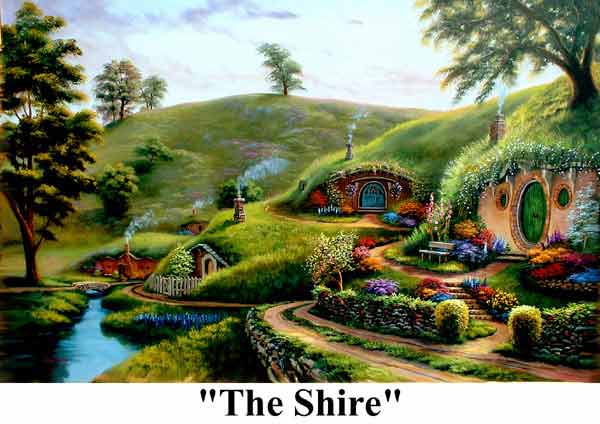
The Shire
The other day I was talking to a friend of mine about the schisms of the Church. Specifically we were talking about the division between East and West that has lasted the better part of a millennia. My friend was chrismated into the Roman Catholic Church several years back, and has since become Eastern Catholic. (For those that don’t know, Eastern Catholics were Eastern Orthodox that have regained communion with Rome, but under Rome’s conditions. This is WAY simplistic, as the actual history of the reunion is quite nuanced.) My friend and I were lamenting this schism. I have to admit that my friend is far more passionate about this problem than I am. After all, I am still just a catechumen awaiting full reception into the Orthodox Church. My main focus is my own spiritual preparation for being made a full member. I am, however in full agreement with my friend in hoping for a reunion of East and West as it once had been.
What does this have to do with The Shire? In relation to the above topic, I was thinking about the Hobbit mentality towards the “outside world”, and how they never liked “adventures” and that sort of thing. They rarely liked contact with the outside world, though they were hospitable enough. But as a result of their simple, quiet lives, Hobbits didn’t know much about what went on in the world at large. Even the most adventurous of them, Mr Bilbo Baggins, though he had many journeys outside The Shire, didn’t seem to grasp the full extent of goings-on in the world.
When Frodo (who had some knowledge of outside affairs through Bilbo) heard from Gandalf that the ring he possessed needed to be taken out of the Shire, he still had no idea what he was getting into. His faithful companion Samwise, upon eavesdropping the conversation, was intrigued by the prospect of seeing elves. Merry and Pippin followed out of a sense of deep friendship to Frodo, but had never left the Shire. And so they found themselves in the middle of a world bigger and more dangerous than they imagined. Not only that, but this world was at war, and they were at the heart of that war.
Being a Fundamentalist Evangelical Protestant, I was kind of in my own world of understanding as well. Things were fairly peaceful, all the bad stuff was “out there” and I had very strong opinions about that stuff, though I didn’t really know much about it. I thought I knew a lot, but I didn’t. Like the Shire, there are a lot of great things about my Evangelical heritage, but I have to admit I feel like I have come out of something like a world-view bubble. But then add to the fact that I have come to discover the Orthodox Church. Whoa!
In the fictional world of Middle Earth, there had been centuries of war, racial divisions (Elves, Dwarves and Men) and the like. Even though the three main races were divided with one another, they fought a common enemy, but not on a united front. Much of the things that had originally divided these groups were no longer factors that existed. Many of the things that continued to divide the races were mistrust based on rumor and legend. While these groups sometimes fought amongst each other, their common enemy plotted all of their ultimate demise. This is the War of the Ring.
While this is a very imperfect example, and cannot possibly communicate all of the nuances, but it is something of a picture of the divisions of the Church. I understand that there are a lot of reasons for these divisions, too many to get into on a blog of this sort. The shear number of centuries, geopolitical circumstances, theological implications, etc, is very overwhelming to a person like myself. While there are more denominational divisions within Protestantism by shear number (over 25,ooo), they don’t compare with the division of East and West (at least in my opinion). It is truly an eye-opening experience to learn how Church history has played out over the centuries.
While I lament and pray for these divisions, let me quickly say that I truly believe that this is the One Holy, Catholic and Apostolic Church. This is the Body of Christ, over which He is the Head. While in the current state of this world, humans will always make a mess of things, so to speak. I have to say also, that the beauty of the working of the Holy Spirit, is in His ability to weave our weakness with the strength and grace of God, and work things out for God’s glory. And this leads to my final observation.
The hobbits were thought to be stupid, soft, slow and weak by the world around them, yet they turned out to be “made of sterner stuff” than even hobbits had guessed. The 4 hobbits of the Fellowship managed to carry the Great Ring, while resisting it’s evil, rouse the Ents to war, wound the great Shelob, speak with Sauron in the Palantir and assist in killing the Witch King. In the end, they proved to have changed the course of history.
I think the influx of Protestants and such into the Orthodox Church has proven to be a good thing. Great for us who have discovered the Apostolic Tradition and origins of the Church. Also good for the Church. I think what we have brought to the Church may prove to be as valuable as what we have found in the Church. I wouldn’t presume that Protestants have had the same kind of impact on the Church as the hobbits did on the outcome of the War of the Ring, but I think the effect has been a positive one. Things seem like they are more lined up than ever for talks, counsel and possible reconciliation between the East and West. The Bishops and other leaders seem to be able to communicate better than in centuries past. While there is still a lot of work ahead, I think there is much reason for hope. I feel a great sense of optimism.
But like Gandalf told Bilbo, “You are just a little fellow in a wide world, after all.” And to that I say amen. No matter what circumstances may bring, I am grateful to have been found of Christ and have Him introduce me to His Church. Like I said before, all this other stuff is over my head at present. My focus is entering the Church, for now. However I echo the intercessory prayer when I pray, “Heal the schisms of the Church, and quench the raging of the heathen.” I not only pray for, but long for that day when we are united as one in Him.
A word to my non-Orthodox friends
 The title of my post is really just to catch the eye of anyone who sees that I posted to my blog, on Facebook. It is also intended to be directed toward my Protestant friends, or those who claim to be followers of Jesus, but not Christians any more.
This Podcast is from a series called the Illumined Heart on Ancient Faith Radio, hosted by Kevin Allen. His most recent episode is titled “Can We Really Know God?” The reason I made a call-out to my non-Orthodox friends, is that he explains the differences between the spirituality of the Orthodox and Protestants (Fundamentalist Evangelicals for the most part). It’s non-confrontational, and is just a good, simple explanation of the Tradition of the Church as it relates to knowing God. It is divided into two parts, the second of which will be out next week. Here is the link:
http://ancientfaith.com/podcasts/illuminedheart/can_we_really_know_god
I am sure my Orthodox and Catholic friends will enjoy it too. Let me know what your thoughts are on this podcast.
Sean pointed out that there is a problem with the link. You can try to type it in to the browser. If not, go to ancientfaithradio.com, go to podcasts, type The Ilumined Heart into the ‘search’ bar, then click on it. The first episode at the top is the one I listed. Sorry that the link doesn’t work. I tried to redo it, without change.
Boromir and Faramir (Revisited)
 On September 1st the Orthodox Church commemorates a Saint known as Symeon Stylites, among others for that day. Let me share an excerpt from abbamoses.com/months/september.html
He was at first suspected of taking up his way of life out of pride, but his monastic brethren confirmed his humility thus: They went to him as a group, and told him that the brotherhood had decided that he should come down from his pillar and rejoin them. Immediately he began to climb down from the pillar. Seeing his obedience and humility, they told him to remain with their blessing.
Happy New Year!… But it’s September!
 Did I really say Happy New Year? Yes I did. Today, September 1st, begins the Church Calender. But why September 1st? I was attending Vespers on August 31st, and heard a bit of the history on how the Church came to begin the year on the first of September. According to the short teaching my priest gave, while the Jewish calender begins with the month of Nisan – which corresponds to our March (Begun by the Passover as recorded in Exodus), the Roman civil calender began in September, on the 23rd. The Jewish calender began around the time of the Spring Equinox. The Roman calender began around the time of the Autumnal Equinox, which was the 23rd of September. I believe some time in the 7th century, the date for New Year was changed to the 1st of September. The Church followed calender. However, the Church did not change its calender to begin the New Year on the 1st of January, some centuries later.
As Fr Patrick points out, the Fall and Harvest time is a good time to begin the year. Kids return to school, the fruits of the year are gathered, etc. We begin our cycle of Liturgical Feasts and Fasts in this month. The year begins with the Nativity of the Virgin Mary, and ends with her death and glorification with Christ. Even though Christ is the Lord and focal point of all our lives and existence, Mary is a type of the Church. So it is not inappropriate to have the calender begin and end with her commemorations. Besides, everything about her that we honor, is really honor towards Christ, who is the Incarnate God that came into the world through her womb.
One of the things that Fr Thomas Hopko points out in his reflection on the Liturgical New Year, is that commemorating the beginning of the year for the Church is a chance to “redeem the time”. By this he means that we remember the Lord in all that we do. What better way to begin the year, than by meditating on the Lord in His Church?
Let me share one of the prayers of this day’s liturgical observance: “O Word of the Father from before the ages, Who, being in the form of God, broughtest creation into being out of nothing; Thou Who hast put the times and seasons in Thine own power: Bless the crown of the year with Thy goodness; give peace unto Thy churches, victory unto Thy faithful hierarchs, fruitfulness unto the earth, and Great Mercy unto us.”
Fr Patrick (my priest) pointed out that the phrase “Bless the crown of the year with Thy goodness” is from Psalm 64:12, and would have been sung liturgically by the Jews during their commemoration of the New Year, and possibly at Rosh Hashanah, the harvest time festival, which is literally called “the head of the year”.
Even though I have now been actively pursuing Orthodoxy for more than a year now, I can say that with a better understanding of observing the celebrations and commemorations of the Church, I am ready for a fresh Church Year. As I continue to prepare for my reception into the Church (though I do not yet know when it will be), I am glad to have the opportunity to “synchronize” myself, so to speak, with the Church.
Keep my family and I in your prayers during this year. And, once again, Happy New Year!
Gollum
 At the close of Riddles in the Dark, we see Bilbo Baggins debating within himself whether or not to kill the wicked Gollum who blocked his exit to freedom out of the cavern-kingdom of the goblins. In the end Bilbo’s mercy wins out, and he leaps over his would-be killer, leaving him alive to follow his nephew Frodo years later on his journey to Mount Doom. In a conversation with Gandalf about the Ring he had been left, Frodo laments Bilbo’s decision to not kill Gollum. Gandalf wisely and prophetically warns Frodo that Gollum could have some part to yet play in the fate of the Ring.
As anyone who has read the books, or seen the movies knows, upon reaching Mount Doom, Frodo was unable to throw the Ring in the Fire. Instead he declares that the Ring is his, puts it on, and becomes invisible to Sam and Gollum. Frodo’s weakness is immediately counteracted by the burning desire of Gollum, who bights off his finger. In his madness and ecstasy over having the Ring once again, Gollum then falls into the Fire, saving Frodo and all of Middle Earth.
I recently heard about some of the early Saints and monastics of the Church and their struggle against the flesh and sin. They followed a very strict ascetic discipline and lived out great piety and holiness. This was all very instructive and inspiring, yet one of the things that stood out was an odd statement. The statement had to do with how the saints embraced their sin, and not despairing over it, in the sense that Paul says when we are weak, we are strong (2Corinthians 12:10). And again he said that at some point in his ministry, God sent him a messenger of Satan to buffet him, in order to keep him humble (2Corinthians 12:7).
These saints were not fools as St Paul describes in Romans 6, who would ask the question, “If God’s grace abounds, should we sin that God’s grace can abound even more?”. To be sure, they fled sin and struggled against it with all there might (in synergy with God’s grace). But they saw their weaknesses, their tendency for a certain sin, as part of what Jesus meant by, “Take up your cross and follow Me.” They were forced to run to the grace and mercy of God, and were therefore driven to the arms of their Loving God (in a sense) by the very sin that tends to separate us from Life. They ran to the God of mercy in tears of repentance, asking for His mercy and for Him to purify and refine them.
In this way, Gollum is like a picture of our flesh and sin. It hounds us, follows us, and just when you think it’s out of the picture, comes back to attack you. Yet even in that attack, our very flesh that tends toward sin is “bitten” off of us, and so we come closer to salvation. God allows the shame of being unable to conquer the evil we do not wish to do (Romans 7), if we are willing to flee to His mercy, to eventually be our salvation. It’s almost paradoxical to think that our weaknesses can be our strength. Yet this is the wonder and beauty of our God. He will allow us to be scarred and maimed, so to speak, just like Frodo lost a finger. Not for the sake of harming us, but for our salvation and ultimate glorification. And in the end, just as Gollum fell into the Fire, so too will our sinfulness be burned away, never to bother or harm us again.
I think this is the idea of the blessing of being “poor in spirit” as our Lord, God and Savior Jesus Christ told us in His Sermon on the Mount. We pray after the Eucharist (not me yet, but you know the prayer) that the Body, Blood and Divinity of Christ would enter our bodies and burn away all sin, yet purify our souls and bodies.
Thank God for the “Gollums” that drive us in our weakness to the strength of our God’s grace, for though they afflict us for a short time, they hold no power over us. With St Paul we can rejoice, “O Death, where is they sting? O grave, where is thy victory? The sting of death is sin… But thanks be to God, who gives us the victory through our Lord Jesus Christ.” (1 Corinthinans 15:55-57)
Boromir And Faramir
 I could not find a good artist’s rendering of Boromir and Faramir, so I chose an image from the movie of Lord Of The Rings. I think this one comes from an extra scene in the Extended Versions. The great part about this image, is that it came with the subtitle. Comparing and contrasting the two sons of Denethor as a metaphor for my experience with my former Evangelical Church, and Orthodoxy, so it is something of a Story of Two Brothers. My attempt is to make a comparison with the book characters, not the movie characters. I think there is a big difference between how Tolkien and Jackson portray these two men. If you have read the Lord of the Rings (or even if you have only seen the movie) you can probably guess who will be who in my metaphor.
This reflection was spurred by an evening of hanging out with some old friends. There were seven of us, four of which used to attend the same church. The other three had contact with that church at one time or another, but never attended. None of us now attend this particular church. I will say that it is a Calvary Chapel in the Southern California, but I don’t want to give any names, so as not to seem to be disparaging anyone’s character. We were laughing about some of our own personal shenanigans back in the day, but then the conversation turned to a more serious topic; the things that have become unsettling about our former church. We noticed a tendency for things in the church to be driven by personalities, rather than led of the Holy Spirit, though they are labeled “Spirit Led”. We also noticed how many people who had once been in leadership at our former church, that are no longer there. Many of these people were suddenly “led in a new direction” (which meant they were asked to leave), usually after some kind of disagreement had occurred. Our former church had once been a small, humble congregation that has since become a stereo-typical mega-church. Our biggest lament was the number of people that have come, then been brushed aside in the name of spirit-led progress, all on the whims of a single personality.
And so comes my comparison.
Boromir, the elder son of the ruling Steward of Gondor was a large, charismatic warrior with a great desire to defend his home and people. He was loved and admired by many. While many of his traits were positive ones, he had a major flaw; he allowed one of his major strengths to become his downfall. In his courage and desire to defend his people from the evil of Mordor, he let himself fall victim to the enticement of the Great Ring. Wishing to use it against the enemy as a weapon, he disregarded any warnings that such a feat were impossible by the very nature of the Ring and the power it possessed. Eventually the delusion of being able to wield the power of the Ring led him to try and take it from Frodo. The ensuing chaos that followed led to the breaking of the Fellowship, and his own death. It is noteworthy that he did in fact die nobly, and recognized his delusion just before he died.
Such is the problem I have seen with a personality-driven church. In many cases the intent of the leadership is good, and worthy of praise. Much of the programs and things of that sort are good. The sinister nature of the personality-driven church lies just under the surface. A strong personality is very attractive to people. As people begin to gather around such a person (though people suppose they are simply gathering around the Word of God) there are inevitably those who begin to stroke the person’s ego.
Let me back up just a little. In case you are wondering, the model that churches like Calvary Chapel follow as their template of leadership is Moses. He heard from God, the people heard from and obeyed Moses. Only problem is, Moses had an actual encounter with the Living God in a radical way (such that his face physically glowed), and was extremely humble. Now back to our church…
With a model as described above, a person begins to be “led of God” and gets people to agree with his ideas. This is the beginning of delusion. For there is no real accountability, or hierarchy. If people disagree with the “vision” of the pastor, they are simply “being led elsewhere” because they do not fit the mold – uh – I mean, “aren’t keeping unity.” Unbeknownst to the pastor, people also begin to see getting into his circle as power. This is never overtly stated or thought, but it lies under the surface. Once in the circle, people begin to use manipulation as a way of keeping others “out”, getting others “in” or getting those that may be yet closer “out of the way”. This can be divisive, destructive and before you know it, the Word of God becomes mere pretense for personal agenda.
Just to make sure I don’t sound like I am picking on my old church (which I am not intending to do), I will say that this story is played out in many mega-churches with this kind of leadership structure. I also want to clarify that I am in no way judging the character of people in these churches. I don’t think many of them even know that this is the case, and would desire to change it if they found out this was going on. It is a tragic reality that should be lamented, and prayed for.
Faramir, the younger brother of Boromir, comes into the story by a more hidden route. He his defending Gondor from a secret outpost right under the nose of the enemy’s lands. He is every bit the leader of his older brother, but less brash. When he comes across Frodo and Sam’s path, he questions them only to discover that they hold on their person the “secret weapon of the enemy”. Yet unlike his brother, he tells Frodo that even if he found it himself, he would have nothing to do with it, because of the evil that it possesses. Faramir obviously possesses a wisdom that his brother (and as the book points out, neither did his father, in using the palantir stone) did not, or at least chose not to heed wisdom. This account comes from the book. The movie version is very different, and in my opinion, weak. Frodo notes that the character of Faramir is very much like Aragorn, the coming king. In his wisdom and virtue, he allows for what would end up being the “salvation” of Gondor and all Middle Earth.
In my experience thus, the structure of the Orthodox Church is more like Faramir, than Boromir. The leadership seems to always have someone, or a group that they are accountable to. There are no charismatic personalities making unilateral decisions because they hear from God. The leaders take their anointing, ordination and apostolic succession very seriously. Just as Irenaeus centuries ago, the bishops of the Church can trace their lineage of authority to lead and teach directly to the apostles. The Holy Mysteries of the Church are God’s Kingdom joined to our creation, and are therefore taken seriously by its leaders. No need to try and be relevant, because the mysteries of the Church have been, and continue to be, the healing of the whole person. Just like Faramir’s complete rejection of the allure of the One Ring, so the leadership of the Orthodox Church reject the allure of “celebrity” that is so rampant in Evangelicalism, especially the mega-church. And ultimately the decisions to reject such things is for our salvation.
I know that the Orthodox Church is far from perfect. The sins of the Evangelicals is no greater than the sins of the Orthodox Church. I lament the many divisions and breaking of communion within the Church over the long centuries. I am hopeful that the international leadership will begin to work these things out. Until they do, I continue to pray for the healing of the Church.
My intent with this post is simply a reflection on the intense spiritual danger of a personality driven church. The Scriptures exhort leaders to not lay hands on a person too quickly, or allow a novice to teach, lest the devil ensnare them with pride. I have witnessed the destruction the devil has and still does bring through a delude leadership. I acknowledge that there are a lot of good things those churches do, but how fearful should these leaders be of there hidden pride? While the Orthodox Church is not perfect, what a comfort and consolation to the soul that the Anchor is Christ revealing Himself in the life and Tradition of the Church, and has been doing so for nearly 2000 years.
Any Cradle Orthodox out there with other experiences of the Church, let me know.
A Vision Of Unity
This link from the podcast, Speaking The Truth In Love by Fr Thomas Hopko is a letter he wrote in Christian Unity. He mentions some stuff that goes shares some of the same thoughts I was trying to share in the last two posts about salvation. Obviously he says it a lot better, and with more authority. He also has a lot of great stuff to say about Christian unity on several levels.
If you listen to it, post your thoughts or reflections on it.
 This is a blog about my journey from Protestantism to the Eastern Orthodox Church, and reflections of have as an Orthodox Christian. Not very original, but I am hoping to sort out some of what I have learned and share my journey with others. I hope this will help explain some things for my friends and family. I also hope this may help someone who is not yet my friend, that I have not yet met.


 Jeremiah Was A Bullfrog... Now He's Eastern Orthodox?