This Blog Is For Sharing & Participation
I welcome all and any comments, feedback, suggestions, etc.
What Will You Do With The One Ring?
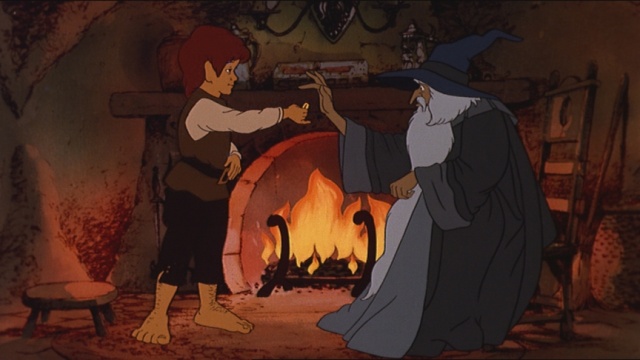 If you have seen the 1978 animated version of the Lord Of The Rings, you’ll maybe remember the scene when Gandalf recounts the history of “Bilbo’s funny magic ring” to Frodo, as they sat in front of the fireplace at Bag End, revealing it to be the One Ring made by Sauron himself. He then asks Frodo, “What will you do with the One Ring?” We know what the ultimate decision was.
His decision meant leaving home, family and friends behind, perhaps to die. His decision left him radically and forever changed.
I was recently reading a blog post titled: Existence, Choice And God by Father Stephen Freeman, on his Glory To God For All Things blog site. He speaks of the role of choice in the life of believers, especially as it related to converts to the Orthodox Church. He contrasts rational choices and existential choices. The Rational Choice is based on looking at the facts, weighing them out, then choosing based on our preferences and the facts. A good example of this is the “Church Shopper”. Going from church to church, looking for the one that you like the best. The Existential Choice is one that comes with deep internal struggle and hesitation. It too looks at facts and weighs them, but there is something deeper that goes beyond those facts and preferences.
In my journey to the Orthodox Church, (which is still in process) the outset of it would have seemed to have been the product of a rational choice. I had to take a hard look at the facts about Orthodoxy, weigh them out and make a decision. I even found a parish that I “preferred” above other ones I found in the area. But did I really just find a “way of worshipping God” that I liked and “Got something out of”? Had I simply had my many questions sufficiently answered to the point where I could make a rational choice about how I wanted to worship God and in what community I felt comfortable in? If it were not for the intense internal struggle I had night and day for several months, I’d say yes.
I will admit that I had much to investigate about the Orthodox Church: Apostolic Succession, the Canon of Scripture, Sacraments, Church authority, Hierarchy of the clergy and episcopate, the place of Mary and Saints in the life of worship and prayer, icons, etc. I will also admit that I had to make sense out of those thing, having no familiarity with any of them and having been taught those things are outright wrong and even evil. But, as I have stated in older posts, I came to a realize that I could try to rationalize everything (which in reality is impossible in Orthodoxy) or I could surrender myself to the call of God to His Church. Once I surrendered, it seemed as though the meaning of it was revealed to me. That meaning, of course, is Christ Himself.
A few months ago I met a young priest and his family. He was a convert from the Assyrian Church of the East. He told me that the language of prayer, worship, and even large parts of the Scripture, is the language of poetry. It’s not the language of science, investigation, or any such thing. It is the language of awe and wonder that comes from the depth of our spirit, to His Spirit (I think of Psalm 42:7 KJV). As I listened to him, I realized that this is what I had sensed so many months ago, as I let go of trying to “get” everything about the Church.
Paradoxically, I also sense the reality of this call to the Church in the fact that it DIDN’T make sense. I was perfectly content as a Protestant, I liked my Church, I had faith in God (Father, Son, Holy Spirit), believed His Word, and did my part to live it out. Did I really NEED to become a part of this (seemingly) far more rigid Church tradition? This move has also created tension in the home. A friend of ours asked if I didn’t see this tension as a sign that I was making a bad choice. I answered, “No.” Scripture tells us that following Jesus brings hardships; from the outside, and the inside. Ultimately I do not see it as making a choice, but as following Christ in the fullness of His Church.
When it comes down to it, I found that I simply had to obey. Not that I checked my brain in at the door, but I realize this is not a choice, but a calling. I am following that calling in the Orthodox Church.
Even though I cringe to use these following examples in the same post as speaking about myself (for I am unworthy of their company), I would like to reference a couple of biblical examples of obedience that was beyond rationality. Abraham followed God out of his homeland, to a place he had never seen. While there he received the seemingly impossible promise of a son through whom “all the nations shall be blessed.” Paul the Apostle followed the Christ he saw in a vision, preached him to the whole world at great peril to himself, having forsaken a comfortable life as a pharisee and Roman citizen. Samuel obeyed God and anointed the head of a little boy who tended sheep for his father, while his older and stronger brothers fought in battle.
So stood Frodo, on the edge of fate, debating about what choices he had in the matter of the Ring. Soon he realized that there was but one thing to do. To set out on the perilous journey, leaving behind all he knew, and to do that which “fate” had meant for him to do: destroy the Ring in Mount Doom.
And so I have come to see that I have not simply made a choice out of many possibilities. If I have made a choice, it is the choice to obey the calling of God. My journey is not so adventurous as Frodo Baggins, nor do I possess the holiness of Abraham, Paul or David. But this journey is one born out of a calling that I must obey, and not just a choice that seems to suit me best.
What Can Orthodox and Evangelicals Learn From One Another?

Image via Wikipedia
From a new series of podcasts on AFR I heard this lecture by Met Kallistos Ware. The topic of this podcast was the same as the title of this post.
I thought his approach to the topic was very irenic, while not compromising the truth of our faith. The point that struck home with me personally was the statement that Orthodox do not have anything “new” to learn from Evangelicals, but things we have forgotten by way of neglect. The most important of these being the personal commitment to Christ, the personal reading and studying of the Scriptures, and evangelism.
This lecture was a reminder to me that though I am entering the “fullness” of the Church in the Orthodox Church, I have many things to be grateful for in my upbringing as an Evangelical Christian. In my journey to the Church I have criticized my former tradition for the many holes I have discovered. While this was okay for a time, in that it helped me learn more about the Ancient Faith in order to fill those holes so-to-speak, being able to affirm the good is more in line with Love. I am compelled by the Spirit to join the Orthodox Church, but I am truly thankful that being an Evangelical has prepared me for the Life in Christ in His Church.
Here is the link to that Lecture. I hope you will all check it out and be inspired by what he has to say.
Do you agree with what Met Kallistos thinks about Orthodox and Evangelicals? What kinds of things do you think Orthodox can gain from Roman Catholics, Oriental Orthodox and even the Church of the East?
Worship in Spirit and Truth
Below is a link to a new podcast series by Fr Thomas Hopko. It explores the Divine Liturgy of the Eastern Orthodox Church as the Worship in Spirit and in Truth that Jesus spoke of to the woman at the well in Samaria. I used to always think that expression was a rather nebulous one that simply meant worshipping God was to be simply of the right doctrine. This podcast shows that that is not what is being spoken by Christ. I hope you will all check this new podcast series out and share your thoughts on it. I have listened to the two podcasts that have been done so far and I really like it. I hope you do too.
Worship in Spirit and Truth – Ancient Faith Radio.
P.S. Sorry to have not blogged for more than two weeks.
Happy New Year!
To a year that has brought me closer to entering the Orthodox Church, I bid farewell. In comes the year I hope to ACTUALLY enter the Orthodox Church.
Happy New Year to all of you out there. Thank you for reading, commenting, or just stopping by.
Twelve Days Of Christmas

Image via Wikipedia
The Twelve Days of Christmas: The Meaning Behind The Song
The twelve days of Christmas are the twelve days between Christmas Day, Dec. 25th, the birth of Jesus, and the Epiphany, Jan. 6th, the day Christians celebrate the arrival of the Magi (Wise Men) and the revelation of Christ as the light of the world.
The Christmas song, “The Twelve Days of Christmas” may sound silly and contrived to many of us. But it actually had its origins in religious symbolism – and with a serious purpose.
It dates from a time of religious persecution. The persecution of Catholics by the British government, a couple hundred years after the Reformation. If a Catholic was caught, they were hanged, drawn and quartered. The song, “The Twelve Days of Christmas,” was written as a kind of secret catechism that could be sung in public without fear of arrest – a learning or memory aid to Christians in fact.
The song can be taken at two levels of interpretation – the surface meaning, or the hidden meaning known only to the Christians involved. Each element is a code word for a religious truth.
1. The partridge in a pear tree is Jesus.
2. The two turtledoves are the Old and New Testaments.
3. Three French hens stand for faith, hope and love.
4. The four calling birds are the four Gospels.
5. The five gold rings recall the Hebrew Torah (Law), or the Pentateuch, the first five books of the Old Testament.
6. The six geese a-laying stand for the six days of creation.
7. The seven swans a-swimming represent the seven gifts of the Holy Spirit.
8. The eight maids a-milking are the eight Beatitudes.
9. Nine ladies dancing are the nine fruits of the Holy Spirit.
10. The ten lords a-leaping are the Ten Commandments.
11. Eleven pipers piping represent the eleven faithful Apostles.
12. Twelve drummers drumming symbolize the twelve points of doctrine in the Apostles Creed.
If you think Jesus being symbolized as a partridge in a pear tree sounds blasphemous, remember:
“Jerusalem! Jerusalem! How often would I have sheltered thee under my wings, as a hen does her chicks, but thou wouldst not have it so.” (Luke 13:34 and Matthew 23:34)
The “true love” in the song refers to God Himself.
The “me” receiving the gifts is every Christian.
So that “silly” song we sing at Christmas time has more meaning than we thought.
Father Mark Hodges has a review of this hymn of the persecuted church on his facebook page. I tried to link it, but could not. Anyhow, I hope you enjoy this. It was something new for me. I must have had my head in the sand for decades…
Nativity

Image via Wikipedia
Have you had “one of those Christmases”? I don’t mean death in the family, flooded home, Major snow storm causing havoc. I’m talking about that sense of being completely out of spiritual sync with Nativity of our Lord. I had that kind of Christmas. Even so, it taught me something valuable.
I had intended to go to a few of the Pre-festal Vespers services this last week, maybe even one early-morning Orthros. I was personally and spiritually lazy and only made it to one Vespers.
On Christmas Eve I had a family gathering to attend. It was an enjoyable day with the family, but it was a long day. My plan was to have my two older girls nap in the car on the way home, so we could go to the mid-night Vigil Liturgy.
However, when we got home, they were too tired to go. When I went to wake them up, they were still sound asleep. I was really disappointed, because I wanted to be able to have my kids experience worship on Christmas Day. Since we never went to Church on Christmas when I was a Protestant (unless by default), I wanted to break that cycle and make worship the center of our Christmas experience, rather than just presents and family time. Mind you, I wasn’t disappointed in my girls (they’re just kids and had a long day) but with the circumstances. To top it off, I had a lively discussion that was complete unnecessary for my to have had, lost my keys, then my cool. I had to apologize to my wife for letting the key thing stress my out. On the drive to Church I felt inner defeat. I was tired after the long day, I was irritated with myself for acting like a jerk over stupid stuff and was already thinking ahead at the fact that I would only get a few hours sleep after the vigil, since I was going in to work that morning at 7am.
I pulled into the Church parking lot and took a deep breath before I went in. Everyone was there already, as Orthros began at 10:30, and I was getting there at 11:30. As the service progressed, and the Nativity hymns were sung, things started to get into perspective. Christ came into a messed up world, born of the Virgin. Though He came to transform it by taking the form of a servant, it was not instantly changed, nor even immediately following his death and resurrection, though His disciples thought it should. But come He did, that He might commune with His creation and redeem it. He came to take on Himself all the messiness of my life too; my failings of the day, the year, my entire life. He communes with me, and calls me to follow Him. It is a communion that does not change me instantly, but over time. So I can take comfort in the Incarnation of the one who enters into my messed up life.
The next day I was back at the firehouse and purposed to pray the Typika on Sunday morning, as I would not be able to go to Divine Liturgy on the Lord’s Day. I found the Kontakion for the day online and prayed in at the proper time in the service. The prayer goes as follows:
Kontakion of the Nativity – Tone 3: “Today the Virgin giveth birth to the Transcendent in essence; the earth offereth the cave to the unapproachable One; the angels with the shepherds glorify him; and the Magi with the star travel on their way; for a new child hath been born for our sakes, God before the ages”.
These words were and are a comfort to me and the meaning of them hit me like a ton of bricks. I had to read it a few times over. I realized that though I offer Him the lowly cave of my life, which isn’t worthy of the least of His saints, let alone the Transcendent God of all the ages, yet for my sake He was born. Our God before all ages. Now matter how low I feel, He meets me there because He has already taken on all my infirmities, sins and weaknesses. Amen!
Light In The Darkness
 “Orthodoxy is Paradoxy”
I have heard this phrase many times in the course of my very short catechumenate, but one I think is very appropriate given the season we are in right now. (Granted, the paradox of THIS season is limited to the Northern Hemisphere, but you know what I mean.) I was looking out my window yesterday, looking at the leaves fall from the trees and on to the lawn, sidewalk and street. Seeing the trees looking more bare each day, the paradox of this season suddenly hit me. How had I not seen this before?
While the days are getting shorter, colder and darker, while the landscape has the appearance of death, we await the Incarnation of the Creator of all things. The very Life in whom we live and breath and have our being comes into the world that seems dead. Indeed, because of the fall of Man, the world is dying. And yet this is what makes the Incarnation so amazing. Because it is tied to the Resurrection, the Incarnation of the Word through the Holy Spirit and the Theotokos is considered by some of the Church Fathers and Saints to be the Re-creating of all things. The Second Coming will be the culmination of all these things, but they were started at the first Nativity 2000 years ago.
The other paradox that hit me as I thought about the Nativity Fast. The Winter season seems more conducive to a sense of deep repentance, mourning, etc than Spring, yet the Fast is less intense, and there is no mournful element to the Nativity season. Spring, the time of renewal and joy, is the time when Orthodox are in the deepest repentance, fast the most intense and mourn deeply (even though it is in the light of victory) leading up to the glorious Resurrection. What a paradox.
This is the great thing about the Church and the Life in Christ in general; She does not simply follow the natural flow the world, but is truly a paradox. Our martyrs would appear to be “of all men most miserable”, but have a joy that is unquenchable. We have more “rules” than almost any other Christian denomination, yet we are free beyond description.
There is just over a week left in the Nativity Fast. So far this fast has been much less daunting than Lent, yet the sense of anticipation is just as high. This is will be my first Forefestal Week. I look very much forward to the services. I especially look forward to being at the Vigil Service with my family. I have always loved the beauty of this time of year for the natural beauty around my, but now that I am preparing to join the Church, I love the discovery of the light in the darkness.
The Gaffer of Bagshot Row
 There is a character in the Lord of the Rings that we only meet briefly, but he is peppered throughout the story, though he never leaves The Shire. He is, as the title says, the father of Samwise Gamgee and affectionately known as The Gaffer. We hear Sam bring forth his father’s wisdom: “As my Gaffer always says…” or criticism: “What the Gaffer would say if he saw me now…”
The few times we get to see actual interaction with the Gaffer, we meet a feisty old hobbit who is quick to give his opinion, which is generally critical and pessimistic. As all hobbits, he enjoys a quiet, peaceful life, yet is ready to stand up to any foe of The Shire. He was the faithful gardener of Bilbo Baggins for many, many years.
I like the general character of the Gaffer. You always know where you stand with him. You will also find a good amount of “hobbit sense”, which may be directed your way if you are beginning to go astray. There is one characteristic that I see a parallel in many of my Christian brothers and sister, as well as myself. I am speaking of his critical, pessimistic outlook, which he is quick to share, though I don’t know if he would fit the bill of a busybody. I think many of us would far exceed the Gaffer in this area.
I have been coming across several comments made by Orthodox brothers and sisters (even a couple monks and clergy) toward other Orthodox hierarchs, jurisdictions and the like, which are rather disrespectful. I wonder if this is an American phenomenon created by a media and politics-fueled rhetoric we see and hear every day. Maybe it’s more widespread than that, and the advent of the internet makes it more prevalent. Whatever the case may be, I have to admit that I find it a bit disturbing. Let me be quick to say that I am not judging anyone, I am sharing my opinion on the criticisms. This is a topic I am loathe to write about, as it could seem very hypocritical or judgmental. Being as these observations are a part of my journey, I will share them.
I have heard insults leveled against the leadership of every level in the OCA, in which their clergy are said to be a group of “failures” from other jurisdictions, denominations, etc. A friend said that my metropolitan was acting like the Taliban in his exercising of episcopal authority within our archdiocese. A hiermonk I spoke to recently also made some insulting remarks in regards to the goings on concerning the Metropolitan of my archdiocese. Another story involved a back-and-forth conversation between a deposed priest and another Christian, which cast a very negative light on the former priest. These are just a few examples, not to mention countless statements born from the disunity between Orthodox jurisdictions, East vs West, etc.
I only give the above examples as a generic overview of what is out there. It’s not intended to be meant as, “Look what these jerks said.” or anything like that, for that would be counter to what I am trying to say. I guess what I would like to say is, maybe there is a better way to communicate our disappointments with our leaders, the goings on in another archdiocese, or the general shenanigans that happen within the Orthodox Church as a whole. I am not perfect by any means, so please forgive me.
There is nothing wrong with sharing the wrongs done within our Church. In fact, transparency is a very good thing. But how we get there needs to be considered. I’m all for sharing information, but shouldn’t we as Orthodox Christians be humble in how we do so. The evils we hear of should cause us to grieve within our hearts and drive us to prayer, in the process humbly asking our brothers and sisters to pray with us. There are times for action, and use of strong words, but those should be our last resort rather than our frontline, go-to action. Don’t mistake what I’m advocating for a Pollyanna naiveté. Speaking up is necessary, but as the fruit of prayerful, thoughtful, humble intercession for the person and/or situation.
I have to admit that I have been a huge offender in the “have you heard?” area, as well as the “Can you believe what those (that) jerk(s) did?” camp. But as with many things within Orthodoxy, I have been confronted with the heart of the Church. It has exposed me for what I am, and beckons me to change. If it has done that for me, who am but a catechumen, then I suppose the same must be true of the Faithful. For instance, I have been instructed to read through the Pre-Communion prayers of the Church. In them I read prayers like “No one has sinned as I have sinned.” “Have mercy on my, O God, according to Thy great mercy.” I can’t remember the words, but there is also a prayer that compares the person praying to the sinful woman who washed the Lord’s feet with her tears and hair. In that prayer we pray and acknowledge that we need to be cleansed, though we are more defiled than she was. And of course there is the Prayer of St Ephraim, where we ask the Lord to give us eyes to see our own sin, and not our brother’s (or sister’s).
With prayers like these, I am constantly floored, and have to beg God’s forgiveness for daring to judge another. And that’s really what I am getting at. We have these rich prayers, sacraments, holy traditions, the scriptures and indeed the very life of the Holy Trinity and all the saints. Since we have this great treasure, let’s avail ourselves of their salvific benefit to our souls. Let’s avoid slandering our brothers and sisters, or broadcasting their sins for all to see. Let’s especially be wary of bringing any accusation against our clergy and hierarchs (doesn’t the bible tells us this?), as they are the icons of Christ to the Church. I’m not advocating clericalism, but rather humility.
I hope I don’t come across as one who has an ideological “log” in my eye. I am nobody and ask your forgiveness for presuming anything of my brothers and sisters. My hope is that if we apply ourselves to the Synergy of our Life in Christ, let the prayers really transform us, then we will be transformed as a Church, casting off the fears, distrust and quarrels that have separated us for far too long.
Fr Irene gave a series of lectures on Mysticism and Orthodoxy at St Barnabas Orthodox Church recently. During a Q&A session, a man asked how we can have these experiences of God. Fr irene said, “You’re not going to like my answer… participate in the life of the Church… and stop judging people.” That is one of the simplest, yet toughest answers I have heard to that question. I think this topic is born of that answer. I have a very long way to go, probably father than anyone who reads this. So please forgive me. But let’s strive together to put aside our harsh instincts and remember to pray, participate and not judge.
The Supposedly Pagan Origins Of Christmas
It’s that time of the year again: Christmas time! The trees, the lights, the stockings, the nativity scenes, and, of course, the giant inflatable Santas (really, what would Christmas be without them?) are going up all over the place. And, as every year, the same recycled and ridiculous historical inaccuracies are getting pushed on the unsuspecting masses. I’ve already seen the articles popping up online and being passed around by friends on Facebook; I’m sure that, as they always do, the National Geographic Channel and the History Channel have something “interesting” and uninformative in the works to deceive their viewers with as well. Search for “Christmas” in Google and immediately you are bombarded with the popular mythology about Christmas’ origins. The History Channel’s webpage on Christmas (the fourth on the list returned from my Google search), for example, erroneously claims, amongst other things, that Pope Julius I decided on a date of December 25 in order to replace the pagan festival of Saturnalia and that “the Greek and Russian orthodox [sic] churches” celebrate Christmas “13 days after the 25th, which is also referred to as the Epiphany or Three Kings Day.”1
Before we begin looking at these trite claims in more detail, I want to point out explicitly that I am writing this post because of an interest in historical truth, not out of any desire to engage in apologetic. In spite of the claims of pseudo-Christian cults like the Jehovah’s Witnesses, even if the date for Christmas had been based upon a pagan holiday (though this is not an admission that it was) originally on that date this would not impede or deligitimize the Christian celebration of the holiday. The days of the week all have pagan names (Wednesday, for instance, refers to the Norse god Woden) and yet I doubt I can find many of those who refuse to celebrate Christmas who also refuse to use the names of the days.2 Similarly, whether the Christmas tree or any of the other holiday accessories is of pagan origin or not is immaterial to the use of them by modern Christians; the toothbrush and toilet paper also have pagan origins and again I doubt that I could find many who refuse to use these items.3 The modern use of a Christmas tree no more implies an adherence to any of the pagan cults which used trees in their worship than the eating of a meal implies a dedication to the god Mithras whose worship involved the eating of communal meals.4
With all of that said, the purpose of this post is to clear away the dross of popular mythology and propaganda from the origins of Christmas and the various ways it is celebrated. We will first look at the origins of a Christian feast celebrating the birth of Christ and how that feast came to be placed on December 25. We will then look at some of the particular ways in which that feast is celebrated by Christians today, such as the display of Christmas trees, mistletoe, and nativity scenes, and search for their respective origins. Along the way, I will attempt to clear up some of the other common misconceptions about Christmas both ancient and modern, such as the already-quoted misunderstanding of the date of the celebration of Christmas by Orthodox Christians.
Since the discussion of the dating of Christmas will involve referencing several different calendars, I’ve color-coded all dates I mention in that section in order to avoid confusion. Dates in black refer to the Gregorian calendar, instituted by Pope Gregory XIII in 1582 and today the common calendar of the West; dates in red refer to the Jewish calendar; dates inblue refer to the Julian calendar, instituted by Julius Caesar in 45 BCE and still in use in the majority of the Orthodox churches today;5 and dates ingreen refer to the Revised Julian calendar, adopted beginning in 1923 by a number of Orthodox churches.6
Early Christians did not celebrate the birth of Christ and even regarded the celebration of birthdays, including even that of their savior, as a superstitious pagan practice. For this reason, no one was even remotely interested in finding out the day of Christ’s birth.
In the early fourth century, Constantine the Great became the first Roman emperor to convert to Christianity. As a result of his conversion, a number of innovations derived from paganism were introduced into Christian practice and belief, Christmas amongst them. The celebration of Christmas was introduced in order to make it easier for pagans to convert to Christianity as Christmas was intended as a Christianized version of the pagan feasts of Saturnalia and the birth celebrations of the pagan gods Sol Invictus and/or Mithras (which feast Christianity was intended to replace differs between individual myth-propagators). St. Julius I, who was Bishop (it is anachronistic to call him “Pope” although most myth-propagators do) of Rome in the years 337-352 CE, is most often named as the culprit in the crime of transplanting the December 25th holiday from paganism to Christianity.
Not only were the holiday and its date brought over from paganism, according to the myth-propagators, but so were most of the elements of the celebration surrounding it. Santa Claus is a Christianization of any number of pagan deities (again, it depends upon the preference of the individual myth-propagator), sometimes even of Satan — the evil one! — himself. The Christmas tree comes from Germanic winter celebrations. The gift-giving comes from Roman Saturnalia celebrations. And so on the myths go.
The problem with all of this is that it is, to be entirely frank, a big bag of worthless excrement.
If the popular conception that Christmas is of pagan origin is incorrect, some may ask, where did it come from and how did it become such a widespread belief? Like the myth of the so-called “Dark Ages,” the source of the mythology surrounding Christmas is the anti-Papist and, later, anti-Christian propaganda of the Protestant Reformation and the Enlightenment. There are in particular two individuals to blame for the invention of the myths.
In 1743, a German Protestant named Paul Ernst Jablonski, in an effort to discredit the Roman Catholic Church, claimed that the celebration of Christmas was one of the numerous “paganizations” of Christianity which had occurred in the fourth century.8 His grand thesis was that paganizations like the adoption of Christmas had degenerated Christianity from its original purity and led to the creation of the Roman Catholic Church.
In the late 17th and early 18th centuries, Dom Jean Hardouin, himself a Roman Catholic monk, in an attempt to counter the claims of Protestants that the Roman Catholic Church was the result of paganization of Christianity, unintentionally contributed to the myths about Christmas.9He attempted, in his writings on the subject, to demonstrate that the Roman Church had adopted pagan festivals and Christianized them without corrupting the Christian gospel.
Those modern myth-propagators who do actually reference sources (that there are so few who do should tell us something about their truthfulness and scholarly nature — or, more precisely, lack thereof) generally cite Jablonski and Hardouin prolifically.
The first question that we’ll look at is when celebrations of Christmas began. Was it really in the middle to late fourth century and are Constantine and Julius really the originators? The answer to these questions is no, no, and no.
While pinning down the earliest celebration of a holiday commemorating the birth of Christ is a difficult if not impossible task, it is undoubtedly clear that such a celebration came about very early.
Already by the end of the first century and beginning of the second, Christians had developed what appears to have been a near-obsession with the story of the birth and childhood of Christ. This concern is evident in such writings as the Infancy Gospel of James and the Infancy Gospel of Thomas, both written some time in the middle of the second century. These works and others like them seem to have been written with a focus on emphasizing the humanity of Christ against certain heretical groups, such as the docetists and, later, the Gnostics and the Marcionites, who denied the humanity of Christ and claimed instead that he was actually solely divine and only appeared to be human. To counter these heretical claims, the Orthodox placed a special emphasis on the human conception and birth of Christ from the Virgin Mary. There is, however, no explicit mention of a celebration of these events. Equally, there is also no condemnation of nor aversion to such a celebration.
Too much has been made by Christmas’ modern detractors of Origen of Alexandria’s rejection of the celebration of birthdays.10 Although he doesn’t mention the birth of Christ specifically, it is assumed that since he seems to have rejected the celebration of birthdays in general as a pagan practice he also would have rejected the celebration of a holiday commemorating Christ’s birth. This may or may not be true, but the reality is that Origen’s testimony doesn’t matter much to the issue. Origen espoused a number of heretical beliefs, due to his acceptance of Platonic influences, which ran contrary to traditional Christian teaching, including universal salvation, the pre-existence of souls, and a rejection of material creation as a by-product of the fall.11 For holding and teaching these and other heretical ideas, he was condemned by several Christian bishops in his own lifetime and afterward; these condemnations culminated in an official anathema against him by the Fifth Ecumenical Council (Second Council of Constantinople) in 553 CE.12 In short, Origen cannot be counted on to accurately convey the consensus of Christians of his time or any other.
Turning to more accepted and accurate primary sources of Christianity’s early centuries, however, we find some decent indicators of the ancientness of an annual celebration of Christ’s birth, although the references are a bit patchwork and often lack details in content. A few examples:
- The earliest mention of such a feast comes from St. Hippolytus of Rome’s Commentary on Daniel, written in about 202 CE; I will discuss this particular passage a bit more in depth in the next section.
- St. John Chrysostom, in his homily delivered in Antioch in 386 CE, says that the celebration of a feast on the birth of Christ is an ancient tradition.13
- The Philocalian Calendar, a calendar of Christian feasts compiled in Rome in 354 CE, lists Christmas as an established feast of the Church.14
- The Apostolic Constitutions, a collection of earlier Christian canons, at least a portion of which probably date from the Apostles, compiled probably in the years 375-380 CE, demands that Christians celebrate Christmas and ostensibly attributes this demand to the Apostles.15
- In 302 CE in Nicomedia, one of the regions hardest hit by the persecutions of Christians ordered by the Emperor Diocletian, a number of ancient sources record that a large group of Christians were shut inside their church and then burnt alive while celebrating Christmas services.16 The usual number listed is 20,000 but such a number seems exaggerated; it is more likely than 20,000 is the total number of Christians martyred in Nicomedia during the persecution and that a significant portion of those were killed in the massacre on Christmas.
- The heretical sect from the Donatists broke from the Orthodox Church in about 312 CE; they zealously, even legalistically, clung to Christian faith and practice exactly as it had been at that moment in time in North Africa and they rejected any further development as innovation and heresy. Significantly, it was recorded by St. Augustine of Hippo in about 400 CE that the Donatists celebrated Christmas.17
- In the middle of the fourth century, St. Ephraim of Syria wrote a series of lengthy liturgical hymns for use during a celebration of the birth of Christ.18
The earliest historical source that exists which places a pagan holiday on December 25 is the proclamation by Roman Emperor Aurelian of a celebration of Sol Invictus on that day in 274 CE.20 The earliest Christian reference to December 25 as the birth of Christ, however, dates from 202 CE. In that year, St. Hippolytus of Rome wrote in his Commentary on Daniel:
For the first advent of our Lord in the flesh, when he was born in Bethlehem, eight days before the kalends of January [December 25th], the 4th day of the week [Wednesday], while Augustus was in his forty-second year, [2 or 3BC] but from Adam five thousand and five hundred years. He suffered in the thirty third year, 8 days before the kalends of April [March 25th], the Day of Preparation, the fifteenth year of Tiberius Caesar [29 or 30 AD], while Rufus and Roubellion and Gaius Caesar, for the 4th time, and Gaius Cestius Saturninus were Consuls.21
Given that Aurelian’s religious reforms, like those of Julian the Apostate a century later, seem largely to have been an attempt to undermine Christianity by introducing popular elements of it into paganism, thereby theoretically making paganism more attractive, it seems far more probable that Aurelian’s institution of a celebration of Sol Invictus on December 25was an attempt to usurp a Christian holiday already established and widely celebrated on that date, rather than the reverse.
If they didn’t get the idea from the pagans, then how did Christians decide on December 25 as the date to celebrate the birth of Christ? Interestingly, the settling of that commemoration on December 25 actually had more to do with Christ’s death than with his birth!
A primary concern amongst early Christians was establishing an accurate and uniform date for the celebration of Pascha.22 Various formulas and historical sources were put forward by early Christians in their attempts to achieve this goal. By the third century, two dates had emerged as standard among Christians; in the West 25 March (you may have noted this date in the quote above from St. Hippolytus of Rome) became the standard date for Christ’s death and in the East Christians believed Christ to have died on6 April.23
Drawing upon an ancient Jewish tradition that holds that a prophet enters life (that is, is conceived) and leaves it (that is, dies) on the same day, Christians concluded that Christ must have also been conceived on 25 March or 6 April (depending upon which date was held to).24 Exactly nine months (the duration of a “perfect” human pregnancy) after 25 March is25 December; exactly nine months after 6 April is 6 January. As a result, Christians came to commemorate Christ’s birth on these two dates; in the West the former was celebrated and in the East the latter.
During the fourth and fifth centuries, a gradual and natural compromise was reached between these two close but differing conclusions. 25 December became the nearly universally accepted date for the commemoration of Christ’s birth (in other words, Christmas) and 25 Marchwas universally celebrated as the date of Christ’s conception. 6 Januarybecame identified, especially in the East, with Christ’s baptism, as St. Luke seems to indicate in his gospel that Christ was baptized on his 30th birthday.25
25 March, commonly referred to as “Annunciation,” is still celebrated by most Christians as the day that the Angel Gabriel visited the Virgin Mary and proclaimed that she had conceived by the Holy Spirit.26 6 January, usually called either “Epiphany” or “Theophany,” is celebrated by Orthodox Christians and other Eastern Christians as the day of Christ’s baptism and by Roman Catholics and some other Western Christians as the day the magi visited the Christ child.27 And, of course, 25 December is still celebrated by almost all Christians as the Feast of the Nativity in the Flesh of our Lord, God, and Savior Jesus Christ, commonly called “Christmas.” The only exception (aside, of course, from those pseudo-Christians who ignorantly reject Christmas altogether) is the Armenian Apostolic Church, the ancient Christian church of Armenia, which continues to celebrate both the birth and the baptism of Christ on 6 January (19 January on the Gregorian calendar).
A common but erroneous claim is the one I cited earlier from the History Channel’s web page on Christmas that Orthodox Christians celebrate Christmas “13 days after the 25th, which is also referred to as the Epiphany or Three Kings Day.” Most Orthodox Christians celebrate Christmas on 7 January (according to the Gregorian calendar); this is, however, 25 December on the Julian calendar. In 1582, the Roman Catholic Pope reformed the calendar used by Western Christians. This calendar, called the “Gregorian calendar,” became the standard calendar of the West and today is the common calendar of the world. The Julian calendar, used by most Orthodox Christians, is currently 13 days behind the Gregorian calendar. The Orthodox celebration of Christmas on 7 January has absolutely nothing to do with Epiphany or Three Kings (which falls on 6 January and so, for those Orthodox who use the Julian calendar, on 19 January according to the Gregorian). It should also be noted that a sizable minority of Orthodox Christians use what is called the Revised Julian calendar, which calendar is currently in sync with the Gregorian calendar, and so celebrate Christmas on 25 December right alongside Western Christians.
To summarize: Even though Western Christians celebrate Christmas on 25 December and most Orthodox Christians celebrate it on 7 January (which is also 25 December) and some Orthodox Christians celebrate it on 25 December, all Christians (except the Armenians!) celebrate Christmas on25 December. Complicated stuff? Yeah, a little…
Now that we’ve addressed and dismissed the mythology surrounding the celebration and dating of Christ’s birth, let’s briefly take a look at the origins of some other Christmas-related items:
- Santa Claus. Contrary to the claims of some horribly misinformed (or uninformed) individuals,28 Santa Claus is real and is not a distraction from the real meaning of Christmas. Santa Claus, who real name is St. Nicholas of Myra, was an Orthodox Christian bishop in Asia Minor (modern-day Turkey) in the fourth century. He suffered for Christ under the persecution of Diocletian and is remembered even today by Orthodox Christians for his charitable, compassionate, and Christlike life. To read more about St. Nicholas, go here. And, if you’ve ever wondered why Santa Claus looks the way he does, take a look at someOrthodox bishops.
- Gift-giving. The gift-giving on Christmas is done in imitation of St. Nicholas and of the gifts the magi presented to Christ; the practice dates to perhaps the fifth century.
- Stockings. The hanging of stockings over the fireplace is derived from one of the stories of the activities of St. Nicholas in which he left several gold coins in the stockings, hung over the mantle to dry, of several poor young girls who were in desperate need of money.
- Christmas trees. Contrary to popular belief, the origins of the Christmas tree are relatively modern and are unrelated to ancient pagan practices.29 The trees were originally used, decorated with hanging apples, in plays presented in Germany on Christmas eve in the late Middle Ages. The practice was brought to America by German immigrants in the 18th century and has remained a staple of American Christmas tradition since.
- 12 days of Christmas. The often misunderstood 12 days of Christmas are the 12 days from the Nativity of Christ on 25 December to the baptism of Christ on 6 January. The 12 day period between these two feast days is a period in which Christians traditionally abstain from fasting (traditionally, Christians fast for four weeks [in the Western tradition] or 40 days [in the Eastern tradition] before Christmas) and instead feast and enjoy good times with family and friends.
- Yule log. The burning of the yule log is another aspect of the modern Christian celebration which has falsely been lampooned as of ancient pagan origin but is actually of modern Christian origin.30 The burning of the yule log became popular beginning in the late 16th century in England.
- Nativity scene. The display of a Nativity scene, commonly called a “creche,” was popularized by Francis of Assisi, a Roman Catholic saint, beginning in 1223.
- Caroling. Caroling door-to-door began in the late Middle Ages as a development from the earlier Christian practice of singing hymns and performing liturgical dramas on Christmas eve.
- Mistletoe. The tradition of kissing under the mistletoe is of unknown origin. The supposed link between the modern practice and the story of the pagan god Baldr is tenuous at best and entirely conjectural.
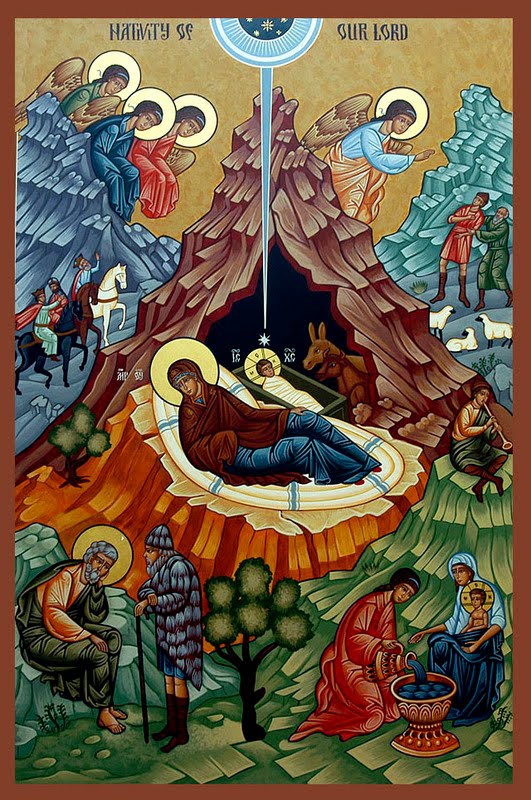
Glorify Him!
Notes
1 “Christmas — History.com Articles, Video, Pictures and Facts” (2010)http://www.history.com/topics/christmas (Retrieved 3 December 2010).
2 “The Days of the Week” (2005) http://www.friesian.com/week.htm(Retrieved 3 December 2010). Interestingly, early Quakers did indeed refuse to use the names of the days of the week for this very reason. See David Yount, How the Quakers Invented America
3 On the origins of the toothbrush see “Who invented the toothbrush and when was it? (Everyday Mysteries: Fun Science Facts from the Library of Congress” (23 August 2010)http://www.loc.gov/rr/scitech/mysteries/tooth.html (Retrieved 3 December 2010). On the origins of toilet paper see “History Of Toilet Paper” (2009)http://www.toiletpaperhistory.net/toilet-paper-history/history-of-toilet-paper/ (Retrieved 3 December 2010).
4 Manfred Clauss, The Roman Cult of Mithras: The God and His Mysteries
5 For basic information on the Gregorian, Julian, and Jewish calendars as well as other calendars and an useful date converter see “Calendar Converter” (November 2009)http://www.fourmilab.ch/documents/calendar/ (Retrieved 3 December 2010). Thanks to my brother Andrew Walker for tracking that great tool down for this essay.
6 For some basic information on the Revised Julian calendar see “Revised Julian Calendar — OrthodoxWiki” (21 April 2010)http://orthodoxwiki.org/Revised_Julian_Calendar (Retrieved 3 December 2010).
7 The myths differ in some ways amongst their various propagators; I offer here a basic summary of the most popular elements. To read some of these myths in their most recent form as stated by their modern adherents, see, for example, the page from the History Channel’s website already cited; Kelly Wittmann, “Christmas’ pagans origins” (2002)http://www.essortment.com/all/christmaspagan_rece.htm (Retrieved 4 December 2010); “Take Your Stand for True Worship – Jehovah’s Witnesses Official Website” (2009)http://www.watchtower.org/e/bh/article_16.htm (Retrieved 4 December 2010); and David C. Pack, “The True Origin of Christmas” (2005)http://www.thercg.org/books/ttooc.html (Retrieved 4 December 2010).
8 William J. Tighe, “Calculating Christmas” (December 2003)http://www.touchstonemag.com/archives/article.php?id=16-10-012-v(Retrieved 4 December 2010).
9 ibid.
10 Origen of Alexandria, Homily on Leviticus, 8.
11 F. Prat, “Origen and Origenism” in The Catholic Encyclopedia (New York: Robert Appleton Company, 1911). Retrieved 4 December 2010 from New Advent: http://www.newadvent.org/cathen/11306b.htm
12 “5th Ecumenical Council (2nd Constantinople) – Anathemas against Origen” (553) http://www.comparativereligion.com/anathemas.html(Retrieved 4 December 2010).
13 Fr. John A. Peck, “The Ancient Feast of Christmas | Preachers Institute” (2 December 2010) http://preachersinstitute.com/2010/12/02/the-ancient-feast-of-christmas/ (Retrieved 4 December 2010).
14 Roger Pearse, “The Chronography of 354 AD. Part 6: the calendar of Philocalus. Inscriptiones Latinae Antiquissimae, Berlin (1893) pp.256-278″ (2006)http://www.tertullian.org/fathers/chronography_of_354_06_calendar.htm(Retrieved 4 December 2010).
15 Apostolic Constitutions, Book V, Section III.
16 “20,000 Martyrs of Nicomedia” (2008)http://ocafs.oca.org/FeastSaintsViewer.asp?SID=4&ID=1&FSID=103664(Retrieved 4 December 2010).
17 Andrew McGowan, “How December 25 Became Christmas” (2010)http://www.bib-arch.org/e-features/christmas.asp (Retrieved 4 December 2010).
18 J.B. Morris and A. Edward Johnston, translators, “Nineteen Hymns on the Nativity of Christ in the Flesh” (13 July 2005)http://www.ccel.org/ccel/schaff/npnf213.iii.v.i.html (Retrieved 4 December 2010).
19 Arnaldo Momigliano, On Pagans, Jews, and Christians
20 Christian Körner, “Roman Emperors – DIR Aurelian” (2001)http://www.roman-emperors.org/aurelian.htm (Retrieved 4 December 2010).
21 Tom C. Schmidt, “Hippolytus and December 25th, the birthday of Christ-Christmas” (8 December 2009)http://chronicon.net/blog/chronology/hippolytus-and-december-25th-the-birthday-of-christ/ (Retrieved 4 December 2010). It should be noted that this portion of Hippolytus’ work was long thought interpolated, forged, or irreparably damaged due to apparent contradictions with other works of Hippolytus and a problematic manuscript tradition. Both issues have, however, been resolved. On the former, see Tom C. Schmidt, “Hippolytus and the Original Date of Christmas” (21 November 2010)http://chronicon.net/blog/chronology/hippolytus-and-the-original-date-of-christmas/ (Retrieved 4 December 2010). On the latter, see Roger Pearse, “The text tradition of Hippolytus ‘Commentary on Daniel’” (12 January 2010) http://www.roger-pearse.com/weblog/?p=3343 (Retrieved 4 December 2010).
22 Pascha, Greek for “Passover,” is the more ancient and appropriate name for the feast commonly called “Easter” amongst Western Christians; it is the celebration of the Resurrection of Christ. The controversy concerning the date for celebrating Pascha was perhaps most explicitly played out in the Quartodeciman controversy of the second through fourth centuries in which Western Christians and the Christians of Asia Minor argued over whether Christ’s death should be marked on 14 Nisan (the date of Christ’s death on the Jewish calendar) or Christ’s death should be remember on the Friday following 14 Nisan so that Pascha should always fall on a Sunday. Eventually, it was decided that the Christian Church should renounce the use of the Jewish calendar altogether in order to avoid a reliance on rabbis who had rejected Christ and that Pascha should always be kept on a Sunday.
23 Tighe, “Calculating.”
24 McGowan, “How December.”
25 Luke 3:23 states that Christ had then began to be 30 years old. On what other day, early Christians asked, can someone begin to be a certain age but on their birthday?
26 “The Annunciation of our Most Holy Lady, the Theotokos and Ever-Virgin Mary” (2005) http://ocafs.oca.org/FeastSaintsViewer.asp?SID=4&ID=1&FSID=100884 (Retrieved 5 December 2010).
27 “Feast of the Theophany of our Lord and Savior Jesus Christ” (2005)http://ocafs.oca.org/FeastSaintsViewer.asp?SID=4&ID=1&FSID=100106(Retrieved 5 December 2010).
28 For example, see “Why A Local Pastor Is On Santa’s Naughty List” (2 December 2010) http://www.q13fox.com/news/kcpq-local-pastor-spoils-christmas-120210,0,1516784.story (Retrieved 5 December 2010).
29 Daniel Daly, “MYSTAGOGY: In Defense of the Christmas Tree” (20 December 2009) http://www.johnsanidopoulos.com/2009/12/in-defense-of-christmas-tree.html (Retrieved 5 December 2010).
30 “CNP Articles – Christmas (Part VI)” (1911)http://www.canticanova.com/articles/xmas/art346.htm (Retrieved 5 December 2010).
Preaching The Gospel In The Modern World (a copy)

Image via Wikipedia
I copied this from the Preacher’s Institute website. I think every Orthodox Christian should read this, ask their bishops, priests, deacons, monastic communities and fellow laypersons to figure out how we can make this happen in our lives. I found this very insightful, informative and encouraging. I copied the entire thing to this post instead of simply giving the link. It’s a long read, but WELL worth the time. Please leave your thoughts on this subject…
I think it fits into the theme of the Nativity Season, since the birth of our Lord is Good News indeed!
This is from a talk given at a conference sponsored by the Northern California Brotherhood of Orthodox Clergy and held at the Annunciation Greek Orthodox Church in Sacramento, California, October 21, 2006.
The theme of today’s conference, “Preaching the Gospel of Christ in the Modern World,” is relevant to everyone here, not only to those who are called to preach sermons from the ambo. Each of us is called to preach the Gospel, first of all by bearing witness to it through our lives, and secondly by making it available to others. This morning I will talk about why we should preach the Gospel, about the prerequisites for preaching the Gospel, and finally about how to bear witness to it in our lives.
The Gospel, of course, is the sum of the message of the Christian Faith, and especially the good news that Christ has saved mankind from the eternal consequences of sin, that He has overcome the central problem of the world — death, both bodily and spiritual — by means of His Incarnation, Death, and Resurrection.
In approaching the subject of preaching the Gospel, the first question that arises is: Why should we be preaching the Gospel of Christ in our modern world?
Why, indeed, when the Protestants seem to be doing it much better? They have evangelistic programs, crusades that fill stadiums, mega-churches, television channels, Christian bookstores, a Christian music industry, and all the money they could want. We Orthodox in America are small by comparison. Why can’t we just concentrate on our beautiful services and our social functions, and let the evangelicals preach to the unchurched?
The answer to this question is that the Protestants, and the Roman Catholics as well, do not preach the whole, complete, and unadulterated Gospel of Christ. Only the Orthodox Church can do that, because the Orthodox Church is the true Church that Christ founded, and that has continued up to today in a continuous, unbroken line of Holy Apostolic Tradition. This is the Church against which, as Christ promised, the gates of hell shall not prevail (cf. Matt. 16:18). Right before His Crucifixion, Christ told His disciples that the Holy Spirit would come and lead them into all Truth. That promise was indeed fulfilled after Christ’s Resurrection. But it did not cease to be fulfilled after His Apostles reposed. Christ has continued to fulfill that promise through two millennia of upheaval and tribulation; He continues doing so even now, and He will continue until His Second Coming. During our Church’s history, heretical emperors, priests, bishops, and even patriarchs threatened to destroy the purity of the Orthodox Faith, but through the guidance of the Holy Spirit the Church was preserved in Truth, and the heresies were overcome.
The non-Orthodox Christian churches have preserved some of the Truth of the original Christian Faith. But whatever they have that is true — whether it be the Holy Scriptures, the dogma of the Holy Trinity, or the dogma of Christ’s Incarnation — they have received from the original, Apostolic Church, the Orthodox Church, whether they acknowledge this or not. But, again, they possess only some of the Truth, and the rest they have distorted because they are separated from the true Church that Christ founded. Only the Orthodox Church is the repository of the pristine Gospel and the undistorted image of Christ.
This, then, is why we Orthodox Christians are called to preach the Gospel of Christ. We have something to give that no one outside the Church can give. Since the Christian Faith is the true Faith, and the Orthodox Faith is the true form of that true Faith, we alone can give the fullness of Truth to the searching humanity of our days. It would be selfish of us to keep it to ourselves. Yes, we should care about our beautiful church services, which are the center of our life as the worshipping Body of Christ; and, yes, we should have our social functions, since we need to have fellowship with other members of Christ’s Body. But, together with this, we are called to share our Faith, to offer it to those who have not yet been given the great gift of being part of Christ’s true Church. This is a tremendous responsibility, and it’s time the Orthodox Christians in this country stepped up to it. Of course, much has been done and is being done. Just in the last twenty-five years since I first discovered Orthodoxy, I’ve seen a tremendous growth in the Orthodox mission in this country. But we can do a lot more, and that’s what we’ll be looking at and discussing today.
Back in the early 1960s, when the co-founder of our St. Herman Brotherhood, Fr. Seraphim (then Eugene) Rose, was working in the brotherhood’s Orthodox bookstore in San Francisco, his ruling bishop, St. John of Shanghai and San Francisco, walked in, as he often did. Fr. Seraphim asked St. John a question he had been pondering: “Nearly all the peoples of the earth have had the Gospel preached to them. Does this mean that it’s the end of the world, as the Scriptures say?”[1]
“No,” replied St. John. “The Gospel of Christ must be preached in all tongues throughout the world in an Orthodox context. Only then will the end come.”[2]
This is an awesome thing to contemplate. St. John, who in other instances demonstrated that he had the gift of prophecy, is telling us that we cannot leave it up to Protestants and Roman Catholics to enlighten the world with the Gospel. That task ultimately belongs to us Orthodox Christians. It’s not enough, for example, that three thousand Chinese are becoming Christian every day, according to the latest statistics. Yes, they are becoming Protestants and Roman Catholics, and that’s good as far as it goes, but they are not becoming Orthodox Christians. Ultimately, it will be up to us to preach the Gospel to them in the Orthodox context.
Fr. Seraphim once noted that,
“When Archbishop John[3] first came to Paris from Shanghai [in the early 1950s], instead of giving a merely polite and formal greeting to his new flock in church the first time he saw them, he gave them real spiritual meat: The meaning of the Russian exile [he said] is to preach the Gospel over the whole earth, which must happen before the end of the world; and that means not just any Gospel, any kind of ‘Christianity,’ but Orthodoxy.”[4]
What St. John said about the Russian exiles can be applied equally well to the diaspora of all the other Orthodox nationalities: Bulgarian, Georgian, Greek, Lebanese, Palestinian, Romanian, Serbian, Syrian, Ukrainian, etc.
Speaking of prophecy, here is one from a Greek saint of our times (not yet canonized): Elder Paisios of Mount Athos. Before his repose in 1994, he was asked by one of his spiritual sons:
“Elder, today there are so many people— billions who don’t know Christ and so few of them who do know Him. What will happen?”
Elder Paisios answered:
“Things will happen which will shake the nations. It will not be the Second Coming, but it will be a Divine intervention. People will be searching for someone to speak to about Christ. They will pull you by the hand: ‘Come here, sit down and tell me about Christ.’[5]
We don’t have to look into the future for this. Already, even now, people are starving spiritually. How can we give them what they need?
I would now like to outline three things which we should have in place in order to preach the Gospel of Christ in the modern world: First, we must know the Orthodox Gospel of Christ; second, we must live the Gospel; and, third, we must know the modern world, in order to know what we’re dealing with.
1. So, to begin with, we must know the Gospel in the Orthodox context. This means that, not only should we know the Divinely inspired Holy Scriptures, but we should know how the Church, which gave us the Scriptures, has interpreted the Scriptures through the guidance of the Holy Spirit. We can know this through the writings of the Holy Fathers of the Church who have written extensive commentaries on the Scriptures, especially the book of Genesis and the entire New Testament. Almost all of these commentaries are now easily available in English. They are not hard to understand, even though some of them, like the commentaries of St. John Chrysostom, were written sixteen hundred years ago.
There is no question in our confused times that cannot be answered by a careful, pious, and reverent reading of the Holy Fathers, who give us to understand the true meaning of Holy Scripture and to know the substance of our Orthodox Faith. We must go to the Fathers in order to become their disciples, laying aside our own “wisdom” which we have acquired from the modern secular world.” When we find the consensus of the Fathers on any given issue, we find the teaching which has prevailed and has been upheld in the Church. Thus, we find the mind of the Church, which is the mind of Christ, since Christ is the Head of His Church.
Of course, we should read Orthodox books by some contemporary authors also, because they distill the teaching of the Fathers and bring it to bear on modern concerns. But to get a well-rounded view of the Patristic teaching, and to know which modern authors reflect more of the Patristic mind, we should not neglect to go to the writings of the Fathers directly.
The Lives of Saints and righteous ones of earlier times and of our own times are also essential reading, as are the spiritual counsels of these same saints and righteous ones. These writings give us a blueprint for our own Christian life, both instructing and inspiring us to live our lives in Christ, in communion with Him, and on the path to unending union with Him.
St. John Chrysostom once said:
“The Christian who is not reading spiritual books cannot save his soul.”
Commenting on this statement, Fr. Seraphim Rose said:
“We must be constantly filling ourselves with the word of God, the Holy Scriptures, and other Orthodox literature, so that, as St. Seraphim [of Sarov] says, we will be literally ‘swimming in the law of the Lord.’ The science of how to please God and save our souls will become a deep part of ourselves that can’t be taken away from us. The process of Orthodox education begins with infancy, with the simplest Bible stories and Lives of Saints related by one’s parents, and it should not cease this side of the grave. If anyone learning an earthly profession devotes all his energy to studying and gaining practice in it, how much more should Christians be studying and preparing for eternal life, the Kingdom of Heaven which is ours for a short struggle in this life.”[6]
2. This brings us to the second prerequisite for preaching the Gospel in the modern world, and that is, we mustlive the Gospel.
Again, to quote from Fr. Seraphim:
“There exists a false opinion, which unfortunately is all too widespread today, that it is enough to have an Orthodoxy that is limited to the church building and formal ‘Orthodox’ activities, such as praying at certain times and making the sign of the Cross; in everything else, so this opinion goes, one can be like anyone else; participating in the life and culture of our times without any problem, as long as we don’t commit sin. Anyone who has come to realize how deep Orthodoxy is, and how full is the commitment which is required of the serious Orthodox Christian, and likewise what totalitarian demands the contemporary world makes on us, will easily see how wrong this opinion is. One is Orthodox all the time, everyday, in every situation of life, or one is not really Orthodox at all. Our Orthodoxy is revealed not just in our strictly religious views, but in everything we do and say. Most of us are very unaware of the Christian, religious responsibility we have for the seemingly secular part of our lives. The person with a truly Orthodox worldview lives every part of his life as Orthodox.”[7]
As we go deeper into the Orthodox Christian life, with daily prayer, daily reading of spiritual books, regular attendance of Church services, and regular confession and reception of Holy Communion, we will see our entire lives transformed in this way. When we come before Christ every day and speak to Him with love and longing, we will find our relationship with Him deepen, so that He will live in us more fully. When we daily reestablish our connection with Jesus Christ in this way, it will become natural for us to follow His commandments throughout the day, in every aspect of our lives. Then His commandments — even the hardest ones, like loving those who spitefully use us (cf. Matt. 5:44) — will not seem burdensome to us.
Through our life of Grace in the Church, we are to be continually transformed into the likeness of God, which is the likeness of Christ. We are to be united with God ever more fully by acquiring and assimilating His Grace, His Uncreated Energy.
For the Orthodox Church, salvation includes the forgiveness of sins and justification before God (cf. Eph. 1:7; Rom. 5:16, 18), but it is also more than these. It means to abide in Christ the God-man and have Him abiding in us (cf. John 15:4), to participate in the life of God Himself, to become partakers of the Divine Nature (II Peter 1:4) both in the present life and in eternity. In the language of Orthodox Patristic theology, to be saved ultimately means to be deified. As the Romanian Orthodox writer Fr. Dumitru Staniloae explains:
“Deification is the passing of man from created things to the Uncreated, to the level of the Divine Energies — Man assimilates more and more of the Divine Energies, without this assimilation ever ending, since he will never assimilate their Source itself, that is, the Divine Essence, and become God by Essence, or another Christ. In the measure in which man increases his capacity to become a subject of ever richer Divine Energies, these Energies from the Divine Essence are revealed to him in a greater proportion.” [8]
In a similar vein, we can say that being Orthodox includes having the right beliefs, the right doctrines, the right worship, and the right interpretation of Scripture, but it is more than these. Being Orthodox means being in the Church. We should not only know this intellectually; we should feel it in the depths of our being. By the Grace of God, although we are sinful and unworthy, we are part of Christ’s Body; we are members of His one and only true Church.
As such, we believe in the Church.
In order to communicate this belief in the Church to those outside the Church, we must experience what it means to be in the Church. In other words, we must experience, gradually and a step at a time, what it means to be transformed into the likeness of Christ, to live in Christ and have Him live in us, to participate in His life, to be deified.
It is significant that, of all the Christian confessions, only the Orthodox Faith understands Grace to be the Uncreated Energy of God, in which God Himself is fully present. In the Orthodox Church, Grace is known to be God Himself. In the non-Orthodox confessions, on the other hand, the grace that is communicated is considered to be a created phenomenon. In Roman Catholic theology, it is said that grace cannot exist apart from the soul, and that it is only a “quality” of the soul.[9]
When in the Orthodox Church we say that we are to be filled with Grace, that we are to acquire the Grace of the Holy Spirit, this means to be literally filled with God Himself. Only in the Orthodox Church do we know and confess that it is possible for a Christian to be deified in the sense of becoming god through His Grace— that is, not God by Nature and pre-eternal begetting, as only Christ was and is, but a god by Grace and adoption. This is what the Apostle John meant when he wrote in his Gospel:
As many as received Him [Christ], to them He gave the power to become sons of God, even to those who believe on His name (John 1:12).
Yes, it is significant that only the Orthodox Church has this understanding of Grace and deification. But it is significant not just in the sense that only the Orthodox Church has the right views on these subjects. Most of all, it is important to consider why the Orthodox Church alone has the right understanding. Of course, one could say that it is because, as I’ve already mentioned, only the Orthodox Church is the true Church which Christ has preserved from error and heresy for two thousand years. But I would say that it is more than this. Does not the Orthodox Church alone have the right understanding of Grace and deification because she alone makes possible this full participation in the life of God, this union with God, this deification? To be sure, those outside the Church can experience God’s Grace. In fact, some Holy Fathers, such as St. Maximus the Confessor,[10] teach that nothing could exist for an instant without God’s Grace. But full participation in God’s Energies, as much as is possible for human nature, is only available in the Orthodox Church.
As I mentioned at the beginning of this talk, the Gospel of Christ is, most essentially, the good news that the central problem of the world — death, both bodily and spiritual — has been overcome by Jesus Christ. Through His Incarnation, His Death on the Cross, and His Resurrection, Christ has brought Life to the world; He has made it possible for man to live eternally with Him in His Kingdom — not only in soul, but also in body after the General Resurrection. Any Christian confession that has retained the basic teachings of Christianity will affirm this. But only in the Orthodox Church do we find the complete understanding and experience of this salvation that Christ has brought to the world, this Life that He has brought to the world (cf. John 11:25), this Living Water that He has promised to His followers (cf. John 7:38). This Life that Christ gives is the Life of God Himself — it is God Himself— and that is why the Saints and righteous ones of the Orthodox Church are known to be literally filled with God, to be deified by Him. And, in the General Resurrection, it will not only be the soul of man that will be deified; the body will be deified as well. Therefore, the Orthodox Holy Fathers have summed up the Gospel of Christ with a phrase that might seem surprising to Christians outside the Orthodox Church.
“God became man,” they say, “so that man can become god.”
These considerations can help us to appreciate more fully why we, as Orthodox Christians, have a responsibility to preach the Gospel of Christ to those around us. We have the right teaching; we know — or should know — what it means to be in the Church and believe in the Church; and we have all the means that Christ has made available to mankind to be saved— saved, that is, in the maximalist sense of being transformed, even deified, in order to be made fit for the everlasting Kingdom of Heaven.
Of course, we do not have to be fully deified — that is, fully and perfectly penetrated by God’s Energies — in order to preach the Gospel. All of us who have been baptized and chrismated Orthodox have already been deified to some extent, since we receive the Uncreated Energy of God united to our souls at Baptism; and all of us who receive Holy Communion experience a kind of deification. St. Symeon the New Theologian, who was deified in the full and strict sense of the word, affirmed that all those who partake of the Holy Mysteries
“with sincerity of heart are quickened and deified” [11]
— that is, deified in the broader sense. We are to grow toward a more full deification, a more full participation in God throughout our whole lives. As we grow in this way, we will have more and more Grace to give to others when we preach the Gospel of Christ.
3. Now we come to the third prerequisite for preaching the Gospel in the modern world, and that is to know the modern world, or, more specifically, the modern Western society in which we find ourselves. Compared to the countries of Western Europe, our American society has retained a considerable Christian sector, but that sector is becoming smaller and smaller. Recent polls have found that every year, there are two million fewer Christians in America. At the same time, there are two million workpeople who say, “I’m not religious; I’m spiritual.” In other words, they are abandoning churches and are opting for a spirituality of their own devising: personalized spirituality.
Fr. Seraphim Rose identified the sickness of the modern world as “nihilism”: the abandonment of belief in absolute Truth, which is grounded in faith in God. As Fr. Seraphim taught, the philosophy of the modern age can be summed up in the following phrase:
“God is dead, therefore man becomes God and everything is possible.”[12]
We have to be aware of the effects of this underlying nihilistic philosophy on the life around us, and on ourselves. Although many people give lip service to God, they live as though He doesn’t exist. And we ourselves, sadly, if we will only admit it, also behave sometimes as if God doesn’t exist, being also under the influence of the spirit of the times.
If there is no God to Whom we are answerable and Who gives meaning and purpose to our lives, then our lives are all about “me”: what I want, my personal gratification, my personal fulfillment, my “quality of life.” According to this view, there is no absolute or objective meaning to life; there is only a relative or subjective meaning: what it means to me, how it suits me. This idea is very strong in our society; we breathe it in with the contemporary air, so to speak.
In preparing this talk, I was reading over the talks that Fr. Seraphim gave at our monastery nearly twenty-five years ago, which I have already been quoting from. Back then, he was saying that the current generation has been described as the “me” generation. Many of us here are from that generation. But what of the generations that have come after the “me” generation? They have been called “generation X” and “generation Y.” These generations have also grown up in a society characterized by a gradual loss of belief in absolute Truth and by a concurrent absorption in self-gratification. At the same time, noticeably more than the “me” generation, they have felt the angst of this empty philosophy of life. As society moves further away from God, we are supplied with more sophisticated ways of distracting us from the pain that comes from being separated from God, and more medications to numb that pain. Generation Y has more access to entertainments than any other generation in history, but at the same time, with its use of antidepressants, it has been called the most medicated generation in human history.
In the meantime, to fill in the vacuum caused by the abandonment of Christian Faith, numerous forms of false spirituality have been on the rise for decades. Today, the fastest growing religion in the United States, in terms of percentage, is witchcraft. This is not unrelated to the fact that numerous movies, television shows, books, and games present young people with the idea that witchcraft is “cool” and “fun.” Members of Pagan and Wiccan groups say that, whenever a popular book, movie or TV show comes out with this theme, they get a surge of phone calls from young people.
This is only the latest sign of the times. There are many other such signs, from the growth of Eastern religions to the UFO subculture, to the pseudo-Christian experiences seen at such gatherings as the “Toronto Blessing.”
And, while all of this pseudo-spirituality is being put into the air, there is a concerted effort to obliterate what is left of traditional Christian society in contemporary America. Not a year goes by without several cover stories in such major national magazines as Time, Newsweek, and US News and World Report, which attempt to undermine Christian faith under the guise of “objective” reporting. Not only is the reality of the Biblical account of creation and the global Flood rejected, but the historicity of the Prophet Moses is dismissed, the historicity of the Gospels are called into question, and the lives of Christ and His Apostles are reinterpreted according to heretical Gnostic notions which were condemned by the Church many centuries ago. The aim of these articles — and of much else of what we see and hear in the media nowadays — is to denature Christianity. In order to fit in with the nihilistic, secularistic, self-worshipping spirit of the times, Christianity must be reinterpreted so as to abandon any claims to absolute Truth, and to abandon faith in Christ as the Only Begotten Son of God. Instead, Christ is made out to be some kind of New Age guru who leads each of us to the realization that each one of us is God: not god by Grace as in the Orthodox understanding, but God by Nature in the New Age, Gnostic understanding. To a self-worshipping society for which absolute Truth has been replaced by “me,” nothing less than this false form of self-deification is satisfactory. It is precisely with this idea that Lucifer tempted Adam and Eve:
Your eyes shall be opened, and ye shall be as Gods (Gen. 3:5).
As we Orthodox Christians reach out to the modern world, we need to take into account this barrage of propaganda that is thrust on people in our society, that makes them forget God, give up on Christ as traditional Christianity understands Him, and live for themselves, live for this world only, live for today. It so happens that we Orthodox Christians have answers to all the misguided attempts to deny the historicity of the Old and New Testaments, and to turn Christianity into something that it is not. Books and articles have been written by Orthodox theological writers, historians, and scientists to defend the historical interpretation of Holy Scripture that is found in the writings of the Holy Fathers. Some of these only exist in Russian, Greek, or Serbian, but some are in English, and others will be translated. It can be helpful for us to avail ourselves of these materials in order to defend our Faith, but we must also realize that, ultimately, it is not arguments that persuade people to come to the Orthodox Church, but something that moves their hearts. And, to move hearts, we must first of all have our own hearts turned to God.
With all the so-called spirituality available to people today, which they can find literally at their fingertips on the internet, people’s souls are empty. They are desperately in need of the fullness of Christ’s Uncreated Grace, which only the Orthodox Church can give.
Now that we have looked at three prerequisites to preaching the Gospel in the modern world — knowing the Gospel, living the Gospel, and knowing the modern world — we can now go on to discuss how to preach the Gospel.
In preaching the Gospel, we should not take the in-your-face approach that is occasionally found among Protestants. Sometimes Protestants will place pressure on people to convert. Perhaps this stems, at least in part, from the Calvinist doctrine that denies free will — even though most Protestant churches have rejected the strict interpretation of that doctrine. In any case, the Orthodox approach in preaching the Gospel is, contrary to Calvinism, to honor a person’s free will just as God honors it. Our task is simply to bear witness to the Truth, and to make it available to others. Each person must make his own choice, without any coercion, as to whether or not to become a member of the Orthodox Church.
What does it mean to bear witness to our Faith? In one of the talks he gave toward the end of his life, Fr. Seraphim Rose said: “Once we are learning of the Orthodox Faith, we must be ready, as the Apostle Peter teaches, to give an account of it to those who may ask (cf. I Peter 3:15). Nowadays there is no one who is not asked at some time about his Faith. We must make our Faith something deep, conscious, and serious, so that we ourselves know why we are Orthodox — and this will already be an answer to those outside the Faith.
“And further, in our times of searching, we should be on the watch for those who are searching. We should be prepared to find them in the most unexpected places. We should be evangelical? — and this does not mean just sticking Bible verses into one’s conversation or asking everyone, ‘Are you saved?’ It means living by the Gospel,even with all our weaknesses and falls — living the Orthodox Faith. Many outsiders, just seeing that we try to lead a life different from the pagan and semi-pagan society around us, can become interested in the Faith just by this.”[13]
To illustrate this last point, I will relate a few stories. In the early history of our brotherhood, some Orthodox pilgrims were on their way home from our monastery, when they stopped at a restaurant in Williams, California. Before the meal, they crossed themselves and prayed aloud. Some people at an adjacent table asked them what Faith they belonged to. They struck up a friendship with the Orthodox pilgrims, and went on to become Orthodox Christians themselves.
Just by doing such a simple things as making the sign of the Cross and praying, one can change the lives of those who are looking for something authentic in Christianity.
Here is another story which provides an even better example of what Fr. Seraphim said about “outsiders” becoming interested in the Orthodox Faith just by seeing us live that Faith. About five years ago, a young mother in Santa Rosa, California was in a toy store with her two-year-old son. As she was walking around looking at things, she saw a woman older than herself, modestly dressed, who had come to the store with her teenaged son. The young mother noticed that there was something different about this woman and her son. They were calm, peaceful, not distracted; but it was their relationship that impressed her most of all. The older mother and her teenaged son obviously had a close relationship; the boy showed respect and consideration for his mother, and she was kind and loving to him. The younger woman thought to herself: That’s the kind of relationship I want with my son when he gets older. So she went up to the other woman and asked her, “Do you go to a church?” It so happened that the older woman was the wife of a priest, and her church was in Santa Rosa. She talked with the younger woman, told her about her church, and told her that there was an Orthodox bookstore just a few blocks away. The young woman went directly to the bookstore, which serves as an outreach center for the Orthodox Faith, and talked with the man who runs the store. She then started attending the church with her husband and son, and in time they all became Orthodox. They still attend the church regularly, and now have another boy in the family.
In discussing what it means to bear witness to our Faith, we should emphasize that, in all situations, we must act and speak with love. Christ told His disciples:
By this shall all men know that ye are My disciples, if ye have love one to another (John 13:35).
We have the fullness of Truth, yes, but this Truth must be spoken and given in love, lest it be corrupted in the very manner in which it is presented. People will look for God in us, and if they see no love there, they will not recognize the presence of God, even if we know all the Orthodox dogmas and can recite Scripture verses and the Nicene Creed by heart.
Fr. Seraphim stressed this in one of his talks. He said:
“Being filled with the Gospel teaching and trying to live by it, we should have love and compassion for the miserable humanity of our days. Probably never have people been more unhappy than the people of our days, even with all the outward conveniences and gadgets our society provides us with. People are suffering and dying for the lack of God — and we can help give God to them. The love of many has truly grown cold in our days — but let us not be cold. As long as Christ sends us His Grace and warms our hearts, we do not need to be cold. If we are cold and indifferent; if our response to the need for a Christian answer to those who are miserable is only:
‘Who cares? Let someone else do it; I don’t feel like it’ (and I have heard Orthodox people say those very things!) — then we are the salt that has lost its savor and is good for nothing but to be thrown out (cf. Matt. 5:13).”‘
May these words warm our hearts, so that we will go forth and bear witness to the Orthodox Gospel with love — a love that flows from our relationship with Jesus Christ, and from the Grace He bestows on us in His Church.
[1] Cf. Matthew 24:14.
[2] Hieromonk Damascene, Father Seraphim Rose: His Life and Works (Platina, Calif.: St. Herman of Alaska Brotherhood, 2003), p. 314.
[3] I.e., St. John of Shanghai and San Francisco. He was glorified as a saint in 1994 by the Russian Orthodox Church Outside of Russia.
[4] Letter of Fr. Seraphim to Fr. Neketas Palassis, St. Thomas Sunday, April 23/May 6, 1973. Quoted in Father Seraphim Rose: His Life and Works, p. 314.
[5] Athanasios Rakovalis, Talks with Father Paisios (Thessaloniki, 2000), p. 137. 2Cf. Fr. Seraphim Rose, “The Holy Fathers of Orthodox Spirituality I,” The Orthodox Word, no. 58 (1974), p. 195.
[6] Fr. Seraphim Rose, “The Search for Orthodoxy” (a talk given at the 1981 St. Herman Summer Pilgrimage), The Orthodox Word, no. 226 (2002), pp. 252-53.
[7] Fr. Seraphim Rose, “Living the Orthodox Worldview” (a talk given at the 1982 St. Herman Summer Pilgrimage), The Orthodox Word, no. 105 (1982), pp. 169-70.
[8] Fr. Dumitru Staniloae, Orthodox Spirituality (South Canaan, Penna.: St. Tikhon’s Seminary Press, 2002), p. 373.
[9] The Catholic Encyclopedia, 1911 edition, vol. 6, p. 705.
[10] See St. Maximus the Confessor, “Four Hundred Texts on Love” 3:27, in The Philokalia, vol. 2 (London: Faber and Faber, 1981), p. 87.
[11] Preparatory Prayers for Holy Communion.
[12] Father Seraphim Rose: His Life and Works, p. 396. Fr. Seraphim took this phrase from Friedrich Nietzsche and from the character Kirillov in Fyodor Dostovevsky’s The Possessed.
[13] Fr. Seraphim Rose, “The Search for Orthodoxy,” p. 253.
 This is a blog about my journey from Protestantism to the Eastern Orthodox Church, and reflections of have as an Orthodox Christian. Not very original, but I am hoping to sort out some of what I have learned and share my journey with others. I hope this will help explain some things for my friends and family. I also hope this may help someone who is not yet my friend, that I have not yet met.


 Jeremiah Was A Bullfrog... Now He's Eastern Orthodox?
