This Blog Is For Sharing & Participation
I welcome all and any comments, feedback, suggestions, etc.
Rivendell
 I edited the blog on 7/21/2010
One of the things I liked about the movie version of Lord of the Rings, is the way they depicted Rivendell. The picture I chose is from the Hildrebrandt brothers. It’s a far cry from the elegant arches, windows and other architecture of the film version, but it was one I liked from childhood. The thing I liked about Rivendell, was that it was a place where ancient history came to life, so to speak. There were various images on the walls, whether painted like a fresco or carved into the very structure itself. There were even a few statues. The one of Aragorn’s mother seemed to resemble the Thetokos (maybe that’s just me). Another element of this living history, was the recounting of ancient history through song and poem, and written form too. It’s not unlike what you would find if you stepped into an Orthodox Church. Icons on the wall, holy vessels carrying incense, the history of salvation being chanted in songs, the Gospel being read, etc.
Rivendell is like a picture of the Divine Liturgy. Not a perfect picture, by any means, but a decent one to work with. Like Lothlorien, one of the things that the hobbits mention, is that it feels for them like time stands still inside Rivendell, while they imagine time passes regularly in the outside world. Being a modern American, time is something that is constantly on my mind. At my very first Liturgy, I was keenly aware of the passing of time. It seemed like it took forever! But that was because I had no understanding of what was going on around me. I have heard from people that have been in Orthodoxy for a long time, that the services still unfold new things to their understanding, so when I say I didn’t know what was going on, I mean that I still don’t, but at least now I understand better than before.
The pattern of the Divine Liturgy has been the same, unchanged (with only minute variations) for nearly two millennia. Each litany pray, “Lord have mercy.” several times, we remember of Blessed Lady Theotokos, and we join the saints past and present in commend ourselves and each other unto Christ our God. There are chants from the Psalms and hymns. There is the Little Entrance procession with the Gospel book, with its prayers, that precedes the reading of the Epistle and Gospel. In our parish, Fr Patrick gives the homily right after the Gospel reading. I have been to a cathedral where the homily was at the end. The “Litany of the Catechumen” follows. Now that I am a catechumen, I feel like I am participating in the Liturgy more than I was as an inquirer (in as much as I am being prayed for). In ancient times, only the faithful were allowed to remain, and the catechumen were asked to leave. The words have been left in, though the circumstances that called for such a thing do not exist in modern North America. The Great Entrance is the procession with the bread and wine through the nave, before they become the Body and Blood of Christ. After the singing of the Cherubic Hymn, the prayers of the priest over the bread and wine that invoke the Holy Spirit’s presence to turn the elements into the Body and Blood of Christ, and the reciting of the Creed, the culmination of the Liturgy takes place. Each person is named, “The servant of the Lord, …” and is given the mystery from the priest. A bowl of Blessed Bread stands off to the side of the Gifts. Each person takes a piece as the finish receiving the Eucharist. This bread is permissible to be eaten by non-Orthodox. Often times, a person or two will bring a piece of bread to me. As it is the custom to fast completely in preparation for receiving the Eucharist, this is the first food eaten by Orthodox on a Sunday (I may not be able to receive the Body and Blood of Christ yet, but I can at least participate in the hunger that comes from fasting. A small step in preparation to become an illumined faithful of the Orthodox Church). After a short hymn of thanks, and a few prayers, we are dismissed by the priest.
This is, of course, only a very brief overview of the service. As significant as the pattern of the service itself, is the setting it takes place in. I have heard some of the Tradition behind the design of a church building, and its significance. I will describe what my parish looks like. The Divine Liturgy takes place in the presence of the Cloud of Witnesses, represented in the icons. There is the sequence of icons depicting the salvation history celebrated in the annual feasts of the Church. There are the icons at the entry of the nave, which is a unchanging icon of St Peter’s release from prison by the angel (he is our Patron Saint). The icon in the center of the naive changes with the church year, and is flanked by the candle sandboxes. Every service is done facing East, which is the part of a church building containing the Iconostasis, behind which is the Sanctuary. The iconostasis is separated by an opening through which only the priest goes. This normally has a fixture called The Beautiful Gate, but ours does not (yet). On either side are the icons of Christ (the Pontocrator) on the right, and the Theotokos holding the infant Christ on the left. Next to Christ is John the Forerunner (baptist), next to the Theotokos is the church’s patron saint. Flanking these, in our parish, are the angels Michael and Gabriel. These angels are placed over side doors into the Sanctuary, in which the deacon and alter servers go through. Directly in front of the gate is the alter where the gifts are prepared. Behind this alter is usually the icon of Mary with Christ in a circle, which depicts Him in the womb. Someone pointed out that the left of the opening is Christ in His Incarnation, to the right is Him returning in glory, and the Gate itself is the Church age, in which we celebrate His sacrifice.
We are not simply commemorating a past event, that event being the Crucifixion of Christ and His subsequent Resurrection. We are not re-enacting the event. We are mystically participating in the event. We are not simply in time, remembering. We are in the eternal, being present. I am obviously not qualified to speak further on this truth, but I can relate the magnitude of this mystery to Scriptures that tell us Christ’s Crucifixion and Resurrection were events that transcended time. We are told in two places that Christ was slain before the foundation of the world. We are told in Hebrews that Christ presented His blood upon the eternal alter in Heaven. And so the Divine Liturgy is not just a service that is attended, it is the culmination of life that is lived with the understanding that God is “everywhere present, and filling all things.” We don’t step out of “life” and into the divine. We enter the fullest expression of a life lived by the Grace of God.
Not on the same scale, but along the same line of historical continuity, the Vespers and Matins services are a connection to the Living Tradition. The Psalms are Chanted, hymns are sung, litanies are done, and the like. The daily Epistle and Gospel reading are done as well. Included in these services are canons that commemorate a particular saint, group of saints, feast or other major event within the life and history of the Church. I find these services to be very instructional. The homilies tend to be more like a lesson in the Church and its history.
This is why I think Rivendell makes a great illustration of this. The ancient wisdom, knowledge, creativity and history of the elves is found there. In fact, Elrond is considered a master of the historical knowledge and lore. All that is outside may change, but inside Rivendell abides the ancient, unchanged by the passage of time. Like Rivendell, the truth of the Church isn’t something you hear, evaluate and think, “That’s nice.” It’s life itself penetrating your core, transforming you from your former, dead state.
One thing is not the same. While Rivendell is a living citadel of a glory that is fading. An era that is long gone, never to return. The life that Rivendell represents is soon to fade away forever. Not so the Church. The glory is the Glory of the Only Begotten. The power is the Holy Spirit. It’s source is the Father. Though we too, like the elves, long for that distant shore (ours is admittedly nearer), we do not see a diminishing. We have indeed been through griefs, perils and deaths without number, we do not fade away, to give way to something lesser. We have, we experience, we live and live in the fullness of Him who fills all in all. This is the Eucharistic joy of the Divine Liturgy in the Church.
It has taken a while to even be able to scratch the surface on this truth. One of the things I have learned to do is to simply take in the Liturgy. I still find myself trying to analyze what I am hearing, but I try to let the truth of what I see, hear and smell sink in deeper than what my past understanding allows for. Upon reading a great description of the nature of a Liturgy, I commented that I want to grasp that truth. The reply from the priest who posted the description was to let the truth grasp me. When I find myself getting distracted during the service, I pray the Jesus Prayer, and ask God to grasp me with His truth. I have heard it said that just showing up is enough sometimes. I have found this to be true. As I keep showing up, I find myself being transformed slowly but surely. I have left begun to shed the skeptic who thought my first Liturgy was an eternal bore, and started to take on a mind of awe and wonder. Not that I have shed my mind, but I believe I am beginning to experience the renewing of my mind in Christ. Now I can honestly say that I thank God His Church has preserved the Divine Liturgy.
I am of the Race of Christ!
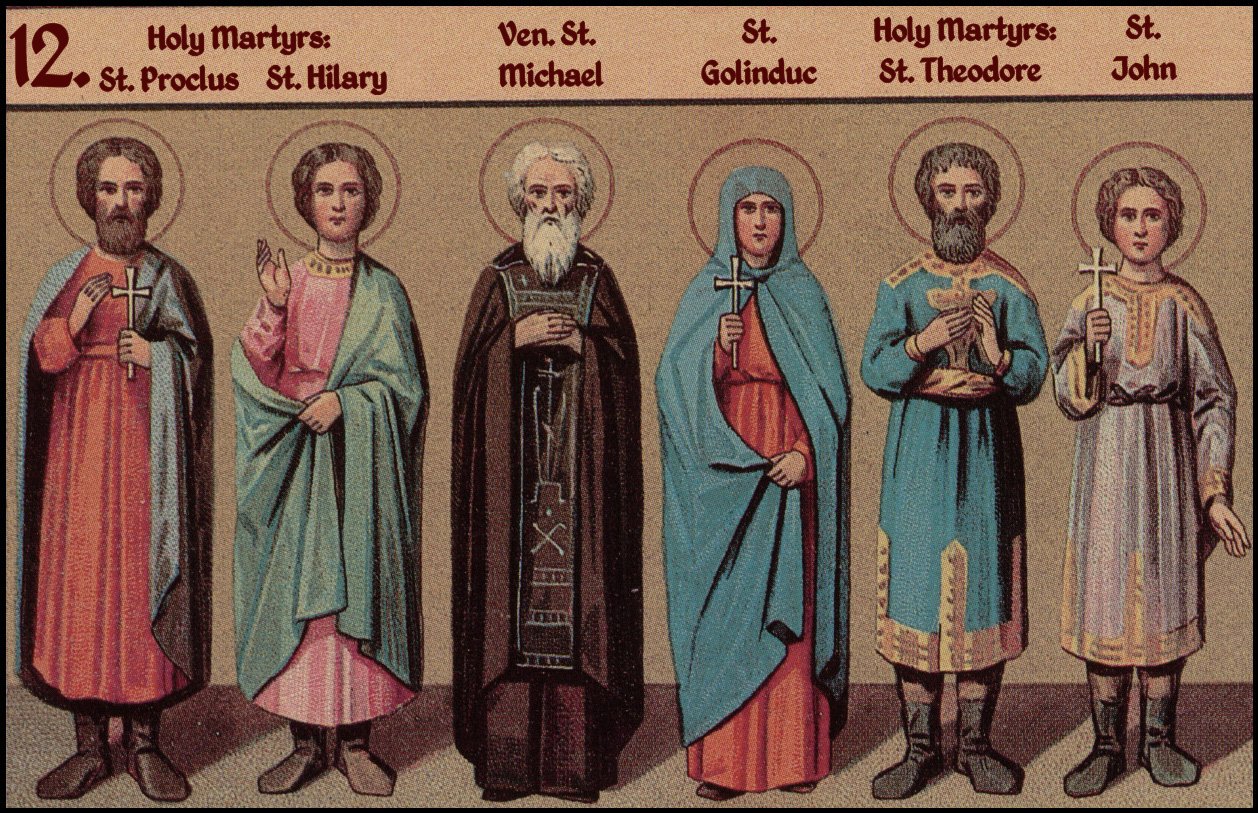 Below is an excerpt from http://www.abbamoses.com for todays reading of the saints. I originally heard is as a podcast at http://ancientfaith.com/podcasts/saintoftheday/jul_12_-_holy_martyrs_proclus_and_hilarius
Imagine how the Orthodox Church would benefit if, when we were asked ‘Of what race are you?’ the first answer that came to mind was not ‘I am Greek, Russian, Serbian…’ but ‘I am of the race of Christ!’
I pray that this truth reaches the hearts of every Christian, especially the One Holy Catholic and Apostolic Orthodox Church. We need to hear this truth. I hope that from the most nominal lay person, to the holy Patriarchs, we will fall on our knees in repentance before the All Holy Trinity and pray God’s mercy on us for seeing anything but His image in our brothers and sisters. Granted we are human, and prone to weakness, but we have the Truth in Christ, and have His life in us, illumining us. Yes we are a diversity of cultures, but we are one race in Him, who has separated the wall of partition. I think this would not just benefit the Church, but transform it. In the back of the Orthodox Study Bible, one of the morning prayers asks that God would “heal the schisms of the Church.” I think this statement above is the key. It seems to me that this is part of the commandment to love one another. If we could live that one simple statement, “I am on the race of Christ.” I think the Church could indeed be completely reunited.
Icons
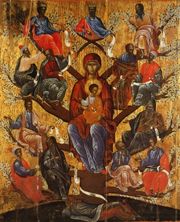 Okay, so I can’t think of a clever connection to The Lord Of The Rings with this topic. I’m sure a fan out there will come up with one, once they read this. I have been thinking about what I have learned about the Holy Icons and their role in the life of the Church, as well as how I relate to them as a follower of Christ.
I recently had it put to me by a friend that icons, as well as any kind of holy object, are simply “extras” that distract us from Christ. This friend contended that since the Bible does not forbid the use of music in worship (in reference to Old Testament scenes where Israel celebrates before the LORD with musical instruments, such as at the dedication of the Temple), but it does not tell us that statues, icons and the like are valid. In her reasoning, her church’s use of the visual arts (lights, stages, music, theatre, etc) was edifying and “Spirit led”. When I mentioned that the Church has used art to point people to Christ for centuries, I was promptly corrected for my “error”. Of course, her assumptions fail to recognize what icons really are. Then again, I had no understanding of icons as an Evangelical, myself.
I have to admit that as an Evangelical I was completely ignorant of icons. I was so ignorant, I didn’t even know that the “really bad paintings” that preceded the Renaissance era, were the very icons the Church had used for worship of Christ, instruction, evangelism, etc. When I first heard from my friend Cameron, who was considering the Orthodox Church, about the use and veneration of icons, I had a picture of little statues in my mind. And the other thing that first popped into my mind was idolatry. I assumed that the veneration of icons was directed simply at the icon itself, for its own sake, and was a part of some kind of perversion of Christianity the resulted in superstition. As I have come to find out, my assumption was not the case. And thank God for that.
For my non-orthodox friends, let me explain icons the best I can. They are 2 dimensional images of a person or event, either Biblical or from the life of a Saint of the Church. They are generally unrealistic in appearance, with proportions “wrong”, “bad” angles and the like. Their purpose is not to depict people or events in a realistic manner, because they are trying to share a spiritual message. Take for instance the icon above. The title if this icon is “The Tree Of Jesse”. While Mary never sat in a tree, with Jesus on her lap, their ancestors on the branches, and Jesse in the ground below it, the purpose of this icon is to show the Biblical truth of Christ’s lineage to Jesse, through Mary. As one person puts it, icons do with color, what the Bible does with words. They teach us. In my blogroll is a link to Glory To God For All Things. Here are a few of Father Stephen’s reflections on icons: http://fatherstephen.wordpress.com/2010/04/21/the-truth-of-an-icon-2 and http://fatherstephen.wordpress.com/2010/05/14/within-a-mandorla/ I add these because Father Stephen has a lot more understanding of this subject, and articulates it far better than myself.
One day my oldest daughter, who was 8 at the time, asked me if icons break the 2nd Commandment. I was floored at her ability to make such a connection. I was stuck with two problems: 1) giving a satisfactory answer. 2) giving that answer in a way that an 8 year old can understand. I don’t have that problem here, so here I go… First, the classic Protestant understanding of the command to make not images, is in fact in incorrect one. If it was strictly forbidden to make images, then art is sin. Also, why would God give that commandment, then instruct Moses to build a Tabernacle with images sewn into the very fabric of it, then later images carved into the very vessels of the Temple? The making of forbidden images is connected to the worship of them as God. Icons, like the ancient images in and on the Tabernacle and Temple, point to God, and do not take the place of God.
Second, the icons do not break the 2nd Commandment because of the Incarnation of our Lord God and Savior, Jesus the Christ. Because Jesus took on a body that could be seen, touched, etc, He can be depicted in picture form. Since Jesus could have been photographed (if the technology was available), then he could be painted (the actual technology available). And more than this technicality of His physical nature, icons point to Jesus in our lives. Since Jesus not only took on human flesh, but trampled down death by His death and resurrected, His life is in us by the Holy Spirit. People who put their faith in Him, live by the grace of God at work in us. The Orthodox understand this as Theosis.
This leads to the subject of veneration. If anything may appear to be “idolatry”, it’s the way Orthodox show veneration. We bow, we kiss, we make the sign of the cross. This is foreign to Western Protestants, and since faith is relegated to mental and emotional. As I have learned, this is basically the way Eastern peoples show respect, and have done so for centuries. So when we venerate the image of the icon, we are showing respect for the person who lived their life fully in the grace of God, and in reality, showing honor to the Lord who gives us this grace by the Holy Spirit. This Holy Spirit, when he touches the material, mystically imparts grace to the material world.
When God spoke to Moses from the Burning Bush, he told him the ground was holy. When Elisha died, the grace of God was still upon his body, to the extent that when a dead man accidentally touches the bones, he comes back to life. The Orthodox don’t try to explain how something like this is possible, but glory in the mystery as it is. That’s what separates a holy icon from any other picture. It’s purpose is to point to God. It’s intent is to show the spiritual reality of an event. It’s ultimate end gives glory to Christ. It is blessed with a mystical grace from the Holy Spirit. It teaches, like the Scripture. It’s not just a strange form of art, it’s holy.
One other thing that I pointed out to my daughter, is that each of us is a kind of icon. The Bible says that we are made in His ikon and likeness. Just as our lives are to be living epistles of God (2 Corinthians 3:2), the icons of the Church tell the story of our salvation, show the great cloud of witnesses (Hebrews 12:1) and help to encourage us in our journey toward salvation. We are the moving counterpart to a stationary icon. As I stated before (stole a quote, really) the Bible itself is an icon of words. I don’t know how I missed it for so many years, but now I’m beginning to understand…
Another thing that I have found to be true about an icon, is it’s ability to aid with with focus. As I pray at my prayer corner before the icons of the Glorified Christ, and the Infant Christ in the arms of the Theotokos, I find it easier to focus on actually praying. Closing my eyes, bowing my head and trying to think of all the things I need to pray for, often times found my mind wandering, or made be sleepy to the extent that I began to daydream. That mystery of grace that is upon the icons through the blessing, makes you aware of the presence of Christ and all His saints. It reminds you that we are not in a two-story universe, but a single-story one (sorry for taking your analogy, Father Stephen). The Kingdom of Heaven is present, and that is a comfort.
I would never have thought a year ago, that today I would have set up a prayer corner in my house (actually, I set up one for my girls in their room too) and be regularly be praying before icons. Obviously prayers are never made to them. I have found them to be very helpful in my developing prayer life. Some would say that those who use such things as icons, have lost the sense of God in their lives. I have come to understand and believe that this is completely false. If anything I can say that I am keenly more aware of God, and on a deeper level that doesn’t come and go with my feelings. It’s not about the object, but the God who has transformed my relationship with Himself, others, and indeed the whole Creation. That the material universe is not a distraction to my salvation, but a cohesive part of it, is a freeing thing to know. Thank God for the icon.
The Dead Marshes
 This image to the left is a picture from WWI. These soldiers are carrying a fallen comrade through one of the many battlefield swamps on the Western Front. This kind of scene, burned into the mind of J.R.R. Tolkien, is the inspiration behind the Dead Marshes depicted in the Two Towers. In the fictional setting Gollum leads Frodo and Sam through on a hidden path through a huge swamp, full of the souls of warriors killed there centuries before. In the book, the swamp appears normal during the day, but at night the swamp begins to glow with a ghostly kind of candle light, from the spirits beneath the surface of the water. These spirits are apparently destined to stay trapped there.
All that is to preface a topic that still has me a bit perplexed. That topic is our prayers for the departed. Perhaps by the time I’m done typing this out, I’ll understand it a little better. Sometimes sharing a thing with others, helps me to understand it just a little better.
In my days as a Protestant, I believed that the instant you die, you are eternally judged, whether for heaven of hell. The final judgement is just the finale, where you are reunited with the body. This life is all you have, and you better get it right (belief in Jesus that is). Verses like, “Today is the day of salvation.” are the catalyst for trying to get someone to “make a decision for Christ” now. Salvation is signed, sealed and delivered in a single transaction.
The Orthodox do not follow this line of thinking. The understand of life after death, is that the state of a person while their soul is separated from the body by death, is a temporary one. In this state, a person is believed to be able to still experience repentance unto eternal life. In the verse, “For it is appointed unto a man once to die, and then the Judgement.” the Orthodox believe that that is a reference to the final judgement before the Great White Throne. Until that point, one’s fate is not “locked in”. This is where our prayers for the departed come in. How is this possible?
Like everything else within the Theology of the Church, it hinges on the Incarnation, Crucifixion and Resurrection of Christ. I have mentioned the High Priestly prayer of John 17 before, in which Christ prays for our unity in Him, as the Church. We are connected to the Holy Trinity and one another. Also, having “trampled down death, by His death” Christ has made it possible for the “Church Militant” to be connected with the “Church Triumphant”. Death has not separated the Body of Christ. We are all one in Him, through the Holy Spirit. This is the same principle that applies to us asking the intercession of the Saints, with some obvious differences.
Since the Saints are obviously in the presence of God, we can ask for their intercessions. In the Holy Spirit, they know what to petition for. In the case of the departed, we don’t know exactly what to pray, but we can pray for God to forgive them any sins committed in this life, and simply conclude, “Lord, have mercy.” We can make these prayers to our infinite God, because He is not limited by time. What if a person died years ago? God is not subject to time, because He created it. We can pray in full confidence.
Here is the General Prayer for the Departed. I don’t think there is a need to comment, as it speaks for itself: “Christ our eternal King and God, You have destroyed death and the devil by Your Cross and have restored man to life by Your Resurrection; give rest, Lord, to the soul of Your servant (name) who has fallen asleep, in Your Kingdom, where there is no pain, sorrow or suffering. In Your goodness and love for all men, pardon all the sins he (she) has committed in thought word or deed, for there is no man or woman who lives and sins not, You only are without sin. For You are the Resurrection, the Life, and Repose of Your servant (name), departed this life, O Christ our God; and to You do we send up glory with Your Eternal Father and Your All-holy, Good and Life-creating Spirit; both now and forever and to the ages of ages. Amen.”
The final end of all this, is that the practice is one born of love. We love those whom we pray for (or should), and we can continue to pray for them, even after this life is over. Here is a quote I stole from a friend, who stole it from St John Chrysostom: “Such is the power of love: it embraces, and unites, and fastens together not only those who are present and near, and visible, but also those who are distant. And neither time, not separation in space, nor anything else of that kind, can break up and divide in pieces the affection of the soul.”
Let me also share how this has effected me. I have come to find some comfort in these prayers, and the idea that one can pray for those who have departed, Orthodox and Non-Orthodox. I have been praying for the souls of those whom I have encountered on various 911 calls. At the moment I see them, I make the sign of the cross and quietly pray, “Lord, have mercy on this departed soul.” When I get back to the station, I find time to pray the prayer I posted above. I have also been to the Third Day prayers for an Orthodox brother who passed last December. Those are some beautiful and moving prayers. The whole service helped me to understand a little better, the mysterious connection of the Body of Christ.
Let me share something personal. My father killed himself when I was 19. He was a man who displayed almost no Christian virtue anywhere, but at church. I can’t tell what his ultimate fate will be, but for years I have believed he was most likely doomed to hell, even though he named Christ as his Savior. I now find a new connection with my departed father by praying for him when I attend services. I light a candle for him, and ask our Gracious Lord to have mercy on his soul, to forgive his sins.
Like I said at the before, I don’t fully get it. But then again, can you really GET a mystery? While you can explain certain things about it, in the end you have to shrug you shoulders leave it to the wonder that is our Faith.
O Elbereth Gilthoniel!
 As I begin this post, I realize that the title of the post might give the impression that I’m going to discuss the Theotokos again (those familiar with who Elbereth is, at least). Maybe indirectly, but I want to share what I am learning about our relationship with the Saints.
As fans of the books will remember, Frodo is given a glass phial by Galdriel, that is said to contain the light of a star, and when all other lights fail, this one will shine in the darkness. In two scenes from Shelob’s Lair, both Frodo and Sam say the name of Elbereth, which triggers an intensifying of the light from the phial. In both cases, the one who speaks the elvish words is given unexpected courage. Withthe elvish words: “A Elbereth Githoniel o menel palan-diriel, le nallon si di’nguruthos! A tiro nin, Faniulos!” Sam is given “supernatural” fury to defeat the giant, demonic spider/creature, and is even given a kind of fearful presence before the orcs of the Tower of Cirith Ungol.
What I mean to point out with this story, is that the connection with Elbereth is not completely dissimilar to our connection to the Saints. Obviously, the “powers” demonstrated in the fictional story are of a mythological nature. The power is solely under the control of the individual to use how and when they please, under certain parameters. They have no tangible link in the Creator of all. In that way, it has no resemblance to our relationship with the Saints. Of course, all these posts only have a very loose resemblance to the theology I am learning and experiencing. So really there may be better illustrations for this topic, but I’m sticking with the Lord Of The Rings theme for now.
This is a topic that I first became aware of in Bible College. Of course, it was spoken of in negative, derogatory terms, and was conveyed under the assumption that it was simply a Roman Catholic “thing”. Being of a Sola Scriptura understanding, it was also assumed that such things are never spoken of in the Bible, and therefore the whole idea was a “late” superstition of the already apostatizing Church. Many scriptures used to combat the idea of “praying to the saints” revolve around Jesus being our One Mediator, that we come boldly to the Throne of Grace, and other such references to us coming to the Father directly because of our position in the Son, by the Holy Spirit. The things I was taught also took issue with our relationship to the sacraments, clergy, etc. Needless to say, I had it pretty well ingrained in my head that “prayer to the saints” = bad. Eventually I learned differently.
For the benefit of any Protestant friends that might be reading this, let me give an explanation of the theology and reasons for our relationship to the saints. For any Orthodox, please feel free to point out any grave errors in my understanding (or even minor ones for that matter). This way, I can see if I’m getting it. Don’t get me wrong, I am under the care and direction of my priest. This just helps me see if I can clearly communicate this to someone who asks.
First of all, as with many things in Orthodox theology, it centers on the Incarnation of Christ. I was just talking with a brother at my parish about how I once thought I understood the Incarnation and the Resurrection. I realized that as an Evangelical Fundamentalist, I really missed the meaning of the Incarnation. Christ’s coming in the world was not just taking a body in which to die, in order to pay a penalty that God needed to be appeased for. The Incarnation was Christ assumption of all creation in Himself, and is the means whereby we have tangible communion with Him (in the Holy Spirit, of course). Furthermore, because Jesus, “was incarnate of the Holy Spirit and the Virgin Mary, and was made man” and we are one in Him, we also have communion with one another (see the prayer in John 17). This includes those that have gone before us.
Jesus tells us that the God of Abraham, Isaac and Jacob is not the God of the dead, but of the living. If this is the case, then those that have departed this life are in fact alive. They constitute the “Great Cloud of Witnesses” (Hebrews 12:1). We see a multitude under the heavenly altar, praying to God in the Book of Revelation. These are our brothers and sisters who behold the face of God. We can ask for their prayers the same way we would of a Christian friend, family, or fellow Church member.
Isn’t that like consulting a medium? No. We are not trying to make contact with spirits in some kind of a pagan way. This is simply making a request for intercession before God, on our behalf. How does it work? I don’t know. It’s one of the mysteries about our faith. As near as I can guess, it has to do with our union to the Trinity and one one another. The same Spirit of adoption that allows us to cry, “Abba, Father” connects us to one another, both here, and hereafter. Can’t you pray to God yourself? Of Course (It would be more fun to use Paul’s words from 1Corinthians 15 – “Thou fool!”). The saints are not Mediators of the Covenant. That position belongs to Christ alone. We are told to pray, one for another. This includes the Saints no less than it does us. It’s a communion that has it’s root in love.
One of the other things about the saints, is that their lives are examples for us, the same way we learn from the Old Testament. These are men and women who have “fought the good fight” and been victorious. They are truly Martyrs (witnesses) of the Gospel. One of the great terms I have come across is “Athlete”. They truly lived a life of sanctified discipline. They “contended earnestly for the faith, once for all delivered”. Every day in the Church, a Saint is commemorated. This commemoration is generally done on the day of their death. This may seem morbid to some, but if you think about it, this is the day they received their reward for a life well lived. These Saints were true “Co-laborers with Christ”. They lived His life, by the power of the Holy Spirit. They show us what a life fully surrendered can look like. Yes there was a lot of unspeakable suffering and sorrow, but what joy at the end! I have learned a lot from these daily commemorations. A great resource is the Podcast “Saint Of The Day” on Ancient Faith Radio. They give a 1 to 3 minute account of the life of a Saint, or Saints.
I understand in my mind that this is a mystery. As such, it doesn’t require extensive explanation. Really, how can you fully explain something like this? I suppose one could try to apply a reasoned, scholastic approach. But this isn’t faith. For my part I had hoped to learn exactly when this practice might have started. If this faith Orthodoxy follows has it’s foundation in the Apostles, then it should reason that this practice came very early. That’s my Western mind at work. I am learning that wonder is often a better way to approach these things. Having said that, there seems to be some empirical evidence that prayer to and veneration of the Saints is indeed an early practice. An old friend of mine posted this link: 4th century icons of Peter and Paul found in Rome – Yahoo! News. This is a catacomb with icons from the 4th Century (300’s), and is evidence of early Christian reverence for Saints. Another thing I learned on Search The Scriptures, that the homilies of St John Chrysostom contain reference to asking intercession of the Saints. I was also discussing this with my priest, and he pointed out that some early precursors to the Christian era, comes from the Books of the Maccabees. I have not yet read those, but I will and will get back to you on that.
For me, this was one of the more difficult things to incorporate in my person life. How does one make the Saints part of their life in Christ? As a catechumen, I kept my same name, but was given the Prophet Jeremiah as a patron Saint. I have always felt a connection with him, from before I ever knew of Orthodoxy. I have learned that the answer to my question was to simply learn from their lives, and ask for their intercessions. It is as simple as, “Saints of Christ, intercede to God for us.” (Which is a common refrain in the chanted prayers of the daily services). Sometimes it’s asking the prayers of a specific Saint. I have ask Saint John Maximovich to pray for healing for my family when they are ill. I have asked for prayer from the Theotokos during times of difficulty. I have found a once awkward practice to be very comforting. Having a patron saint to call on is quite a comfort. It’s really no different than the comfort one draws from hearing a friend say, “I’m praying for you.”
Do I still address the Father, Son and Holy Spirit in prayer? Absolutely. If anything, this strengthens my prayer. And just to clarify, it is never actually prayer TO a Saint, it is asking the intercession of a Saint. Doesn’t Christ make supplication for us, as it says in the letters of Paul? Yes He does. But not only He Himself, but in His Saints prayers are offered. This has been a wonderful discovery. It’s like finding out you have a whole extended family you never knew about. And not the kind that you wish you never found out about, once you do. This is a family you can really “be proud of”.
So, like our characters in the story, we can call on power that is greater than ourselves. We can find strength and encouragement in the darkness. “A light when all other lights have gone out.”
A Shortcut To Mushrooms
 In this chapter of the Fellowship of the Ring, we find out that Frodo and his two cousins, Merry and Pippin, were once trouble-makers in their youth. Throughout the trilogy we see these two characters have something of an impetuous nature, despite all they experience over the course of the tale. In the movie trilogy, the artistic license of the screenplay writers makes this characteristic even more pronounced. The picture to the left is, I think, the best example of that. The looks an their faces, covered in soot, is classic. Just before they are about to get into more trouble Gandalf grabs them by the ear, and sets them straight (for the moment).
Just to make sure I had chosen the correct word to describe Merry and Pippin, I looked up the definition of impetuous. It is defined as follows: impetuous |imˈpe ch oōəs|adjective – acting something or done quickly and without thought or care . While Merry and Pippin are somewhat exaggerated examples of this definition, I know I can be like that too. You have heard the term “without a second thought”. Sometimes I wonder if I do things before I’ve even had a first thought. Nowhere is this more evident in my life than in my tendency to engage a conversation where I assert my own opinion, or argue a point, because I “know” that I’m right. After going to Bible College, I had the perfect channel for that tendency… apologetics and evangelism. I should really put those two in quotes, especially the evangelism. For all my arguments, I never once brow-beat someone into the Kingdom with my convincing arguments. For all my studies, I never once convinced the pseudo-christian cult purveyors on my front doorstep to forsake their false prophets, and embrace the truth. I have to admit, I was a little more than frustrated with my inability to convince people. In the end, I chalked it up to people simply being blinded by Satan, and counted myself “lucky” to be in the Truth of Christ.
When I initially discovered Orthodoxy, and became increasingly convinced of its veracity, I brought with me my tendency for argument. A few places this was most prominent were discussions with my wife, a few of my Protestant friends who held opposing views, and pseudo-christian cult members. Orthodoxy was like a treasure chest, full of great things which I could point to in my conversations with people. I found I had a stronger position to explain why the Mormons are not the re-establishment of the True Church. I could point to the Church, Church Fathers and Tradition, to validate why I disagree with the Liberal and Emerging Church movements, that think the morals of the Church should “evolve” with the culture. (sorry for the broad generality with that last statement) I had struck the Mother Lode! I had a well which I could never exhaust the contents of. I was like Po in the Jade Palace; excited, but I had no idea what I was doing.
For the first few months I was soaking up information like a sponge. I asked a million questions, which, when answered, sparked more questions. Incidentally, my priest referred to me as a “bulldog” because of the amount of questions I ask. I don’t know how to take that… Anywho… As I was soaking up information via podcast, books, etc, I came across a 3 part series on Converts on the Our Life In Christ podcast. One of the first things they addressed was new-convert zeal. Apparently, neophyte excitement is not always a good thing. DOH! The whole series can be downloaded from Ancient Faith Radio from the Our Life In Christ series under Converts, so I won’t get into too much detail on what I heard (besides, I can’t remember all the quotes from the Church Fathers, Saints, monks, etc).
One of the main things I remember being struck by, is that zeal has always been linked to pride, in the perception of many Orthodox. This comes from Paul’s teaching to Timothy about not allowing novices to teach the flock of God. One of the great dangers of ignoring the warning of scripture, tradition and Church teaching is the sin of prelest. Essentially, prelest is a spiritual self-deception. One can think they are doing great spiritually, but really be deceived (like the parable of the publican and the pharisee). The podcast also talked about the argumentative nature of many Protestant converts to the Orthodox Church. They emphasized that again and again, the Fathers, Saints and spiritual men and women of the Church write that the true virtues are found in Galatians 5:22-23, and do not include zeal and assertive arguments. While there is a place for “earnestly contending for the faith (Jude vs 3), FIRST comes the virtues, the Fruit of the Spirit.
One of the other things they spoke about, was the impatience converts tend to bring to their initial experiences with Orthodoxy. I had noticed within myself the tendency to ask, “Just tell me what I need to start doing to become Orthodox, so we can get this show on the road! Oh ya, and how long will all this take? Let’s start making it happen!” What the podcasts addressed was the need for slow, prayerful, sober instruction, as well as patient preparation for the life within the Orthodox Church. Orthodoxy is not just a group you join, an idea you subscribe to or a title you take on, but a life lived in communion with the whole of the Church. It is truly not a sprint. It’s not even a marathon. It’s more like a steady migration. It follows it’s seasons, has its joys, its perils, and it goes from glory to greater glory. I can’t remember the Saint who said it, (I think it was one of the Gregories) but essentially the quote expresses the idea that eternity will not be a static state, but one in which we continue to become more like God, without in incumbrance of sin.
Needless to say, I was floored by the things being communicated. I realized that I had been proud, impatient, and ignorant. I felt like I had a kind of epiphany, where I not only had an insight into myself, but I knew what I had to do about it. I realized that I needed to humble myself before God, and ask for mercy. I needed to submit myself to the instruction of my priest, as one who has been given authority by the Church to lead and feed the flock, and administer the sacraments. I needed to be patient. Not only with the glacier-slow pace of things within the Orthodox Church, but with myself. Changes within myself will come slowly, steadily, and when they do, by God’s grace, they will be of a more permanent nature than the fleeting “changes” I had experienced throughout my life as a Protestant. I need to be prepared to enter into the communion and life of the Church, not just learn how to become a member of it.
As a result of being confronted with the truths I encountered, I have begun to step back and simply learn to let the teachings, hymns, canons, iconography, prayers, celebrations, commemorations and ritual (in a word: Traditions) of the Church grasp me, and do their work in me. I try to see through the eyes of wonder and hear with the ears faith. I may not be able to participate sacramentally (having not been fully “received” into the Church), but I can be present, and participate to the extent that I can. Strangely, (maybe that’s not the right word to use) I find a comfort and peace in simply being present and participate as I am able. Not only has it given me fresh eyes with which to read the Scriptures, but it has opened my mind to a whole new (old really, I guess) understanding of salvation itself. It’s hard to try and find words to describe what is really indescribable.
And most importantly, I have noticed some changes within myself. I have mentioned some of those changes in other posts, so I won’t bore you with them here. My own perception of how I’ve changed in not as important as how my wife thinks I’ve changed. She says that I am kinder, gentler and more apt to pray. She says that other people have noticed some changes, but they can’t put their finger on it. Thanks be to God for these changes. My prayer, and the prayer I ask of all who may remember me in their prayers, is that I continue in the grace of God, so these changes remain. I also pray that these changes will lead to my whole family and I being able to commune together within the life of the Orthodox Church.
A Request For Prayer
To any who might read this, please remember my daughter Shea (5) in your daily prayers. I just found out this morning she has the mumps. This news comes as kind of a shock, since she has been vaccinated. I thank all of you for your prayers.
The Last Stage
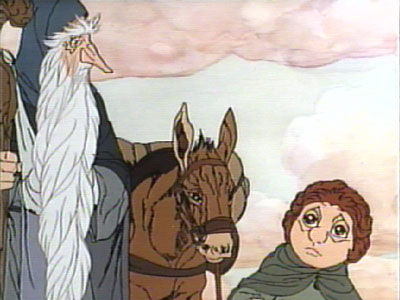 On the very last page of The Hobbit, Gandalf, Bilbo and Balin are having a conversation at Bag-End about the goings on in Dale, Lake-town and Lonely Mountain. Referencing a prophecy that the dwarves had shared at the beginning of the story, Bilbo says, “Then prophesies of the old songs have turned out to be true, after a fashion.” To which Gandalf replies, “Of Course! And why should not they prove true? Surely you don’t disbelieve the prophecies, because you had a hand in bringing them about yourself? You don’t really suppose, do you, that all your adventures and escapes were managed by mere luck, just for your sole benefit? You are a very fine person, Mr Bilbo Baggins, and I am very fond of you; but you are only quite a little fellow in a wide world after all.”
“Thank goodness!” said Bilbo laughing, and handed him the tobacco-jar.
I love this scene from the book. I never really understood the significance of the final statement by Gandalf, until I began this journey towards Orthodoxy. Okay, I probably still don’t, but I think I have a slightly clearer idea than before. I was meditating on a blog/podcast by Fr Stephen Freeman (Glory to God For All Things) called, “Chief Of Sinners” just the other day. This phrase of Gandalf’s came to mind. You can read Fr Stephen’s words yourself, as he communicates far more articulately than I. However, I will try to put his reflection in a nutshell, so I can share the connection. Some of what I share is for the benefit of the Non-Orthodox, but will be common knowledge for Orthodox.
In the Divine Liturgy, before taking the Eucharist, the whole congregation says a prayer, which includes the following words: “I believe that Thou art truly the Christ, who art come into the World to save sinners, of whom I am chief.” As Fr Stephen points out, these are not simply poetic words trying to communicate a sentiment of piety. These words communicate a deep truth of the fact that those who are “In Christ”, not only participate in His life, but since He was “made sin”, we participate, so to speak, in the sin of the world that He took on Himself. Because of this mystical union that we have with Christ, we have a union with one another, just as Jesus prayed in His John 17 prayer. We are united to one another’s successes, as well as one another’s sin. Even further than that, as a quote from Dostoyevsky points out: we are guilty of the sin of all and for all.
As a Protestant, I had the understanding that I was “accounted” righteous, and that my life in Christ that is by faith, is “reckoned”. I had an understanding that my life is in Christ, but I never really understood what it meant. The faith I was to live by, was more of a mental ascent than anything else. Because of the lack of the physical in my faith, anything that was connected to Theology was all in my head. Not only that, but as a Calvinist, the outcome of my life was completely left to God’s sovereignty. It was almost as if life “down here” is being remotely (emphasis on remote) controlled from “up there”. I am oversimplifying, of course, so forgive me.
Since coming in to Orthodoxy and the sacramental world view, I have come to see the “here and now” nature of our fait; the way that physical and spiritual are inextricably linked, and that we are linked to one another much more deeply than I ever understood before. When another sins, I am guilty with them. I can’t, therefore, judge them, but I pray for them. When another experiences joy, I should not be jealous, because their joy should be mine. Everything I physically do participates in the unseen spiritual reality that is all around me, and not somewhere far above (or below) me. This is why sacraments (the Holy Mysteries) are what they are. We get to physically participate in heavenly realities. Not only that, but we “absorb” them into our bodies, as in the case of ingesting the Eucharist. I have not yet fully participated in the Holy Mysteries yet, but having been present during a few of them, I get a better idea of their significance in our life in Christ.
How does this have anything to do with the conversation between Bilbo and Gandalf? I was reflecting on the idea that our life in Christ is a participation, a synergy, a co-laboring (Paul uses the term in one of his epistles) with His uncreated grace. I think we (I should just say I), like the character Bilbo, can discount the work of God in and around us, by virtue of our participation in it. I tend to think of “God’s Plan” as big-picture kinda stuff, while trudge along in my little corner of the world, trying to live a godly life, in obedience. I also tend to see my personal piety as isolated from the rest of Christendom. But that’s the great thing about a sacramental world view; we truly co-labor with Christ, we truly are a part of one another in Him. Nothing I am or do is “in a bubble” that does not have an effect on the rest of my brothers and sisters in Christ. I, we, are the body of Christ.
As I inch ever closer to that day when I will begin to full participate in the Holy Mysteries of the Church, I find this reflection and great challenge, and a wonderful joy. It challenges me when remember that I really do mete out to myself judgement when I dare to judge another in their sin. It brings the joy of knowing that I am connected to one other, to Christ. I am beginning to see that not judging my brothers and sisters is more than just a mental exercise. While it does happen in our minds to a great extent, it is not just left there. It makes every “Lord have mercy” have a new meaning to me. I can pray those three words with conviction, not just for myself, but the whole body. I am slowly becoming aware that the life I am being prepared to live in the Church is not lived out on my own. I really am, “… quite a little fellow, in a wide world after all.” That world being the Church. To that I can truly say, “Thank goodness,” with all the joy and comfort of a hobbit sharing pipeweed with friends.
Scouring Of The Shire
 At the end of the chapter in which the Shire is cleansed of the evil that had taken it over at the hands of Saruman. I like the fact that in that story people who are written off as weak, somehow find the courage to rise up and root out evil. It’s a great picture of God choosing the sick to confound the wise, or the mustard seed growing into a great tree. But that’s not the idea I want to share. At the end of the chapter, when everything has been restored and Sam is having kids, a few obscure events are written about. These events surround the character of Frodo. Each time an “anniversary” of a traumatic event comes, Frodo becomes inexplicably ill for a day, then becomes “normal” again. In one such case he is found shivering, clutching his chest in pain with one hand and grasping for dear life with the other the small, light-giving vial of Galadriel and saying something about finding no healing. Eventually that healing does come, but it comes in the form of him forever leaving the shores of Middle Earth, to live among the immortal elves in Valinor.
I can’t help think about this annual cycle of pains Frodo experienced is not entirely unlike our cycle of struggle, fasting, feasting, commemorating and celebrating in the Orthodox Church. I have yet to experience a full Church year, but already I’m beginning to get the gist of its flow in the life of the Church, corporately and individually. When I say, “get the gist” I actually mean that I really don’t have a clue, but I think I might have the slightest of glimpses into the cyclic life of the Ancient Church. I can say that I already have begun to notice it having an effect in my life. Nothing dramatic, but a shifting of my “phronema” or mindset, that is beginning to take root in my behavior as well.
The first and most obvious cycles are in the feasts and fasts. Feasts of celebration are preceded by a period of struggle in fasting. The two that seem to have the most mourning aspect to them are Pascha (Easter to my Western friends) and the Dormition of the Theotokos. I mentioned in the post on Pascha the deep sense of sinfulness and mourning over self that comes with the Lenten season of fasting. That sense of mourning intensifies as Holy Week gets underway, until that ecstatic release of joy when we shout “Christ is Risen!” on Pascha night. And though I can’t think of any other feasts that have such an intense sense of mourning associated with it, each of the celebratory feasts has some kind of preparation of fasting. Each of the fasts has a different intensity level, length, etc, but each is ended by a period of joy. Some of the fasts are broken with a week-long “no fasting”. Celebrated every year, is the story of salvation in Christ.
Beyond the annual cycle of celebration and struggle, is the weekly fasting on Wednesday and Friday. These days commemorate the betrayal and crucifixion of Christ, respectively. Each week we remember Christ by two days of denying our flesh with a fast.
Oh ya! What is a “fast” in the Orthodox tradition? Generally, it is the abstaining from all dairy, meat, wine (some say any alcohol of any kind) and olive oil. Why? It is simply the exercising of the will over the flesh. To deny yourself, in order to give greater heed to prayer, good works and alms giving. There is no inherent evil in any of those foods listed, nor is it expected that one would not do any of the good works listed on non-fasting days. It is simply a cyclical practice that helps shape us more into the image and likeness of our Lord.
Beyond the annual and weekly cycles, are the daily cycles. Daily? Yes, daily. We have the cycle of prayers in the morning and evening, meal times, etc. One of the other great practices, is the monastic practice of praying the “Royal Hours”. These are 9 am, 12 noon and 3 pm. They represent the hour Jesus was scourged, the hour He was nailed to the cross, and the hour He died. These are generally done in monasteries, but are sometimes done my “regular parish Christians” as well. This is never meant to be a legalistic or superstitious observance. Rather, it is simply a cycle meant to focus our hearts on and draw us nearer to our Lord, transforming us more and more into His image. The Orthodox term is “theosis”. As Peter puts it, we are becoming “partakers of the divine nature”.
Additionally, we have a “lectionary” or cycle of readings from the Scriptures. Generally it is a Psalm, Epistle and Gospel. During certain feasts and fasts there is the addition of a Prophet and a Proverb. I like this reading cycle a lot. If you are able to get to vespers or matins during the week, you can get a pretty good idea of how the Church interprets a set of Scriptures based on when the readings are, in conjunction with the Festal and Liturgical season. Along with that daily cycle of readings is the commemoration of a Saint or several Saints. Every day one can learn about those who have successfully lived the Christian life, and find an excellent example in them. The Saints are commemorated on the day of their death. I think it’s because most of them did not have a birthday that was well known and also because their death was their entry into the presence of Christ. Since many died as martyrs, these are metaphorically spoken of as athletes who were victorious.
What a wonderful cycle we have as Ancient Christians (I say we, looking into the future) in the life of the Church. I notice for myself, that I not only grow as an individual, but I grow with my parish, and indeed the whole body of Christ on earth. Not only us “who are alive and remain”, but the whole communion of saints who repose in the presence of the Risen and Glorified Christ. I become a part of something that has been practiced, from the very first Christians who were made into the Church on the day of Pentecost. One of the best things about this cycle is it’s practicality. It is never “enforced”, only encouraged. Our piety before God is never left to the individual in a willy-nilly fashion. We, as a Church observe these things together, at a set time, in a set way. I find it a comfort to have such a tradition. I am not trying to forge ahead with no other guidance than what I perceive to be the “leading of the Holy Spirit”.
Let me quickly add that the willy-nilly fashion is a product of my Fundamentalist/Evangelical upbringing and is fairly common in non-denominational churches. Maybe the problem of willy-nilly was my own. Many times, as I stated above, personal piety varied from individual to individual when I was non-denominational. Some of the more formal style churches tend to follow the cycle of the Church Year. One such such Church I know of for sure are the Presbyterians. I believe High Church Anglicans, Reformed (Dutch, Baptist and the like) and, of course, the Roman Catholics. The Western cycle is quite different than the East, as I have learned from an Eastern Catholic friend of mine, who is under a Roman Bishop.
As I become more and more immersed in the cycle of fast/struggle and feast/joy, I find a certain rhythm to my life now. It is a difficult rhythm, to be sure. But a struggle with 2000 years of foundation I can stand on. 2000 years of tradition to look to. 2000 years of saints to follow the example of. I have an entire Church in which I live my life on the journey toward salvation.
The Fall Of Gondolin
 When I first read The Silmarillion, the story of the elves and their rebellion, periods of glory, war, sorrows, etc reminded me a great deal of the Old Testament. No sooner had things seemed to quiet down, or a victory seemed to be at hand, when tragedy would strike. Reading the story of the fall of Gondolin, you see the crown jewel of the elves forever crushed. The thing that brings it down is pride and betrayal. You see it coming before it happens. You wish it wouldn’t, but it does. I wonder why Tolkien wrote so much tragedy in the lives of the elves. I wish they could get the upper hand on evil and have peace. Why such suffering? I have to admit, I feel a little betrayed. Like something that could have been so wonderful, never was.
I don’t know about anyone else, but when I first read the history of the Orthodox Church, it kind of felt like that. I mentioned it in another post, but I felt offended by the history I was confronted with. From the podcasts I had heard, I got the impression that the Church that contained the Fullness of Faith was also something at least close to perfect. The Church I read about in the pages of The Orthodox Church by Kallistos Ware was anything but perfect. After a bit of reflection on why an imperfect Church would be a stumbling block for me, I think I have come up with a few answers.
I think the root of my “offended sensibilities” was a misguided understanding of the Scriptures. I, like many Fundamentalist Evangelicals, believed that the Bible was more or less an “actual, factual” account. Scriptures were not just God’s Word, but that Word is inerrant and infallible. That perspective lent itself to a sort of romanticized view of the accounts of the Bible, which in turn also created an unrealistic view of the early Church. I knew there was conflict, but I thought with the guidance of the Holy Spirit (after all, hadn’t He “dictated” the entire Bible up to the time of Jesus?) the answers were pretty obvious. I hope this doesn’t sound too confusing, but when I be
came aware of the fact that my old views of Scripture, the Church, etc were incorrect, I must have subconsciously transferred my misguided concepts to the Orthodox Church. I was still investigating the claims of Orthodoxy, but I thought if it was the fullness of Him who fills all in all, it would be just about perfect.
The Church that I was confronted with on the pages of Metropolitan Kallisto’s book was full of jealousy, divisions, vain-glory, wars, hate, murder and a laundry list of other things too numerous to list in a single blog post. Was this really the “pillar and ground of truth” spoken of by Paul to Timothy? As I would come to find out, yes. The podcasts I listened to helped tremendously. Search the Scriptures covered a multi-teaching section on the history of the Bible, and the Church. Father Thomas Hopko, as well as the guys from Our Life In Christ also explained a lot of the historical aspects of the Church. As always, Fr Stephen Freeman’s reflections on Glory To God help to put these things into perspective, as well. You can refer to my earlier post on the podcasts to find out more about the ones I listed here.
I learned that God has worked with very flawed people, from the time of the Fall to the present. I learned that “inspiration” does not mean possessed or dictated to, but works in conjunction with our human flaws with all its ugliness and messiness. I have also reflected on the very troubled history of the people of Israel and how they had The Oracles of God, yet sinned grievously. Their sin did not negate the truth of the God who chose them. The Church, the Israel of God, has the fulfillment of all the truth of the Old Testament in Christ, yet that truth is held in “earthen vessels”. With all its “earthiness” getting in the way, God has led His Church from its birth on Pentecost, to the present.
Another thing I had to combat in my mind, came from the critical arguments arising out of Emerging Church and Liberal camps. These are most prominent in Protestantism, but there are a few Roman Catholics involved in this as well. It seems to me the main criticisms that come from these groups bring into question the authority of the Church and especially Scripture. I thinks it’s mainly a challenge of Fundamentalist thinking on scripture, Church, etc. It proposes that the theology of the Church “evolves” with the changing culture and as such, scripture, theology, morality, etc should be interpreted in the context of society. In this thinking is the idea that there is no real way of “knowing” that we have true doctrine, worship, church authority, apostolic succession, etc. I am painting with way too broad a brush and am leaving a lot out, but I am oversimplifying to make a point.
My point with all that, is to say that such thinking (even though I by and large rejected it, it still crept into my head) dismisses the human errors within the Church as reasons to doubt her authority and dismiss the teaching and dogmas established by the Church. Such thinking says that anything that was taught by the Apostles has long been misunderstood and it’s up to us to figure it out for ourselves. With this kind of thinking rolling through my head, all the humanness of the Church through the centuries strips the authority passed on by the Apostles and reduces it to a nice idea that can no longer be proven. It makes the dogmas of the Church seem like a silly thing to have gotten so worked up about. I wondered if this Church that seemed to have fought so much with itself, had really preserved the faith passed down by the Apostles. Was it all just perspective?
I have discovered that in all the apparent messiness of Church history is the leading of the Holy Spirit. By Church I mean the one defined by the Fathers; that being Orthodox (One, Holy, Catholic and Apostolic). The Apostles handed down to faithful men, that which was handed down from Christ and they in turn passed it on. Amazingly, this was worked out by the Church over several centuries. Though there have been those that have broken away, the Church remains one. Not an institution of man that can be criticized, scrutinized, marginalized and divided into various groups, but the living body of Christ on earth; One, Holy, Catholic, Apostolic and visible. (I know I said it already, but it’s a phrase worth repeating)
Like Asaph, who came to understand the things that stumbled him, so too when I step into an Orthodox Church to celebrate Liturgy, I get perspective on the history of the Church. I hear the hymns, psalms and prayers as they have been done over the centuries, I smell the incense that have been a symbol of prayer from ancient Jewish times, I am in the presence of the “cloud of witnesses” (Heb 12:1) the holy icons of saints, patriarchs, angels and Christ Himself and I am led in worship to our God by the priest, with the congregation. This is not just another format or flavor of worship by one of many denominations. This is the Living Tradition. This is the experience of the Life In Christ, passed down by the faithful, unchanged. Like ancient Israel, the Church has those who do not “discern the body of Christ”, but that does not lessen what it is and Who it represents. To apprehend this mystery, or more accurately, be apprehended by it (thank you Fr Stephen) is to understand the Church and its history.
So… the Fall of Gondolin. While I originally thought I was going to make a comparison with Gondolin and the Church, adding a huge disclaimer that no such complete and utter destruction has happened to the Church, I can see that’s not the metaphor this posts comes away with. In truth I have come to realize that Gondolin represents my faulty understanding of the Church. A glorious and magnificent fortress-city that existed only in my mind. THIS is the Gondolin that has been forever razed to the ground in ashes. A fictional Church, full of make-believe characters who believe in an equally made-up God. Like the elves who escaped the destruction, what one is left with is a lot more painful and the road ahead is full of toil, tears, sweat and blood. Yet we who are saved by Christ look for a city without foundations, whose builder and maker is God.
 This is a blog about my journey from Protestantism to the Eastern Orthodox Church, and reflections of have as an Orthodox Christian. Not very original, but I am hoping to sort out some of what I have learned and share my journey with others. I hope this will help explain some things for my friends and family. I also hope this may help someone who is not yet my friend, that I have not yet met.


 Jeremiah Was A Bullfrog... Now He's Eastern Orthodox?