This Blog Is For Sharing & Participation
I welcome all and any comments, feedback, suggestions, etc.
Nativity (Christmas) and the Eucharist

Image via Wikipedia
I am on a streak of not posting topics that consist of an Orthodox reflection using a Lord of the Rings/Hobbit analogy. I hope that any of you who read this blog regularly don’t mind. Since the overall theme of the blog is to share my reflections on my journey to the Orthodox Church, maybe I’m not to far off the mark.
I have been thinking about the upcoming celebration of the Incarnation of the Word of God, Jesus Christ our Lord. As I have stated in other posts, in the Life of the Church (Its Traditions, Teaching, Doctrine, Hymns and Prayers) the Incarnation is central to its spirituality. Indeed, the Incarnation is central to our salvation. He joined Himself to us and His entire creation by becoming man. That union is fully realized because of His death and resurrection.
The Church experiences that fullness every time the faithful receive the Body and Blood of Christ in the Eucharist. In fact, every Liturgy includes the experience of the Incarnation, Earthly life, Death, Resurrection and Second Coming of Christ. I have mentioned before that someone has pointed out that the icons on either side of the gate of the Sanctuary represent the Incarnation (Mary holding the Christ Child) on the left, and the Second Coming (Christ) on the right. In the midst of these the faithful receive the Body and Blood of Christ. We don’t receive bread and wine (though the Gifts are that), we receive the True Body and True Blood.
I was listening to a podcast in which the person speaking stated that to deny the real presence of Christ in the Eucharist is to deny the Incarnation in a sense. I never would have thought of it this way, but to deny the mystery of the Eucharist is to deny the mystery of the Incarnation. This seems like a harsh statement. But if you think about what he’s trying to say, if the Bread and Wine are merely symbols and not the Body and Blood of Christ, then how can we believe that Christ the Eternal Son of God became fully human, while still being God? The Church confesses that the second person of the Holy Trinity became man, but remained unchanged as God. It is precisely this mystery that allows us to say that though the bread and wine are exactly that, they are more than that by the power of the Holy Spirit; they are simultaneously the Body and Blood of our Lord.
The Orthodox Church doesn’t try to explain this, it simply rejoices in the wonder of the mystery of our great salvation. Actually, we rejoice in God, Father, Son and Holy Spirit, who has wrought this great salvation of His creation. This is the faith of the Orthodox Church. And though I am not yet Orthodox, I can rejoice in this upcoming celebration of the birth of the One who gives of Himself to His Church; the One who is, “Divide, but never disunited. Eaten, but never consumed.” Someday I will be among the faithful who experiences this. Until then, I prepare for that day…
Those readers who are Orthodox, is there anything you would add to this reflection?
P.S. The point of the podcast speaker (and this blog post) is not to disparage those who take a symbolic view of the Eucharist. The point is the wondrous connection that exists between the Eucharist celebrated in the Church and the Incarnation of our Lord. It’s not meant as a refutation, but instead a celebration. O great Wonder!
Origins of the Christmas Tree

Image via Wikipedia
This is a copy from a post on the blog Mystagogy
By Father Daniel Daly
Several years ago during the Christmas season, a religious program on television caught my attention. The program featured a discussion on the dangers of cults, especially to young people. I found myself agreeing with the panelists as they warned young people about the hazards of involvement in occult or “new age” spirituality.
During the interview, however, one participant made a statement that shocked me. “…and the Christmas tree is pagan too…,” he asserted. The Christmas Tree? Pagan? Could it be that something most of us enjoy so much might be actually pagan in origin? Despite its growing commercialization, the Christmas tree is still associated with the fondest memories of our early childhood. Who does not remember approaching the tree on Christmas morning? Today people are so captivated by it that some even put it up in November! It finds a place in the homes of believers and unbelievers alike.
Most people are aware that the Christmas tree came to America with immigrants from Germany, but just where did the Christmas tree originate? Are its origins to be found in paganism, as the speaker suggested?
The Christmas tree does not date from early Germanic times. Its origins are to be found in a tradition that has virtually disappeared from Christianity, the Liturgical Drama. In the Middle Ages liturgical plays or dramas were presented during or sometimes immediately after the services in the churches of Western Europe. The earliest of these plays were associated with the Mysteries of Holy Week and Easter. Initially they were dramatizations of the liturgical texts. The earliest recorded is the Quem quaeritis (“Whom do you seek?”) play of the Easter season. These plays later developed into the Miracle and Morality plays. Some were associated with events in the lives of well-known saints. The plays were presented on the porches of large churches. Although these liturgical dramas have now virtually disappeared, the Passion Play of Oberammergau, Germany is a recent revival of this dramatic form.
One mystery play was presented on Christmas Eve, the day which also commemorated the feast of Adam and Eve in the Western Church. The “Paradise Play” told the well-known story of Adam and Eve in the Garden of Paradise. The central “prop” in the play was the Paradise Tree, or Tree of Knowledge. During the play this tree was brought in laden with apples.
The Paradise Tree became very popular with the German people. They soon began the practice of setting up a fir tree in their homes. Originally, the trees were decorated with bread wafers commemorating the Eucharist. Later, these were replaced with various kinds of sweets. Our Christmas tree is derived, not from the pagan yule tree, but from the paradise tree adorned with apples on December 24 in honor of Adam and Eve. The Christmas tree is completely biblical in origin.
The first Christmas tree dates from 1605 in Strasbourg. By the 1700s the custom of the Christmas tree was widespread among the German people. It was brought to America by early German immigrants, and it became popular in England through the influence of Prince Albert, the German husband of Queen Victoria.
The use of evergreens at Christmas may date from St. Boniface of the eighth century, who dedicated the fir tree to the Holy Child in order to replace the sacred oak tree of Odin; but the Christmas tree as we know it today does not appear to be so ancient a custom. It appears first in the Christian Mystery play commemorating the biblical story of Adam and Eve.
How legitimate is it to use a fir tree in the celebration of Christmas? From the very earliest days of the Church, Christians brought many things of God’s material creation into their life of faith and worship, e.g., water, bread, wine, oil, candles and incense. All these things are part of God’s creation. They are part of the world that Christ came to save. Man cannot reject the material creation without rejecting his own humanity. In Genesis man was given dominion over the material world.
Christmas celebrates the great mystery of the Incarnation. In that mystery God the Word became man. In order to redeem us, God became one of us. He became part of His own creation. The Incarnation affirms the importance of both man and the whole of creation. “For God so loved the world…”
A faith which would seek to divorce itself from all elements of the material world in search for an absolutely spiritual religion overlooks this most central mystery of Christmas, the mystery of God becoming man, the Incarnation. “The Word became flesh and dwelt among us.” Enjoy your Christmas tree.
Anticipating Nativity
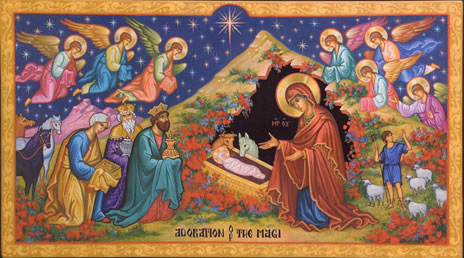
So, we have done one week of the Nativity Fast. This is my first time observing the Nativity Fast. This time last year I was still wrestling with Orthodoxy, though I was very near conceding. I don’t remember the date, but I think it was sometime about this time of year when I, like Jacob the Patriarch, clung to the leg of the Lord, begging His blessing. In other words, I stopped trying to figure out the Church, and began to trust and believe in the Church as the Spirit-led Bride of Christ. Not surprising, it wasn’t long after that point that I began to realize that as the Resurrection is the center of our hope, the Incarnation is at the center of Orthodox theology, which is also its spirituality.
The theology of the Eastern Orthodox Church is not simply a set of concepts, theories and principles about God that are dry and systematized. Theology is the life of the Church, its very experience of God Himself. This experiencing of God Himself is made possible by the Incarnation. This experience is often called “mysticism” or described as “mystical” and has various otherworldly adjectives attached to it. But the Incarnation of Christ, His Nativity, show us that we experience God Himself in everyday life. In a 3-Lecture series given at St Barnabas Orthodox Church Hieromonk Irenei Steenberg speaks about Eastern Orthodoxy and Mysticism. I hope you will listen to it. His points are very good. I want to share some of what he did in his lecture that applies to Nativity.
We tend to think of the mystical experience as being only one that can be found in solitude, or at least it is one that is outside the realm of everyday life; a kind of phenomenon that would sound like an “Encounter of the Fourth Kind.” I know I have been (I suppose I continue to be to an extent) guilty of this belief. But precisely because Christ came in the flesh and lived an ordinary life in which people encountered Him, we can experience the Living God in our regular life. We don’t have to walk around with our heads around in the clouds to do it either. The Scriptures are far more practical then they are esoteric. Love God, love your neighbor as yourself, give to those who ask, forgive. Simple. While I have heard of great monastic Saints having extraordinary experiences that were what we would call “supernatural”, mostly they encounter God in their daily tasks, surroundings and neighbor.
As a non-monastic Christian I can experience the living Christ in my life now, though maybe by a different path than a ascetic monk. We have a different setting for our life in Christ, but our goal is the same. Both the parish Christian, and the monk (or nun) have a vital role to play in the life of the Church, that allows them to experience God. I find this encouraging. For I have thought of monks as the supermen of our faith, which may be true, but little ol’ me can have a role to play in the life of the Church too. All because He is come in the flesh.
Also, on the note of anticipating the feast of Nativity, I find the spirit of this fast much lighter. When I can’t eat meat or dairy, I can eat fish! It’s like setting up the Christmas tree and decorating the house for Christmas; you may not get to open the presence yet, but there is a joyful anticipation. Instead of dreading the season of consumerism and shopping stress, I find myself thinking about which charities I want to give an extra gift to, how I can teach my girls about “giving to Jesus” by giving to the poor, and having an overall sense that this season is about the coming of the One who makes Christianity what it is. Yes, I have always had that understanding that Christmas is about Christ, but I love how the disciplines of the Church set you up to engage that understanding in tangible ways. Prayer and fast but a part of that preparation.
Lastly I am anticipating the midnight vigil service with my girls. I have Christmas Eve off this year, and will be able to attend the midnight service with my older two girls. They had such a great time at Pascha, that when I told them there is a service coming up for Nativity, they were excited. The fact that they are excited makes me excited. I have not been to Nativity Vigil before, as I had to work last year, so I am very eager to experience it. With the fast being a bit lighter than Lent, I am not anticipating the experience will be the same intensity (you have to admit Pascha Holy Week is the most intense thing ever experienced in a Church, other than I suppose one’s baptism, chrismation and first reception of the eucharist), but I am sure it will be wonderful.
So this post finds us one week into the fast, and one week closer to the Nativity we anticipate. May we great those around us this season with the words “Christ is Born! Glorify Him!”
Two Understandings Of Christianity

Today I read an excellent transcription of a lecture given by Fr Alexander Men, titled Two Understandings Of Christianity. I encourage you to read the lecture. The first half is a bit tough, but the last several paragraphs are the real meat of it. Give feedback on the lecture, and this post as you can.
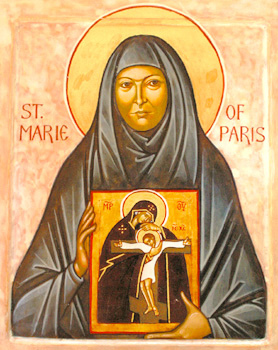
In the lecture he contrasts the two traditions within the Church: namely hospitality and asceticism. The two images on this post reflect these traditions. On the left is St Maria of Paris. Her story is quite extraordinary. She is a great modern example of the love of Christ shown through service toward others. On the right is the image of an Ascetic Monk.
Fr Alexander points out that the earliest centuries of the Church she was engaged in meeting the social needs of people, as well as the care for their souls. As time went on, and some chose the life of asceticism (simply meaning to reject a life of pleasures in order to more fully commune with and contemplate God in prayer) more and more this way of life was believed to be superior to the first. In fact, social justice, hospitality and the like were sidelined and became the realm of “the secular”. As such, there have come to be great divisions in the Church. Not only this, but Christianity as a whole has been relegated to the fringe, as “secular” society has been left with the task of meeting the needs of people, while the Church shrinks away into itself. This Fr Alexander laments.
What he calls for is a return to unifying these two understandings of our faith. The Scriptures make a case for both ways of life. They are held in tension, but are never mutually exclusive. Fr Alexander even shares his vision for a balance between the hospitality of the Church, her care for souls, and the ascetic life. He goes so far as to say that the divisions have forced us to see that they came about as a result of mistaken notions, and though an evil to be repented of, may be the strengthening of the Church in the end, if she will unify.
The Orthodox Church has within her life (the life in Christ) the things necessary to answer the “secular vs sacred” question, for she sees nothing as secular. Everything has the potential to be spiritual, except sin. What the Church has to recapture is the desire for unity as Christ prayed for in John 17. Not only unity with the Orthodox Church herself, but reunion with the Roman Catholics and the Protestants, as each has something good to bring to the table. I am not speaking of compromising doctrine in the name of unity, I speak of unity in Truth.
The world is desperate for the Living God, but does not see Him within the Church. To be sure, He is here in His Church. People’s vision of Him tends to be obscured by people. The Orthodox Church truly is the “fullness of Faith”; we need to live that! Our Life in Christ is one of prayer, sacrament, and love. As such it should produce in us a spirit that cannot help but touch the world, in it’s needs. Praise God for organizations like IOCC, OCMC and FOCUS who live the Gospel to its fullest by bringing it to others. The Orthodox Church in Albania is another shining example of how all of life is under the umbrella of “sacred”, and the Church is grow miraculously.
My prayer is that we will have to courage to work for the unity that will be for the life of the world, bringing all things under Christ, as Paul prayed for in his letter to the Ephesians. I obviously do not have all the answers. One thing is certain: I can pray, receive the sacraments of the Church, not judge my brother, love others as myself and share that with those around me. As Fr Stephen Freeman shared with me in a reply; these are exciting times we live in, though they are distressing as well. If the Church can make it out of the fourth century, then were can make it through these days we live in. We have great potential in the 21st century, and while things seem doubtful, they are in fact more hopeful than they have been for centuries.
I hope his words prove true.
Liturgy For St Matthew The Evangelist
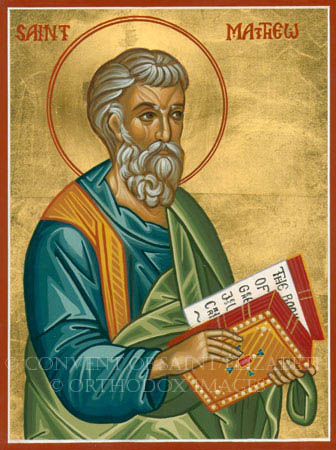 I woke this morning at 4am, unexpectedly brought to by some disturbing dreams. I stood before my prayer corner and said some prayers, then laid back down. I would need to be up in an hour, for my parish serves a 6am liturgy in the middle of the week. As today is the commemoration of the Apostle and Evangelist Matthew, this is the day of the week it fell on. So today I had some firsts. I was up early, which means I didn’t hit the snooze (also a first). I started my prayers for preparation to receive Communion (A discipline I am beginning now) early. In order to not make myself late for the service, I decided to complete the prayers at the Church. Upon arriving, I was early (You guessed it. Another first). Those of you with kids can appreciate this rare treat. I was also the only one in the nave. The priest was in the Sanctuary, preparing for the service. Complete silence for me to finish my prayers in the house of the Lord! It was great.
Just as I was finishing my prayers and beginning to gaze at the icons around me, trying to focus my usually wandering mind, the reader came in. And so began the service. For a few minutes, I was wondering if it was going to just be the priest and I, but being as I am only a catechumen, this could not be possible. By the way, I have no problem with that at all.
So it was my priest, my friend the reader and myself. I decided to grab a service book for a change (normally this parish does not use them, chanting, singing and praying the service by memory at the leading of the choir). I was up front near the reader stand and the gate of the Sanctuary. I wasn’t anticipating it, but I made a kind of connection in the service that I have not made previously. I was thinking about the meaning of the words to the hymns, antiphons and ektenias. When I was not singing, I read along with the silent prayers of the priest. I looked over at the candles I lit at the beginning of the service for my family, and loved ones past-on periodically, and remembered that I was carrying them in my heart before the Lord in the service. The reader had to take off for work immediately following the dismissal, and so I prayed the post-communion prayers out of the pocket prayerbook. It struck me as a foretaste of what I will get to participate in when I am finally received in to the Church. It made me long all the more or that day. Even more than that, I wish to someday enjoy that participation as a family.
But even after having sung that I would “lay aside all earthly care”, and asking Christ to grant this day to “be without sin and blameless” I found myself almost immediately falling short. I think I fell into the routine of life before I even ate breakfast. Get back home, get the girls out the door to school, finish feeding the baby… it all seems to flood in so fast. Thankfully it’s not in the falling down that we live, but in the getting back up. As a fellow blogger and Orthodox Christian, Angela points out in her 40Day blog that we can pray as we do. All the things we sing, hear and participate in in the Divine Services can be lived out in every activity of life. The great discipline of the Jesus Prayer is that we can literally “pray without ceasing” as St Paul admonishes us in Scripture. So though I fall quickly, God picks me back up just as quickly.
Like we pray in the pre-communion prayers, our sins may be like an abyss, but God’s grace in unfathomably greater than all the abyss of our sins. Just like the Apostle did not stay at the sinful task of exacting taxes, but got up at the Lord’s bidding, so too we can walk away from that sin and run into the the mercy of the One who in the Lover of Mankind.
Apostle and Evangelist Matthew, intercede with the Son for us that God may grant us great mercy.
He’s Still On The Cross?
 This post was edited to correct a mistake I made on originally posting it. 11/16/10
When I was still attending Calvary Chapel (an Fundamentalist type church) I would often hear how wrong it was to portray Jesus as still on the cross, as found on crucifixes. The pastor would always say, “He is risen and no longer on the cross! They don’t get that. They are so focused on His suffering, they do not live the Resurrection life!” or something to that effect. We prided ourselves on being people who understood that Christ has risen, and will come again some day. We live in hope, while “those people” lived in legalism and despair, because “their Christ” is still on the cross.
Such an understanding is first arrogant, but also fails to understand a great many other things. Father Stephen Freeman has excellent teachings about the error of viewing the Cross as a past event, and the Second Coming as sometime in the future. You can access his blog via the blogroll under “Glory To God For All Things” or his podcasts on Ancient Faith Radio. Excellent reflections that will give you hours of stuff to meditate on, in just a few minutes.
In learning about the teachings of the Fathers, Traditions and prayers of the Church, my former Dispensational understanding of the Bible and eschatology has slowly been broken down, and washed away. In its place is growing the understanding of the Kingdom of Heaven as now. In its place is growing the true understanding of the divinity of Christ.
One of the hymns of the Church declares that while Christ was on the Cross, He was also in paradise with the thief, in heaven at the right hand of the Father, and harrowing Hades. Basically the hymn is declaring the omnipresence of Christ as God, even while He was incarnate. If you think about it, it makes sense. In Revelation we see that Christ appears at the end of all things as a “Lamb having been slain” (literally just slain), and yet He was crucified before the foundation of the world. There is something beyond our comprehension that is the mystery of the Cross. When we unite ourselves to Christ in baptism, we unite to all of Him. His Incarnation, His Crucifixion and His Resurrection. That union is eternal, even here in time (from our perspective).
Note: The above reference is not a hymn, it is one of the prayers said by the priest during the Divine Liturgy. After the Great Entrance (procession with the bread and wine/Gifts) and the Litany, the priest sets down the Gifts and prays silently, while the choir sings. This is the part of the prayer I referred to above: “In the Grave with the body, but in Hades with the soul, as God; in Paradise with the Thief, and on the Throne with the Father and the Spirit wast Thou, O Christ, filling all things, Thyself uncircumscribed.” Powerful!
So while I can say Christ “was” born, slain and resurrected from our linear vantage-point, in reality those things are not merely past events which we remember. They are present realities we live in Him. I have come to understand that limiting these events to our temporal, linear understanding falls miserably short of the reality that is our salvation.
When I am in the Divine Liturgy, I am beginning to understand that I am not attending a service of “remembering” the crucifixion of Christ, and definitely not “re-crucifying” Him. God Forbid! That is biblically unthinkable. When I stand in the Nave of the Church in the Divine Service, I am experiencing the actual Crucifixion, in a mystery. As St Symeon proclaims, “O Awesome wonder!” For this reason I have no problem seeing Jesus depicted on the cross.
Lastly, I have come to learn that Jesus was not some kind of cosmic scapegoat that suffered at the hands of the Father, taking our punishment. He did in fact suffer our penalty of Death, but it was not wrath that He suffered. That cross, while it was a shame, it was also an open victory over and throwing down of the enemies of God. The Crucifixion went far beyond suffering, as a thing to sorrow over. While we do sorrow for our sins, and at the thought of the Pure One of God dying on our behalf, we see the Cross of Christ as His victory over death. His resurrection is the ultimate culmination of that victory, but He triumphed on the Cross too. So for that reason also, I do not see a problem with having Christ depicted as on the Cross.
No, it is not a failure to understand the Resurrected Christ, it is the fullest understanding of Him. If I was so qualified (which I am not) and had all the space in the world to write, I could not begin to touch on the mystery of the cross. As I grow along this journey, I continue to find new joys and wonders that are the Orthodox Christian Faith. If anyone knows the actual hymn reference that I mentioned above about Christ omnipresence, please let me know what it is, and where I can find it. Thanks
Frodo and the Shire
 Maybe I’ve mentioned this topic before, but I would like to take a different direction with it…
In the final chapters of the Return of the King Frodo is still deeply and irrevocably scarred by his long journey to Mordor as the Ringbearer. As much as he loves the Shire (indeed he was very reluctant to leave to take the Ring to only Rivendell) he cannot find complete healing there ever again. After several years of periodic episodes of grave “illness”, Frodo decides to leave Middle Earth with Bilbo, Gandalf, Elrond and Galadriel, by way of the Grey Havens. The scene is very heart-wrenching when you realize that Sam is unaware until the very end that Frodo is leaving too. In the end Sam is able to accept that Frodo’s journey has left him too scarred to stay, that no matter how much he loves the Shire, Frodo cannot stay. No amount of time can bring healing to the depth of the wounds received along to the road that finally ended at Mount Doom. The least of Frodo’s scars is the missing ring-finger, bitten off by Gollum. We don’t ever find out whether or not Frodo found the healing he sought, but we receive a description of the shores of Valinor, and can only assume he found peace there.
As with just about every one of my Lord of the Rings/Hobbit analogies, only one aspect of this analogy has anything to do with what I am trying to share. So hopefully I will make sense.
Like Frodo, my journey has changed me forever. As I have stated in older posts, it was a journey that found me and compelled me onward with a sense of urgency. Along the way I was never scarred, wounded or anything of the sort. Mine was a journey of truth revealing itself to me in its fullest sense. Though I suppose it could be said that there were spiritual “perils” as my long-held beliefs were challenged and put to the test. While I have said it before, let me restate here, that just as the Quest had many points at which it could have failed completely, so too did I experience doctrinal and mental roadblocks that threatened to end my journey. All seemed lost and hopeless. Frodo and his friends scarcely made it to Rivendell, not to mention the perils of the road to Mount Doom and the final test that awaited him and Sam there. Seemingly miraculously Frodo and his friends always made it out alive. Gandalf even conquered death, so to speak. Every single roadblock I came across, God found just the right thing to dismantle it.
When people ask me about my decision to become Orthodox, they almost always say something about “all that ritual and stuff.” One of the things that I tell people that I can hang my hat on, so to speak, is the fact that this journey came looking for me. Not only that, but every time it seemed like I could go no further, I realized I could not just go back to Protestantism, and God showed me the way past whatever difficulty I came across. I know that this journey is in the hands of none other than God Himself.
When I say I could not go back to being a Protestant, it is not to say that it was a bad thing to have been one. I would never have known Christ had I never been a Protestant. I am grateful for my past, but I am all the more excited for the future. While I have come to change my understanding of many of the things I learned as a Protestant, the foundation was Christ, and it was Trinitarian. It had all the basics. What I am now entering is the fullness.
Once I knew that the journey was at the point of no return, and I had made the decision to surrender to the mystery of salvation as found in the Church, there was no life for me in the Shire any more. I could not live as a Protestant but ascent to the truths of the Orthodox Church, occasionally taking in a service, celebrating a feast or two throughout the year, or praying the prayers in private. As Met Kallistos tells it in his book The Inner Kingdom, the bishops are the teachers and protectors of the apostolic teaching and tradition. The Orthodox Christian lives in communion with the bishops. I don’t just want to be Orthodox, I must be Orthodox. Not just a few truths added to what I already believe, but a radical change in my way of life as a Christian. A whole life.
Unlike the leaving for Valinor, which would take Frodo forever away from his home, friends and family, I head to a metaphorical Valinor. To be sure I will no longer be a member of our Presbyterian Church, but will be a full member in the Antiochian Archdiocese. Not that I don’t have a great love for my friends at the Presbyterian Church, for I do very much. I, however, would be kidding myself if I did not make a full entry into the Church. Like I said, being as this is a metaphorical Valinor, I will still see all the people I love. I get to do what St Andrew did 2000 years ago, call my friends to “Come and see.”
Are you saved?
Saint Ignatius Brianchaninov on True Zeal
This is a post from Orthodox Christian on Blogspot. I thought it was so good, I’d share it.
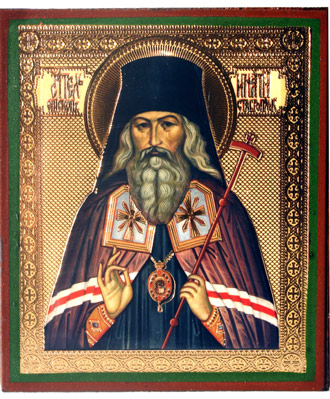
If you want to be a true, zealous son of the Orthodox Church, you can do so by the fulfilment of the commandments of the Gospel in regard to your neighbour. Do not dare to convict him. Do not dare to teach him. Do not dare to condemn or reproach him. To correct your neighbour in this way is not an act of faith, but of foolish zeal, self-opinion and pride. Saint Poemen the Great was asked, ‘What is faith?’ The great man replied that faith consists in remaining in humility and showing mercy; that is to say, in humbling oneself before one’s neighbours and forgiving them all discourtesies and offences, all their sins. As foolish zealots make out that faith is the prime cause of their zeal, let them know that true faith, and consequently also true zeal, must express themselves in humility regarding our neighbours and in mercy towards them. Let us
leave the work of judging and convicting people to those persons on whose shoulders is laid the duty of judging and ruling their brethren. ‘He who is moved by false zeal,’ says Saint Isaac the Syrian, ‘is suffering from a severe illness. O man, you who think to use your zeal against the infirmities of others, you have renounced the health of your own soul! You had better bestow your care on the healing of yourself, and if you want to heal the sick, know that the sick need nursing, rather than reprimand. But you, instead of helping others, cast yourself into the same painful illness. This zeal is not counted among men as a form of wisdom, but is one of the diseases of the soul, and as a sign of narrow-mindedness and extreme arrogance. The beginning of divine wisdom is quietness and meekness, which is the basic state of mind proper to great and strong souls and which bears human weaknesses. Ye that are strong ought to bear the infirmities of the weak (Rom. 15:1), says Scripture. And again: Restore a sinner in the spirit of meekness and gentleness (see Gal.6:1). The Apostle counts peace and patience (Gal. 5:22) among the fruits of the Holy Spirit.
Beorn
 Of all the characters in the Hobbit, my favorite side-character is Beorn. Does it get any better than being a giant man that has a ranch full of animal servants, and getting to turn into a giant bear? He does make me a little nervous though. You’re never quite sure whether he’s your friend or not. Gandalf and the dwarves seem to have gotten lucky (very lucky) to have received the help they did. But I have to say that the chapter of the Hobbit that introduces us to Beorn, his compound and the animals that live there, is one of my favorite parts of the story. It’s like an oasis of peace and security in a land of danger and chaos.
During my reading of The Hobbit to my girls, I started thinking about some of the not-so subtle nuances of Beron’s personality. Gandalf starts off by warning the dwarves that Beorn does not like guests, and they need to be on their best manners. Even if they are, they may not get more than chased off his doorstep. In fact, Gandalf has to tell the story of their journey in such a way as to trick him into showing their company hospitality. Once Bilbo, Gandalf and the dwarves are in his house, Beorn himself warns them not to go outside at night, because they are in danger if they do. After they leave with provisions and lent ponies, Bilbo notices that Beorn is following them, in the shape of a bear. When he asks Gandalf about it, he is told not to take notice. When Gandalf finally explains it, he tells the company that if they thought about crossing Beorn and keeping the ponies, he’d probably turn on them as a deadly enemy.
Sometimes I think this is the way we see God. He doesn’t really like people to bug Him for stuff. If we are lucky or clever, we might talk Him into helping us, against His better judgement. Even if we do get on the inside, we are in peril if we step outside. Not only all that, but He is watching us all the time; if we keep our end of a bargain we are safe, but try to pull one over on God, and He is now our enemy; woe to us!
Now, I don’t think there are many that really think God hates them, but with an understanding of God and His Wrath against sin, we tend to think His wrath extends to us ourselves. Even though I know God sent His Son into the world out of love, I have tended to feel that God really despised me when I fell into sin. I have to admit that I have had trouble reconciling God’s wrath against sin, and His love for me through Christ. Was Christ like Gandalf, who “tricks” God into forgiving me? Would God pounce on me if I dared to not keep my word? Over the years I have come to learn the difference between God’s chastening and God’s wrath, but there are times when I still wonder. Maybe I just play head-games with myself…
Like many things I have learned from the Orthodox Church, I have learned about the kindness of God. Not that God is perceived as unkind to Protestants. What I am saying is that the things I have learned from the Church have really helped to solidify my understanding of the love of God for mankind.
The prayers of the Church contain all her doctrine and dogma. In the prayers we call God the Lover of mankind, man befriending God, merciful, gracious, good and kind. We contrast our great sinfulness by praising God for His great mercy. We acknowledge our utter unworthiness, but glorify Him for counting us and making us worthy. In the prayers of preparation for receiving the Eucharist we declare that we are overcome by our sin, but God in His kindness makes us worthy to partake of the most holy mystery, and purifies us from within.
While I have never been made more aware of the depths to which sin and hypocrisy dragged me down in the prayers of the Church, I have never been to the heights of glory in the grace and love of God for me and all mankind, as found in the prayers, hymns and canons of the Church. In the movie Ostrov, Father Anatoly goes to his solitary island to beg and weep for God’s mercy, because he believes he killed his skipper back in 1942. He is plagued by this for more than 30 years. For all this agony he tells a young boy who is brought in by his mother to have his hip healed, “Pray to God and ask him to heal your leg. He will hear you, He is Kind.”
What a paradox this is. Great grief at our own sin, but great relief at he boundless grace and mercy of God.
Of Course the Holy Scriptures are full of this kind of paradox. In the Old Testament we seem to have God telling Israel that He will destroy them if they sin, that even their righteous is called filthy rags. Yet the Prophet Jeremiah, who also predicts great suffering and destruction at the hands of the Babylonians, speaks of God having a plan for the good of Israel, and not for their destruction (Jeremiah 29:11). In the New Testament, Christ Himself judges no one, and shows kindness to all, yet calls the leaders of Israel whitewashed tombs that are full of death. He tells Peter that the Heavenly Father revealed His identity to him, but in a moment is called Satan. Paul tells us of the super-abounding grace of God towards us, but tells that we need to be holy, because of the “terror of the Lord.”
One thing that I learned when I first began to learn about the theology of the Orthodox Church is that all the paradoxes in Scripture are interpreted in the light of God’s grace and kindness, never in the light of judgement. And so I come to God in prayer, knowing that He forgives all my sins, that He shares His very life with me, and transforms me into the very image of His Son. So even in the deepest grief over sin, we can come to the Throne of Grace, knowing that He is good, and the lover of mankind.
Lord Have Mercy…
 This is a blog about my journey from Protestantism to the Eastern Orthodox Church, and reflections of have as an Orthodox Christian. Not very original, but I am hoping to sort out some of what I have learned and share my journey with others. I hope this will help explain some things for my friends and family. I also hope this may help someone who is not yet my friend, that I have not yet met.


 Jeremiah Was A Bullfrog... Now He's Eastern Orthodox?

