This Blog Is For Sharing & Participation
I welcome all and any comments, feedback, suggestions, etc.
Galadriel
 Well, I’m sure you can guess where I’m gonna go with this one. In thinking over the topic for this post, the closest comparison I could think of from the Tolkien world is Galadriel. My topic for this post is The Virgin Mary, the Theotokos (God-Bearer), as I have learned of and encountered thus far in my journey. Even as I’m typing this, a couple comparisons are coming to mind.
Galadriel is, of course, the Immortal elven queen of Lothlorien. She holds a very special place of honor among the elves of Middle Earth, but is never the object of their worship. She is also surrounded in a bit of mystery to the outside world. I think it would be safe to say that those outside of the elven race are even fearful and suspicious of her, based on false rumors and legends.
Having said that, anyone who has read the Silmarillion knows that Galadriel was a part of the initial rebellion of the elves that landed them in Middle Earth, unable to return home to Valinor. In that light, Mary is an antithesis of the Galadriel character, the way she is seen as a kind of anti-type to the rebellion of Eve, with her submission to God in accepting the Annunciation from Gabriel.
Like most Protestants, one of my big hang ups was the veneration of Mary. Listening to the podcasts of Journeys to Orthodoxy, I got the picture that Mary is a pretty big deal. It wasn’t until I stepped into an Orthodox Church and heard a few prayers and hymns addressed to her, that I saw how big. She was, well… an even bigger deal than Galadriel to the elves. As I read the service book with the congregation, I stopped when I realized these were prayers to Mary. I resumed again when they were address to one of the Holy Trinity. It made me cringe inside. I said within myself, “I don’t REALLY have to believe this stuff about Mary do I? Ever Virgin? Ever Blessed? The Mother of our God? More honorable then the cherubim… We magnify Thee?” The answer was yes. The place of Mary in salvation history is a dogma of the Orthodox Church.
I am in no way qualified to give any kind of apologetic on Mary and the teachings of the Orthodox Church about her (not that you needed me to tell you that). This is obviously not going to be any kind of treatise, I am simply going to share some of what I have learned and what I have experienced.
I had this idea that Orthodox put Mary up on such a high pedestal, that she became something like a fourth person of the Godhead. Nothing can be farther from the truth. She does have a very prominent place in Orthodox spirituality, but is definitely human. She was by no means “just a vessel”, but was a person in need of a Savior, like all of us.
One of the things I used to argue was that Mary is never really exalted in Scripture (back in my Sola Scriptura days). A careful reading of Luke Chapter 1 shows that she was indeed special. I won’t pretend to be able to give a satisfactory explanation of the texts, but I encourage you who may have never considered this before, read the Annunciation by Gabriel the Archangel, the Prophecy of Elizabeth, as well as Mary’s Magnificat that follows. After that, read John Chapter 1, in which the Apostle tells us that the infant conceived in Mary’s womb of the Holy Spirit is none other than the Creator Himself, the Divine Logos of God. I have come to realize, if I can grasp the reality of the Incarnation, I walk away with Mary being pretty special. Actually, that is really the point. The Incarnation. I always had an idea that even though the Incarnation was “special”, the real deal was what happened during Pascha (Easter). Maybe that’s why I was off in my understanding of Mary. I have since come to see, in a slightly clearer way, the enormity of the Creator of the Universe becoming a human… and that (“He” I should say) is why Mary is so special.
As far as the Traditions go, there are some non-canonical writings that were based on the Tradition. One such writing is the Protoevangelium of James. While this writing has a lot of things “less than accurate”, there is a lot that does come from the Tradition. This writing nearly stumbled me on my journey and caused me to turn away from Orthodoxy. A kind friend referred me to a great podcast by Fr Thomas Hopko that explains the whole thing very well. http://audio.ancientfaith.com/hopko/stt_2008-11-20.mp3. I will let him explain the whole thing. One thing I will say is that this writing basically tells about the life of Mary, from her conception onward. I think the podcast link is pretty awesome, Like I said, it kept me on then path…
Another great series of podcasts are found under “Our Life In Christ”. They have an eight part series called Encountering Mary. Theses guys explain in a lot of detail all the things you could want to know about the Orthodox veneration of Mary, as the Theotokos. When I was having a lot of difficulty internally, these podcasts helped out a lot. You can type the title of the podcast into the iTunes Store search and it comes up. If you don’t fancy iTunes, http://www.ancientfaith.com has it (for those who are unfamiliar with it).
At some point, I become comfortable with with the veneration of Mary (in general at least) and even the prayer, “It is truly meet to bless thee, O Theotokos, ever blessed, most pure and the Mother of our God. More honorable than the cherubim, more glorious beyond compare than the seraphim. Thou who without stain barest God the Word and art truly Theotokos, we magnify thee.” I got that Jesus is what makes a hymn/prayer like that even possible to say. Having said that, there were many times when a hymn, canon, etc had a phrase that would make me cringe when I heard it. The same was true for a lot of the statements made about the other Saints as well. I can’t remember any specific ones, off the top of my head, but that’s not the point. The point is, I thought some of the content was teetering dangerously close to blasphemy.
When I was a boy of about 10 or so, some dudes came walking up to me as I was washing the family car in our driveway. They were dressed in suits and had a briefcase. Very official looking. They said they were Jehovah’s Witnesses. I had no idea who Jehovah was, and why these guys were gonna tell me about why he was in court. (witness. court. See the connection?) My dad promptly came out and said something to the effect of, “No thanks, we’re Christians.” I thought, “What does that have to do with being a witness at a trial?” The painfully obvious fact was, we were no more Christians because we said we were, than I was an Oscar Meyer Wiener, for wishing I was one… but I digress. The point is, I was thoroughly confused, because I was completely unfamiliar with the subject I was confronted with. So now, here I was in an Orthodox Church. Jehovah needs witnesses at his trial, but too bad… I’m a Christian. Have a nice evening. I was more clueless than the Beverly Hill Billies.
I had purchased an icon of the Theotokos holding the infant Christ, along with a few others, for my prayer corner at home. It seemed a little awkward to pray in front of at first, but after a while I got the gist. Still, I had my doubts about some of the things I would hear in the prayers and hymns of the Church. Over the course I time though, I began to not only feel more comfortable with the hymns and prayers, but to understand them somewhat as well. The podcasts from the guys guys from Our Life In Christ were invaluable in helping me to this point.
The major changing point came one evening at a Little Compline service. It was a Friday even, which for us meant that the Akathist Hymn to the Theotokos was sung my the choir. Once again the inner cringe started to come over me. And then, I said the Jesus Prayer, and asked God to help me understand. I suddenly remember a OLIC podcast that talked about the language of wonder within the Orthodox Church. I also remember the thought, “It’s because of Jesus.” entering my head. While that thought was still being processed, something that I can only describe as being like a mental lightning bolt hit me. ” I think I get it!” I thought. I was suddenly washed over with a feeling of comfort. I couldn’t describe it at the moment it happened, but during Fr Patrick’s homily, it hit me what had happened during the Hymn. God’s peace.
I have come to realize that all the things spoken of about Mary, the Theotokos comes from wonder. Child-like wonder. Not a simpleton, a child. Trusting, at peace and joyful. There is a wonder at the majesty of who Christ is and what He has done, both in eternity and on earth. That wonder at Christ is passed on to those who emulate His life, even though they be sinful humans. It’s a wonder that doesn’t just say that God is everywhere present and fillest all things, it’s a wonder that believes it, REALLY believes it. This wonder is expressed very poetically. What I was listening to with an objectively critical mind, was meant to be heard with the ears of faith, and interpreted by a heart of love. Love for God, for His Saints and all His people. Especially the woman found worthy to bear Him in the womb. It’s like that statement, “Seeing isn’t believing, believing is seeing.” I won’t pretend like I don’t still have those moments when I question something I hear. I am able to stop and look at it through the lens of wonder a little more easily now.
I am still brand new, and have a long, long way to go. Compared to the length of the journey, I haven’t even taken the first step yet. Paul said we see through a glass darkly. I feel like maybe little more light is getting to me…
The Grey Havens
 I’m sure any of you who are fans of Tolkien’s books and saw the Lord Of The Rings movies, noticed that Gandalf’s description to Pippin of “the after-life” is taken right out of the scene at the end of the trilogy, when the boat carrying Frodo, Bilbo, Gandalf and company reaches the shores of Valinor. At first I thought it was kind of cheesy, but after thinking about it, I suppose the scene from the final chapter of Return of the King could be seen as a metaphor for death.
In my formerly held Evangelical Protestant faith I obviously believed that there is conscious life after death. Whether you ended up in heaven or not was determined in this life. Once you were dead, game over, destiny decided. If you were saved, good for you. If not, well… not so much. While I understood that God takes no pleasure in the death of the wicked (Ezekiel 18:32) I thought the outcome was pretty cut and dry. I was in denial at the time, but truth be told I had a kinda heartless point of view on the matter. I was never as blatantly calloused as those Seinfeld scenes: “Well, you wanna go get some coffee?” “Sure.” but you get the idea. In my mind, once a person was gone, that was it until we meet again (maybe), so there was nothing more to be done than remember the person occasionally.
You can imagine that I was a little surprised to learn that the Orthodox offer prayers for the dead. Really the proper Orthodox term is the departed, or those departed this life. At first, I thought this was a kind of crazy superstition or at worst, necromancy of some sort. I came to realize that the Orthodox take the prayer of John 17 to mean that the oneness in Christ includes those who have departed. Not only do we ask for the intercession of Saints that are in the presence of Christ, but we can pray for those who are departed. Not that we try to “communicate with the dead”, but simply acknowledge a real oneness in Christ through the Holy Spirit. It is also an understanding of the grace and mercy of God, that it is not limited to those in this life and therefore does not end with this life. We who “alive and remain” (1Thess 4:17) can pray for God’s mercy on those who have died. I am still very much learning this part of Orthodoxy, but I find the idea of appealing to the grace and mercy of our Lord on behalf of the departed very comforting.
I might have mentioned it before, but the first time I tried putting this into practice was on the side of a steep cliff, stuffing a body into a bag several hours after a fatal motorcycle crash. I did not know what the proper prayers for the dead are, but I felt a kind of inner compulsion to pray over this unknown individual. I made the sign of the cross, asked Christ to grant him rest in His kingdom, and asked the Theotokos to pray for Christ’s mercy for this person. Strangely it did not feel as awkward as did veneration, the first few dozen times I did it. It actually felt quite natural and comforting.
Since that time I have prayed for several people that I have seen on calls. I will discretely make the sign of the Cross and pray, “Lord, have mercy.” under my breath. I try to avoid anything conspicuous since I am there in an official capacity for an emergency, representing the fire department. When I get back to the station, I try to take a few minutes to pray the Prayer For The Dead before my portable prayer corner I keep near my bed.
In fact, this post was prompted by two deaths in as many days on the shift I am currently working. First was a young man in his 20’s who crashed a motorcycle on a mountain road, then went about 70′ over the side. His friends had tried to do CPR for several minutes, but did not realize his injuries were too great. Tragically, he had survived 2 tours in Iraq only to die at home. Second was a 5 year old boy killed in a boat accident that should have never happened. The boy was probably dead instantly, but we give them the benefit of the doubt at that age. Not knowing anything about these two, I don’t know their standing in Christ. One thing I do know, Christ is merciful and the lover of mankind. So though I am faced with a real tragedy two days in a row, I can take comfort in the one who saves and has trampled down death by His death, ascended into heaven and (this being the feast day of Pentecost) has sent down the Comforter. So I can pray for the repose of these two, that Christ would grant them rest with all the saints.
When one of the parishioners from St Peter’s recently reposed, we did the third day prayers. It was my first experience of such an event. I was deeply moved for the parish, because they had lost someone close (I being a newcomer), but it was also moving to participate in those prayers. My work schedule did not allow me to make the funeral or 40th day prayers. I was pleasantly surprised to find out I will be given a full Orthodox burial, as a catechumen. (YESSSSSS!)
One other note I would like to share. I mentioned the death of my dad nearly 18 years ago, which was a preceded by years of trouble. I had come to hate my dad for the years shame I lived with. What I thought was an event long since dealt with, was something that kept building under the surface. For years I have periodically had very violent confrontations with my dad in my dreams. Since coming to this wonderful gift we have of praying for the departed, I have begun to light a candle for and pray for my dad on a nearly weekly basis. It hard to carry anger for someone that you pray for. I think of the prayer that says, “Lord, bless my enemies. Even I bless and do not curse them…” I feel a kind of ache in my heart as I say the prayers, but one of compassion, not anger.
So I stand forever changed by this practice of praying for the departed. I find that I allow the calls to touch me a little more. While this can be dangerous if mot handled carefully, I think allows me to show a little more compassion. Not only that, but I can pray with conviction. How can I do that if I keep my heart impenetrable? Thank God for this practical participation in the mystery of our salvation.
Mirkwood
 A big part of my journey into the Orthodox Christian Church have been podcasts. They not only introduced me to Orthodoxy, but have been a continued source of education, inspiration and growth in the faith. I have had a lot of my old beliefs blown away, many questions answered, had even more questions come up and have had 2000 years of Christian history opened up to me. I have found that the ancient beliefs of the Church are not some rigid “cage” to be escaped, but a living framework upon which the body grows and lives. I haven’t even listened to a quarter of the podcasts on Orthodoxy that are out there, but the ones I have heard have deeply enriched my life.
To me, the scene in Mirkwood when Bilbo climbs up the tree and sees above the canopy of the forest for the first time, reminds me of how these podcasts first struck me. When Bilbo breaks through, he is able to see a world of beauty, where before he was groping in the dark of the forest, unaware that such beauty was just above his head. I felt like I was groping around in the dark of this world, when I heard of the Orthodox Church, I learned that God was “everywhere present and filling all things”. As such I have become aware of a world I never knew existed. I thought I did, but I really just groped and hoped, so to speak. The podcasts are like a glimpse into that world I never knew was right there.
Don’t misunderstand me, I don’t mean that I have become aware of a reality “Up there” that I can cling to “down here”. It’s more like when Elisha prays that his servant would have his eyes opened to see the heavenly host around them.
I would like to share the podcasts with you, along with their general content and how they have effected me, or what have learned from them. I already mentioned couple of them in earlier posts, but I will include them here, as I only gave them a minor mention.
The first podcast is Journeys To Orthodoxy. This podcast is a series of interviews with people that have come into the Orthodox Church from various backgrounds. I mentioned this one a few posts back. These interviews changed my life by introducing me to Orthodoxy. I originally found them on iTunes, but they have since been taken off. They can be found on the Icon New Media Network website. There are a lot of other good podcast series on that website as well.
The next one I found was Glory To God. This is the podcast version of the blog by Father Stephen Freeman called Glory To God For All Things. They are 5 to 15 minute reflections on the Orthodox Faith. His first several podcast were his thoughts on the two-story universe versus a one-story universe. The idea is that most of Christianity views God as “up there” while we live “down here” (two-story), whereas the Orthodox believe God to be “everywhere present and filling all things” (one-story). I have found Fr Stephens reflections to be very profound and always challenge the way I have viewed things in the past, or the way I have done things. The nice thing is, they are not too long, but packed full of depth.
I think the next one I found was Beyond The Veil by Presvytera Jeannie Constantinou. She is a professor at University of San Diego who teaches a overview course on the Bible. She did her Doctoral Dissertation on the Book of Revelation and translated the first commentary on it by Andrew of Caesurae. This podcast is a study of Revelation from an Orthodox perspective. She completely dismantles the Dispensational view of the Rapture in the first couple podcasts, but switches gears into teaching the general patristic understanding of that book. There are only a dozen podcasts so far and they are slow coming, as she has a pretty busy schedule and another podcast she does. This podcast is on Icon New Media Network. As a former Evangelical, the book of Revelation dominated all other books of the Bible in their importance. Anything that hinted of Amillennialism was suspect. I have come to realize that my former view was attached to another heresy centuries earlier, and that the Church Fathers never interpreted Revelation in a strictly literal fashion.
About the same time I found another one by Presvytera Jeannie on Ancient Faith Radio, called Search The Scriptures. This is a podcast version of the University class she teaches on Introduction to the Bible. It is an overview that covers the Bible and Tradition, translation, canon development, interpretation, etc. The first couple dozen are very in depth, and are about an hour long. She does a study of the Trials of Christ by the Jews, then the Romans. Very fascinating stuff. The podcasts that are overviews of the individual books of the Bible are a mix of patristic (Church Fathers) interpretation and scholarly understanding. All of it is from an Orthodox perspective. This podcast had a huge influence in showing me that the Orthodox Church was not a bunch of superstition and empty ritual, but had an intelligent approach to the Scriptures, as well as a sacramental one. I also learned that the Bible and Tradition are not mutually exclusive, but rather the Bible is a written form of some of the early traditions. Very eye-opening. I had the pleasure of corresponding with Presvytera Jeannie by email. She answered a lot of questions for me, and helped clear up a lot of issues. I have also had the pleasure of attending Liturgy one Sunday, at the parish her husband is the pastor of, in Temecula, CA. It was nice to meet someone face to face, who was shaping my understanding of Orthodoxy.
My friend Shawn Wallace turned me on to a podcast called Speaking The Truth In Love by Fr Thomas Hopko. This is a series of topics and reflections by a retired Orthodox priest and for professor and dean of St Vladamir’s Orthodox Seminary. As my friend Shawn aptly pointed out, “He knows some stuff.” A lot of his podcasts cover the Church Calender. By which I mean he covers a topic, or series of topics, depending on what part of the Church year it is. Some are instructional topics, and others address issues within Orthodoxy that he believes need to change. One of the best (in my opinion) is a series done from Albania. He talked to the Patriarch who went there in 1992, after the communist government once again allowed Christianity to be legal once again (all religions were illegal, actually). Then he talked to missionaries, seminary students and lay-workers. I was excited to hear that Orthodox Christianity has such a great work going on in Albania. One of the main things that helped me past a rocky point was his teaching on the Protoevangelium of James. Someone put a question to me that nearly stumbled me on my journey. An acquaintance pointed me to it when I was wondering if the Orthodox Church bought the account of the protoevangelium as Scripture. Fr Thomas helped me tremendously. It was a stumbling block God used him to help remove from my path.
I found Our Life In Christ and checked it out on a whim. Steve Robinson and Bill Gould are a couple of laymen (I think Steve is a Deacon now) who came out of Evangelicalism to the Orthodox Faith, and had a heart to teach God’s Word. Steve was formerly a pastor, and found radio to be an avenue for his gift to be used. A lot of these podcasts are digitized versions of actual radio broadcasts on a Protestant radio station in the Phoenix, AZ area. They cover a lot of topics, but mostly the basics of the Orthodox Faith. They get very in depth and sometimes take a long time to finish a topic. Actually, this podcast is archived, as they hove not put out a new one in about 18 months. I found this podcast series to be one of the most instructional in my new journey. I would listen to these guys for hours on the way from home to Monterey and back. One of the things that made the biggest impression on me was when they mentioned a monastic teaching that says zeal is not necessarily a godly thing, and may actually be nothing more than the sin of pride. This subject made me seriously examine myself as I sought to enter the Church and take a good hard look at my heart and motives. This really helped me ask for and to seek humility as a catechumen in the Orthodox Church.
About this same time I found one called The Intersection of East and West by Deacon Michael Hyatt, who is also President of Thomas Nelson Publishing. It is a bible study done at his home parish in Nashville, TN. I find it fascinating and encouraging that so many in prominent Protestant circles find their way into Orthodoxy. The most helpful series of lectures have been on the 7 Ecumenical Councils, and the study on For The Life Of The World by Fr Alexander Schmemman. The format is very reminiscent of a Protestant Church Bible Study. But overall, very good.
One of my favorites is The Illumined Heart with Kevin Allen of St Barnabas Church in Irvine, CA. These are mainly interviews of people who have come into Orthodoxy, much like Journeys, only a bit shorter. The very first interview I was able to listen to was a priest named A. James Bernstein. He was raised Jewish, became Christian, helped found Jews For Jesus, then became Orthodox. What I found so intriguing was that he had come from Judaism. As a person with some ethnic Jewish background, I wondered about if there were really any ancient Jewish roots within the Orthodox Church. After listening to Fr James, I knew that the Orthodox claims to Apostolic Tradition must be true. There were many other interviews that impacted my journey, but Fr James’ has been the most profound for me. I bought Fr James’s book Surprised By Christ and read it. It is an excellent read and I recommend it to anyone considering the Orthodox Church, especially a Jewish person, or Evangelical Protestant of a pro-Israel persuasion.
Next are the two series by Fr Andrew Steven Damick: Orthodoxy and Heterodoxy & Roads From Emmaus. The first is a sort of comparative religions study, comparing all in contrast to Orthodoxy. I found the roots of Protestantism in the US to be most fascinating. I have come to understand my upbringing a lot better. The second covers various topics. They seem to both be in the format of a lecture series, and/or a bible study at the parish. They don;t have a lot of podcasts yet, but I look forward to Fr Andrew’s teaching every time the podcast renews.
The Path and The Saint of the Day are both excellent resources. The Path is the daiey Lectionary reading of the Epistle and Gospel readings, with a patristic commentary. It is nice to both hear the Word and read it daily. Saint of the Day simply reads an excerpt from the daily commemoration of the saint remembered by the Church on that given day of the year. Very good to learn the lives of those who have gone on and conquered before us.
There are so many other great podcsts that I have not been able to check out so far. Most can be accessed on the iTunes store under Ancient Faith Radio, Icon New Media Network, or Orthodox Christian Network. I hope these few are a blessing to some of you, as they have been to me. I also hope that you find many more.
Additionally, I wanted to say that the videos on the right, listed as “Our Journey Home” parts 1, 2 & 3 are the conversion stories of my parish priest and his wife. Check them out. They are fascinating. He is a very pastoral and kind priest. I really appreciate his ministry within our parish.
Recovering The Ancient Paths by Dennis L. Carrigan
I copied this article from a great new website called: Journey To Orthodoxy, which link is at the end of this article. The content and intent of the letter is listed below, but I wanted to share this because it is the parish I currently attend. It is a pretty amazing story, and one I hope blesses you.
“Jesus Christ the same yesterday, today and forever”
The following is a revision of a letter (article) we wrote to the International Church of the Foursquare Gospel to explain our decision to withdraw from that organization in order to pursue our being catechized unto Chrismation into the Orthodox Church. We have revised it to make it more useful for a more general distribution by members of our congregation who may want to help in explaining our decision to families and friends.
The Carpenter’s Company is in the process of becoming a part of the Orthodox Church. This obviously means that we have had to withdraw from the International Church of the Foursquare Gospel which we did in early May, 1996. All this is actually the culmination of a journey which began for us in 1987 when the Holy Spirit commanded us to ask for the
“ancient paths” (Jeremiah 6:16).
A Journey Begins
Our quest for the ancient paths did not actually get underway until June 17, 1989 when we began to meet every morning at six o’clock for prayer. We soon called it Vigil, the name given to the night office of prayer for over fifteen hundred years. We could not possibly have anticipated where this path would eventually lead us. Nor could we have foreseen that Vigil would last so long or become what it has.
When we began Vigil, the Lord’s Prayer was our prayer outline. About a month later, the Holy Spirit led us to begin to celebrate the Eucharist. Later worship was added. And as this process continued, now adding a certain element, now eliminating another, Vigil gradually became a different kind of meeting. Although its form was changing, one thing remained constant: the meeting began on its first day and has continued to the present with a strong, abiding, palpable sense of the Lord’s presence concerning which every visitor has remarked. However, the longer we maintained our daily Vigil, the further our path diverged from the path we had once traveled with Foursquare. Although we recognized we were becoming somewhat unique among Foursquare churches, we have always been confident that our conduct was well within the boundaries of Foursquare’s tolerance for diversity. More recently, however, especially since our encounter with Orthodoxy, we’ve become aware that we have been straining those boundaries.
A Spiritual Focus
By the time two years had passed, we had become a people with an intense spiritual focus. I suppose that is to be expected of a people who meet every day for prayer. We were beginning to give focused attention to issues to which we had only given lip service before.
- We had all become faithful in maintaining a consistent, daily quiet time with the Lord. This was the first time that any of us had experienced consistent, long-term faithfulness in this regard.
- We had become the kind of community we had only dreamed of before. We were learning what it really means to be “the family of God” as a matter of daily, practical reality.
- Meeting daily as a prayer community meant that we could no longer tolerate in one another the “little” sins and acts of disobedience we’d learned to ignore when we used to meet weekly. Consequently we allowed the Holy Spirit to restore church discipline among us.
- We became a people who gave themselves to the discipline of Scripture memorization. We have memorized I John, Romans, John and are now memorizing Galatians.
A Liturgical Direction
Meeting every day also made impossible the kind of innovative creativity a weekly schedule allows. Consequently, our daily worship became patterned. To our amazement, however, the more we repeated the prayers and songs we were using, the more meaningful they became to us. The result was predictable: our daily Vigil gradually became liturgical.
Enter, The Church Fathers
In 1992 on a personal retreat at St. Andrew’s Abbey, a Benedictine Monastery, I bought a copy of The Rule of St. Benedict (sixth century). Upon returning home, the leadership team began to read it together. What we discovered astonished us: The Rule dealt with situations we were facing fight then, but for which we had found little if any help from contemporary authors.
In the Introduction and footnotes were references to many others of the Church Fathers, most of whom we had never heard of before. Finding and reading these Church Fathers, particularly the Apostolic, Desert and Monastic Fathers, has perhaps been our most significant discovery. Their writings, though ancient, were more relevant and immediately applicable to our experience than anything we had ever heard or read. As a church which was becoming spiritual in focus, we had found an ocean of resource.
The Carpenter’s Company had become a church whose emphases had become prayer, strong and joyful worship and a commitment to learn obedience to God’s Word. Rather than “fulfillment” and “being affirmed” we put much more stress on “putting to death the deeds of the flesh and its passions and desires,” a consistent theme of the early Church Fathers.
A Growing Discomfort Results
When we began keeping Vigil, people who heard about it seemed to be impressed and were very complimentary. Without exception, they would say “If you keep this up for a year, you are going to have revival!”
However, as we did continue, they began to question why we were apparently neglecting the programs one might find in most churches. We assured these detractors that not having these programs didn’t mean we had neglected any of the areas of need these program customarily addressed. On the contrary, we had begun to discover that these things were more effectually dealt with by the things we were doing. Nevertheless, by stressing the things we did, we found ourselves more and more at variance with the prevailing Evangelical and Charismatic/Pentecostal culture.
While we’ve been walking on this increasingly spiritual pathway, we began to observe one thing after another in what was our own Foursquare denomination that caused us growing concern: Although we noticed these things with regard to the denomination with which we were then affiliated, they were and are nonetheless true of most Evangelical groups as well. Five examples follow:
1. The “Painless” Emphasis: About a year before the L.E.A.D. Seminars (a program promoted by Dr. John Holland, the President of the Denomination, for the “enrichment” of Foursquare ministers) began, the ICFG circulated a survey on “Fulfillment in Ministry” among all Foursquare ministers in the United States. I was alarmed at its focus on academic achievement and management style and its almost total neglect of more directly spiritual/devotional matters. I wrote a letter to this effect to Dr. John Holland. He didn’t like the letter. It was “disappointment” to him, and he asked that we get together for lunch. We did. During our conversation, Dr. Holland said, “Dennis, we don’t want to cause our people pain when they come to church. They have enough pain in the world.”
I was stunned. After pondering Dr. Holland’s response for quite a while, I could no longer avoid concluding that Foursquare had embraced and now espoused the “feel-good doctrine” of the 90’s. Is not pain the result of our sin? Although confronting sin causes pain, will not such confrontation, in the long run, lead to a more godly and joyful life? Therefore, aren’t ministers supposed to cause pain by confronting sin? Didn’t Christ our God cause pain in His spiritual directive to the rich young ruler? Did not Paul cause pain in his letters to the Corinthians and the Galatians?
2. Self-Esteem: Although not Foursquare himself, Dr. James Dobson has most certainly had as significant influence on the thinking of the contemporary Foursquare denomination as he has had on any other Evangelical group. Several years ago he wrote that virtually every human problem could be solved if we could build high self-esteem in both ourselves and others.
According to Romans 6-8, our problems emerge out of our sinful, flesh nature, not out of our lack of self-esteem. Dr. Dobson’s opinion contradicts this. Yet nowhere in the Foursquare movement or Evangelicalism at large, to my knowledge, was a significant voice raised to oppose Dr. Dobson’s variance. On the contrary, as far as our pastoral counseling practices are concerned, most Evangelicals have embraced and adopted this teaching.
3. The Addiction Doctrine: At the L.E.A.D. Seminar two years ago Dr. Ted Roberts taught about “sexual addiction.” We have but to assume that became of his role as a L.E.A.D. instructor Foursquare thoroughly endorsed what he taught. According to the implications of what Dr. Roberts was teaching, sexual misconduct is to be considered a kind of disease to be dealt with therapeutically by some twelve-step type program.
Have we not missed Paul’s clear message in Romans 6:16 – “Do you not know that to whom you present yourselves slaves to obey, you are that one’s slaves whom you obey, whether of sin leading to death, or of obedience leading to righteousness?” What Ted Roberts and others call addiction, Paul calls slavery to s/n. Those who give themselves to sexual sin, become slaves of sexual sin. Freedom isn’t restored through therapy, but through confession and repentance. That is clearly not what Ted Roberts was teaching.
Compounding his error, Dr. Roberts said that King David was a “classic sexual addict.” Though challenged from the floor, he defended and maintained his position. His statement was blasphemous. David did sin sexually, once, with Bathsheba, but ultimately repented (Psalm 51 – the Psalm most often quoted in the New Testament). He has always been known as “a man after God’s own heart,” a type of Jesus’ Kingly Ministry and Jesus Himself was called “Son of David.” Calling David a “sexual addict” (pervert) reflects blasphemously on the Father who endorsed him and the Son who came in fulfillment of his type, and on David who turned from his sin.
4. Majoring on Theological Minors: At one of the panel discussions at last year’s Southwest District Pastors’ Conference, a recently appointed pastor asked whether children should be allowed to take Communion if they haven’t yet been baptized. I was aghast at our District Supervisor, John Watson’s answer. “It’s not an issue? he said, “If you make it an issue, you’ll end up pastoring a church of twenty people. Making those things an issue will narrow your base and we are about broadening our base.” John’s meaning was clear: such secondary, non-essential issues must not get in the way of making our churches as big as we can.
Since when is either Water-Baptism or Communion, a secondary, non-essential issue? Has not, rather, church size always been considered of secondary importance, at best, until the very recent Church Growth movement?
5. Capitulation to Feminism: The more recent turn taken by Foursquare Women International away from being an auxiliary missionary service organization to being focused on the “affirmation” of women in a role of leadership and ministry, we believe is a clear capitulation to the subtleties of the spirit of feminism which is abroad in our land, a surrender to the spirit of this present age. Certainly Foursquare is not alone in this drift. Other Evangelical and Charismatic groups are years ahead. Although the languages used are the various dialects of “Evangelese,” the elements of the Feminist Agenda are clearly in place. It doesn’t take a Ph.D. historian to recognize that in this regard Evangelicalism as a whole is embracing a not too latent or embryonic feminism today just as mainline Protestantism did just twenty years ago.
A Turning Point
It has been a source of no little concern for us that although we have remained deeply confident that what we have been doing has been right and pleasing to the Lord; nevertheless, the more we pursued our course, the more estranged we became from Foursquare in particular and from Evangelicalism in general.
Recently, two things brought all of this to a head: Last year, we sent Robin and one of the wives of our Church Council to the Foursquare Women International Conference in Dallas. They returned with a video. I was stunned at the wholesale endorsement that Foursquare leadership at that conference gave to the ‘Toronto Blessing,” a movement so spurious that even John Wimber has disclaimed and dissociated himself from it. Is our anxiety for renewal so undiscerning that while we strain the gnats or by-law infractions, we are willing to swallow a camel of such an obvious spiritual deception as the “Toronto Blessing?”
The second thing happened about the same time. One of our members picked up a copy of The Spiritual Life and How to Be Attuned to It1 by someone called Theophan the Recluse. He wrote exactly the same thing as the Church Fathers. So we were very surprised to learn that this man had lived in nineteenth century Russia.
We sent to the publisher and received a catalogue of many more writers from this tradition, all of whom wrote and taught like the Church Fathers. They were not only Russians, but Greeks, Syrians, Armenians, Arabs and Egyptians as well. Unbeknownst to us, we had discovered the spiritual writers of the Eastern Orthodox Church.
Orthodoxy?
After spending several months reading these writers we came across The Orthodox Study Bible published in 1995 by Thomas Nelson. It’s not unusual to find an obscure press publishing works like these. But a major publisher like Thomas Nelson publishing a special Bible for the Orthodox is something else. Who are, these Orthodox, anyway? Having this and several other questions, we wrote to Conciliar Press2, the people behind its publication, for answers and to open dialogue.
Five days later I received a call from Father Peter Gillquist. I knew Peter Gillquist as one of the regional directors of Campus Crusade for Christ who surrounded Bill Bright when I was on part-time staff in 1963. Now he is an Orthodox priest. Father Peter sent me a copy of his book Becoming Orthodox which tells the story about how he (and other regional directors of Campus Crusade I had known) discovered Orthodoxy and recounts their journey which resulted in their conversion to the Orthodox Church.
Although different in several of the particulars, our journeys were parallel. As we spoke further with Father Peter and read his and Jon Braun’s book, Divine Energy, we discovered that, although substantially different in liturgical form, the spirit and faith and doctrine that had developed among the Carpenter’s Company was in fact, Orthodox. As diverse from Foursquare as we had become, we had become like the Orthodox.
Our unanimous decision to become an Orthodox Church, therefore, is simply the logical conclusion of the decision we made in June, 1989. Although our pursuit of Orthodoxy is only less than five months old, we have been “becoming Orthodox” for the past seven years. We just didn’t know it until now. In finding Orthodoxy, we have found “the ancient path, where the good way is” (Jeremiah 6:16). Metropolitan Philip, a hierarch of the Orthodox Church has said that the Orthodox Church is the best kept secret in America. Our conviction is that we haven’t found just another church, we’ve found the Church, the one true Holy Catholic and Apostolic Church of history. In the words of a young man who recently found salvation through Orthodoxy:
… at last, I finally began to see how everything did fit together, how Truth was not “scattered in a thousand pieces,” but was preserved, intact and unchanging, in the One, Holy, Catholic, and Apostolic Church … I had finally, through all my searching, found the key, the ultimate source of Revealed Truth in pure, undistorted form. Something had always kept me looking for the “hardcore,” no-compromising Christianity, because I knew down inside that, if Jesus Christ is God, then Christianity had to be the most radical belief in the world. And it’s not surprising that the most hardcore, radical, all-or-nothing message I’ve ever heard comes not from anything “modern, new and revolutionary,” but from the “original thing” – the One Church, the only Church, the true Church the Orthodox Christian Church, the mystical Body of Christ.
Indeed, Jesus Christ is the same, yesterday, today and forever!
Read more: Recovering the Ancient Paths : Journey To Orthodoxy | The Orthodox Christian ‘Welcome Home’ Network
The Counsel Of Elrond: Part 2
 After my first Divine Liturgy, I attended the chrismation of my friend’s children, at an Eastern Catholic Church in San Diego, on the Feast of the Transfiguration. I was able to follow the flow of the service, which was nice, but I still had so many questions and reservations about the things I was seeing and hearing. For it only being my second Liturgy, it felt a lot more comfortable. Even having questions and reservations, I felt almost tormented with the truth I had been confronted with. I needed to find answers to the questions I had swimming around in my head. This stuff was keeping up at night, and the first thing that greeted my waking mind.
Another Sunday morning found me at a local parish for Liturgy. This was an Antiochian parish just up the street from my house. It mostly an arabic speaking service, so I had some difficulty following the liturgy. After the service, I wandered around inside the church looking at the icons, the layout and such. The deacon and his wife introduced themselves to me very warmly. I told them I was an inquirer, and this was my third liturgy. They quickly grabbed the priest and introduced us. His name was Fr George Ajalat. He was not the regular priest, but had come from the cathedral in Los Angeles to serve that Sunday. He graciously took the time to answer several questions that I had. Two things really struck me about that conversation. First was how kind and humble his answers were. I made sure that I wasn’t antagonistic, but even so, he was just a nice guy. Second was that the answers made sense. Not the way that I had encountered so many times before, where someone has to wrestle a scripture to say what they want it to say, just a simple appeal to Tradition and Scripture in conjunction with one another to answer my questions. And like I said before, it wasn’t even the answers themselves, as much as the kindness and grace that exuded from him. Although he did answer some questions…
He explained how the Saints, Mary and such are honored by virtue of Christ. What makes them “special” so to speak, is Christ’s life. In the case of the Saints it’s how their life reflected His. In the case of Mary it’s that she not only lived a virtuous life, but bore the Uncreated Son in her very body. Her place within the Church is based on her relationship to the Son. We can ask for their intercession to God on our behalf in the same way we can ask one another. It’s not a kind necromancy, but they being “In Christ” as we are, we can ask for their prayers. He also explained how the icons are representations of spiritual truth, and that we can use them because of Christ’s Incarnation. The veneration of the icons is not a worship of wood and paint, or even the person or truth depicted, but an honoring of Christ in them, and Christ in the Church. The kissing, he explained, is an ancient custom of showing respect still practiced in many cultures to this day. A lot of what he said went over my head at the time, but reflecting back on it, I can understand a lot more clearly now. I left with my head in a whirl from all the information, but also with a sense that I could move forward. Things were making a little more sense to me.
During Lent I had the chance to go down to the Antiochian Cathedral in Los Angeles, on Lazarus Saturday and see Fr George again. I had the chance to tell him I had become a catechumen and that our conversation was a big part of my journey continuing. I also had the opportunity to meet his wife, and get a personal tour of the cathedral.
A few Sunday’s after my encounter with Fr George, I went to another Antiochian Parish in San Dimas called St Peter the Apostle. I had found them during an internet search for Orthodox Churches in my area. I read that they were formerly an Assemblies of God Church that discovered the Orthodox Faith together as a church in 1996, much like the Evangelical Orthodox Church had done in the 1980’s. I thought it sounded interesting, so I checked it out. I decided to bring my two older girls with me. It was in an inconspicuous building, but the inside of the nave was beautiful. They had only chairs around the perimeter, which only a few older people were sitting in. The other parishes I had been to had pews or chairs in rows, but this was more like what I had read in the book “The Orthodox Church” by Timothy Ware. The thing I first noticed after the beauty of the nave, was that nobody had a Service Book. They were doing it from memory! And the whole congregation sang the hymns like they were an extension of the choir. It was quite amazing.
One of the conflicts in the background of this visit had to do with the schedule of services at the Presbyterian Church I attended, the schedule of the service at St Peter’s and the fact that I had the kids with me. I had thought I could attend the Liturgy at St Peter’s with the girls, then book out of there in time to get them to the second service for their kid’s stuff. The kids were pretty antsy due to the length of the service (we didn’t even make matins), but were pretty good by kid standards 😉 After the dismissal, I made for the door but was headed off by the priest’s wife. I was anxious to not disappoint my wife, but my Chatty Kathy side came out. I was also taken by the fact that my girls seemed to blend right in with everyone. My middle daughter is a social butterfly, but my oldest is a bit shy. Yet both of them were enjoying themselves like they were with old friends. After we left, the girls told me they really wanted to come back.
Needless to say, I was late for second service at the Presbyterian Church. So late, in fact, that I missed the whole service. Oops!
I felt like I had found what I was looking for. This parish had something on almost every day of the week. They also had a “Sunday School” for the kids. They also had an awesome spread of food after Liturgy! I wasn’t 100% sure at the time, but now I am fully convinced that I have found my Church home. I have gone from a curious inquirer, to a serious catechumen here in this parish. Not only has the discovery of Orthodoxy and joining this parish been a joy, but also seeing my girls participate with me has been a blessing as well. St Peter’s is not only an active parish, but a loving one too. While I recognize that the people of this parish have a history together that goes back for a couple decades or more, they have made me feel like part of the family. Not only myself, but my whole family. Even though my wife has no desire to become Orthodox, they have shown her love without condition.
I have not even really gotten on my way as an Orthodox Christian, but it has been an interesting journey so far. A lot of “small world” experiences along the way have made it even more interesting. Finding out people I had met, been friends with, or friends of friends, etc, were becoming, or had become Orthodox and even Roman Catholic. It has been surprising and encouraging to hear so many are finding the Apostolic Church founded by Christ.
Even though I have given the gist of how things have happened, I would like to also try and share some of what I have come to learn about Orthodox doctrines and dogma, or at least how I understand them.
Jesus And Healthcare
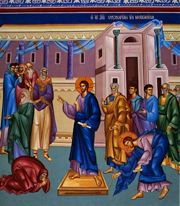
Jesus Forgives the Sinful Woman
This is a note I shared with a few people on facebook. I share it here, because it reflects a change I have made in my point of view on this issue as a result of Orthodoxy. It is also a response to several of my Protestant friends who express a view I believe to be inconsistent with the Scriptures and the Traditions of the Church. So here goes:
Let me say on the outset that this is NOT an endorsement of any political point of view, legislation or anything of the kind. Nor is it an assumption of what political view Jesus would have on the issue. This is a reflection based on what I believe the scriptures would have the attitudes of Christians (or maybe I should say those who claim to be Christian) to be towards others, as it relates to this issue.
To my non-christian friends, I again reiterate that this is not meant to be a political discussion, and is not directed towards you (though I respect every one of you and your opinions).
I have noticed a lot of talk about the new healthcare legislation has sparked a very passionate backlash among some of my Christian friends. And most of that backlash comes in the form of statements like, “Healthcare is not a right.” or, “These people are in their situations because of their own choices, and should have to pay the consequences.” and, “The government wants to take MY money to pay for THEM.”
In the not too distant past, I would have totally agreed and had “Scripture to back it up.” But I have begun to reevaluate my view on scripture in regards to this healthcare issue. Why? Because it comes down to three words: Mercy, Grace and Love. Before, I thought these were simply to be applied spiritually, but now I see that Mercy, Grace and Love are infinitely practical. Yes, they are spiritual, but if they are not lived out practically, then I am a liar (1 John).
I have begun to finally, really see myself as a wretched sinner (not that I hadn’t before now, but I think I’m finally grasping it) and I have no business judging my fellow human beings on this earth. Jesus has shown me mercy, given me His grace and Loved me when I was His enemy. How do I have the arrogance to deny that to another? All I can say for myself, as I come to this revelation, “Lord, have mercy.”
So when I hear my fellow Christians making statements like the ones above, I have to say something. Not in judgement, but in admonishment to be turn from our hard-hearted attitude.
I can see if we were saying we disagree based on the fact that we don’t think such a system would truly work, or even make things worse. I can see if we were opposed because a better idea is out there, and we just need to let more people know about it, and get the votes. But that’s not our beef. “They don’t have a RIGHT to healthcare.” “I shouldn’t have to foot the bill.” “It’s not government’s job.” I submit to you all that this is a merciless attitude and has NO place in the heart of a true Christian.
First: If “They” don’t have a right to healthcare, then do you? I challenge you to find any part of the Scripture that speaks of our rights. You definitely won’t find it in the New Testament. John the Baptist says “Him who has two cloaks, give one to him who has none.” Our Lord says, “To him who asks, give and do not deny anything.” and again, “Give, expecting nothing in return.” We are not asked to determine if the recipient is worthy, just give. We are told to have mercy, to give, not just for the benefit of others, but our own too. We are told in 1 Peter that all things are ours in Christ. As Christians, we possess everything, and nothing. So how can we hoard what we think is ours, and keep it from those who do not have? According to the Gospel and the Epistles, this is a sin.
Second: If people are only in bad circumstances because of their own choices, do you suppose yourself better than other people because you are not in that situation? I hope not. In fact, Fr Thomas Hopko points out that, given the same circumstances of life, we might have fared the same as anyone else. We might have been the Prodigal son, and not the righteous son, given the circumstances. As a matter of fact, the attitude of the “righteous” son is what I am getting at.
Last: We don’t want to pay for the bill. James tells us if we tell someone in need, “Be warm and be filled.” and do nothing, our faith is false. How can we, who have been GIVEN all by God, withhold anything from others? Even if that means higher taxes? We all pay taxes for Fire, Police and Emergency Medical Services, and yet almost never use it. We pay, and someone else uses it. Why aren’t we up in arms about that? Because WE benefit from it too. This shouldn’t be the concern of the Christian. Yes, we need to be wise and responsible with our finances, but generosity is never foolish, nor irresponsible. Selfishness, however, is.
I have had it argued that if the government takes the taxes, it negates our blessing through charity, which should be our prerogative, not theirs (the gub-ment). Whoever, however the money comes isn’t the point, nor is your “feeling good about giving”. It comes back to the attitude of our heart.
Allow me a little creative license for a moment to illustrate my point by changing the words of a popular parable of Christ:
Two people came into a church to pray. A well-dressed, middle-class working man, and a poor, recovering addict mother. The man prayed within himself, “I thank you Lord, that I am not as bad as some. I go to three services a week, I volunteer, I have a good job with benefits, pay my tithe and my taxes, and I don’t get involved in bad things, like that druggy over there.” The woman, with eyes full of tears, looking at the floor said, “Lord, forgive me, and don’t let my child get sick again. I can’t afford the medicines.”
Many of us would never presume to pray such a prayer, but it is secretly our attitude. A prayer during Lent in the Orthodox Church, which comes from the parable of the publican and the pharisee, reads something like this: “Lord, I have not been as righteous as the pharisee, and yet I boast. I have sinned worse than the publican, and yet I have not repented.” When I heard that prayer, I was rocked to my core. I think it illustrates our deepest attitudes, and our need for repentance.
My hope is that we all learn to show mercy to those in need, give grace, and love them. Not just because our salvation depends on it (show me your faith without works), but because we love the God who first loved us. Thank you for allowing me to reflect on this issue.
Lord have mercy on us all.

 I want to interrupt my flow to talk about what I learned and experienced during my first Lent and Pascha (2010). I think the image of the dark of Moria, transitioning into the “immortal” splendor of Lothlorien matches what I felt and experienced during this time of year. From beginning to end (especially the end) it was powerful. This season has actually changed my perspective on some things, and hopefully changed me for the better. Obviously this is just the beginning of what will be a lifetime of change.
Just as Frodo found himself in a violently abrupt plunge into the darkness of the mine, so I found the beginning of Lent to effect me almost immediately. I was struck by the sense of my own sinfulness. The first of the services I was able to attend was Great Compline. I remember walking into the church and it was dark and sombre. The censor of incense had no bells, and the vestments of the priest were of a deep, rich purple. The Tone of the prayers, the hymns, canons and litany were of a mournful sound to me. I had come excited about my first Lent, but was quickly taken by the solemn mood of the service. The only prayer that I really remember was a reference to the Publican and the Pharisee: “I have not had the righteousness of the pharisee, and yet I am proud. I have sinned worse than the publican, and yet I have not repented.” I suppose if that is all I could remember of the service, that’s more than enough. Those words were a blast from a shotgun to me. It was as if the Heavenly Physician had shown me a glimpse of what was inside me and said, “This is what I need to deal with.” Lent wasn’t just a Church season to be experienced, but was a purification to be gone through.
I had just been enrolled as a catechumen a few weeks prior, and had spoken to my priest about wanting to be purified and made ready for reception into the Church, not just given a bunch of information about being received into the Church. I realized that the Lenten season is a big part of that, with it’s prayers, hymns and services that are leading up to the crucifixion of our Great God and Saviour, with Whom we must be crucified. My introduction to it was powerful. I remember being overwhelmed by these feelings of mourning over my own sin, feeling the need of mercy and yet knowing I was not worthy to even think about asking (but I did). I remember asking myself now this overpowering sense of sinfulness was to be reconciled with the fact that Orthodoxy’s general view of mankind is far higher than the average Protestant (especially Calvinist). Father Stephen Freeman was gracious enough to answer the question by email. His answer helped me gain some perspective.
At the end of the next week I was able to find some reprieve. I went to the Little Compline with the Akathist to the Theotokos. I have a slight part of me that winces at the exalted language used in reference to the Virgin Mary. This time, however, I specifically told myself to remember the fact that all such exalted language points to the beauty, majesty and holiness of Jesus. As soon as I corrected myself, I remember beginning to find a solace and joy in the rest of the Akathist prayers. It was like a mini oasis in the Lenten season’s “desert” of repentance. It also helps that one of our women in the choir has the voice of an angel. It was then, and still is hard to describe the peace I had from that service. One of the other things I found to be powerful were the prostrations. It was quite an experience to bow my whole self, physically before God. Even my two older girls liked it.
As far as the fasting went, the only thing I really craved was ice cream, and hard-boiled eggs. I had a few jars of eggs that were pickling during that time. It got hard to wait at the end… but luckily I did. My wife was very supportive of my dietary changes. I do regret not being able to observe the “relational” fast better, but this is only my first Lent… One struggle that proved to be the most difficult, was balancing how many services to go to, but still be courteous to my wife, who is not Orthodox and give time to the family. We had many discussions about why I was attending so many services. I explained that this is part of Lent. Maybe I went a little too gung-ho. I’m sure I will learn moderation…
Palm Sunday, through Good Friday was kind of a whirlwind and a blur. One thing that stuck with me, was that my girls wanted to come to most of the services I attended. It was a real joy for me to have them there with me. Even my 9 month old seemed more tolerant of the length of the services.
I made sure to not attend every service during Holy Week, to be supportive to my wife’s feelings. The services at the end of the week I told her, were the most important for me to attend, and she was okay with that. The service of the crucifixion was very powerful. The scene of the priest and deacon nailing the icon of Christ to the Cross was very moving. My girls said it scared them. The prostrations before the cross were especially moving. At the burial service, in which Christ is wrapped in linen and “buried”, the solemnity seemed to reach its peak… but not just quite. I was not able to attend service where the Church does a procession, then walks under the bier, as a symbolic act of dying with Christ, due to family obligations. Through the night, the Psalter was read at the funeral bier of Christ. It is called the “Vigil at the Tomb.” I came in about 5am. It felt as if I was actually keeping vigil at a tomb. I had not expected that at all.
That morning’s service saw three catechumen baptized and chrismated. It was a surprisingly bright service, considering “Christ is in Hades” during this point in the history of Holy Week. I was excited for my brothers in Christ, and also had a sense of anticipation for the day that I and my family will be received in the Church. I also got to meet on of the people whose journey to Orthodoxy I was able to hear on podcast. That was a real pleasure.
All that day was exciting. Tonight we go to the main Paschal Service before midnight, and declare that Christ is Risen. My two older girls, despite being warned how late it would be, were so excited about going, they actually only took a catnap before we left for church. My wife was unable to attend due to work obligations. The first part of the service was very solemn and dark, then the lights went completely out. My girls got scared, but I held them close and whispered to them that it was okay. At that point Father Patrick came out from behind the veil in the Sanctuary with the candlestick, singing “Come Receive The Light” in Greek or Arabic (not sure which). To me, that was the most moving thing of the whole Lenten experience. I don’t know why, but it was. We did the procession, came back into the church and declared, “Christ Is Risen!” “Truly He Is Risen!” The brightness and joy of the Church was amazing. Even more amazing was that my girls were too amped to fall asleep, and stayed awake for the whole thing.
It was a joy better than Christmas Morning. I don’t know which was a greater joy, the service itself, or the fact that my girls were there to enjoy it with me (maybe a little of both). As we transitioned from the Liturgy to the after feast, it felt like a battle had been fought and won, and we were celebrating that victory together. Even though I am brand new to the parish, I felt, that night, like I really belonged. It was a feeling I remember experiencing at “Grad Night” in 1992. It was a sense of intense joy, coupled with the feeling that you never want it to end, but know it must. The girls and I drove home that night (Morning really) overjoyed, and sharing the things we like best about the experience. It was a transcendent moment all its own.
One of the things that I believe has begun to change for me as a result of Lent, is a compassion born out of a humble reflection of my own sin. What I mean is, I can no longer judge situations or people the way I have in the past. I realize that I need to show the mercy of God to every person, the way I have been shown mercy. One of the biggest changes in perspective, that demonstrates this, is my change in stance on some issues regarding healthcare. Here is a link to something I wrote as a reflection:
http://www.facebook.com/notes/jeremiah-nelson/jesus-and-healthcare/415518819401 (let me know if this doesn’t work)
I’m sure I have left out a lot, but this is already too long. I had to share what I could remember, before I lost it for good. I know that the experiences will change as I grow and change, but I think to myself, “If this is what it’s like before I am fully received into the Church, imagine what it will be like when I am illumined.”
The Council Of Elrond: Part 1
If you aren’t getting annoyed with the Lord of the Rings/Hobbit titles yet, I thank you for your patience. I thought this fitting for the next phase of my journey. Frodo had come to Rivendell to drop off the Ring to those who would supposedly know what to do with it, but instead finds the course of his life forever altered, taking on a journey he never intended, having brought the Ring this far. Not only that, but he was on that cusp of becoming a shadow, as the knife of the Nazgul works its way to his heart. He and his companions also learn of the danger their peaceful land of the Shire has been in, in the midst of the problems of the world that they didn’t even know about.
I am doing this post in two parts. Partly because of how long it takes me to complete a post, and the fact that it would be far too long a post. As it is, the last post was too long.
As I had mentioned, I was excited by the prospect of holding to an orthodox understanding of the Bible and life in Christ, without having to become a liberal, or remain a Fundamentalist. I had been disillusioned that the “new wine in new wine skins” of Calvary Chapel was nothing more than a continuation of pietist emotionalism that has swept throw this country since the 1800’s. I was sick of the “taste not, touch not” mentality of life. At the same time, I did not want to throw out all doctrine, because I saw the foolishness that teaching led to. I was happy to leave such a recent movement (Calvary Chapel) for something more historically grounded (Reformed Theology) and started to appreciate the hymns and relative formality of the Presbyterian Church. I felt like I was connected to something bigger than my own understanding of things. There was a sense of nostalgia I had as I thought about the early reformers, and their effect on the forming of America. I liked feeling connected to something with history. At the same time, I wanted to appreciate where I had come from. As I had stated in my comments on CCBC, I learned a lot from my Fundamentalist days. Where I was once bitter and angry about a lot of things I experienced, or saw in the experiences of others, I started to take them for what they were; opportunities to learn.
One day, whilst getting my facebook fix, I saw a “So and So likes this” about something called Journeys To Orthodoxy. “Orthodoxy,” I thought. “This must be what I was reading about in Dr Mouw’s book.” So I click on the link, and find that it is a podcast series. I download them to my ipod, and started to listen while cleaning my pool. I didn’t know what to expect, so I no preconceived ideas, but I was NOT ready for what I heard. These were interviews with people who had converted to the Eastern Orthodox Church. I could honestly say, “I did NOT see that one coming!”
A friend of mine had converted a few years prior, (who I remember at the time thinking was crazy) so I thought I would listen to what these people had to say. I also had a friend who, along with his wife and kids, had become Roman Catholic. We followed similar paths out of Calvary Chapel and into the Presbyterian Church, but then he made a long journey to the Roman Catholic Church. I remember thinking his observations well thought out, as well as thought provoking. I thought it would be worth looking into Orthodoxy, given the amount of thought provoking material I had read from my friend about Rome. If nothing else, I figured it would be good material to keep in the back of my mind. Like learning something about pseudo-christian cults, so I could figure out why they were wrong.
There were so many things that I heard, felt and learned in the hours I spent listening to the podcasts, my head was swimming. Let me just give you an overview of the stories I heard. I will get into the specific points I questioned later. The general theme was that each person had a sense of something incomplete within themselves, with the form of worship they practiced and the kind of Bible interpretation their Churches taught. Some of them came from church backgrounds and found some form of paganism, with which they became discontent. They all started to ask questions, with varying degrees of unsatisfactory answers. Some started to learn about the writings of the Church Fathers, some were invited to a liturgy by someone, and some came to an Orthodox liturgy after a lot of study. After months or years of learning, experiencing, wrestling and struggling, they chose to accept the teaching of the Orthodox Church, and became Orthodox.
One of the things that struck me was how similar their testimonies were. They all said they had the sense they were coming home. They all talked about how the Church has continued from day one, and did not go apostate for hundreds of years. The thing that I liked the most was that they all said the worship of the Church was the worship of the apostles, the doctrines were their doctrines, and their traditions were their traditions. The other thing I liked was their sense of being connected to Christ in His Body, which had been missing from their former worship… and mine. Christ is present in His Church, and always has been.
One of the things I had always wondered was, how had the apostles done things? Apparently, this was it. But before I believed that, there were a lot of issues that needed to be cleared up. A lot of this stuff was downright disturbing to me, because it flew in the face of everything I had learned as a Protestant. These things sounded so… CATHOLIC!!! And everyone knows Catholicism is just a bunch of paganism that was Christianized! I say that tongue-in-check now, but I believed it back then.
My list will not be earth shattering truth for anyone because, as it turns out, almost all protestants share these doubts and issues about Orthodoxy. I didn’t like the idea of priests and hierarchy, and liked their titles even less (father being the first). I didn’t like the Real Presence in the Eucharist (especially after reading Foxe’s Book of Martyrs years earlier). Prayer to the saints was over the top, and the icons were idolatry. I especially didn’t like how they seemed to exalt Mary too highly. All these things, coupled together with the ritual, seemed to form a “Christian Superstition”. I had put up my “wall” of doubt, but made it just high enough to still peek over. But having said all that, I think I was hooked from the first podcast. Despite the many doubts I had, there was no turning back now that I had discovered the Church. Or maybe I should say discovered BY the Church.
One of the people that was interviewed on the podcast was a man that sounded a lot like myself. His church background and love of apologetics sounded a lot like me. And yet this guy had become Orthodox. I became very intrigued, and decided to try and contact him via facebook. He not only gave me links to several articles about Orthodoxy from the perspective of converts, but gave me his cell number. I thought this was pretty cool. It took me a couple weeks to finally call, but when I did it was exciting. We seemed to share a lot of things in common, so I asked how he had gotten over his issues with Orthodoxy. As he shared his testimony with me, and we conversed, a small part of that wall broke off. I still had a lot of questions, but this conversation was so exciting and compelling, I had to learn more.
At this point I shared my discovery and conversation with my wife. The gist of it can be summed up in four words, “What? Are you CRAZY?!?!?!” At this point I was only looking into the claims I had heard on the podcast, so I assured her I wasn’t going to do anything “Crazy”. (Oops) I wasn’t sure what I was expecting to get as a reaction from her, but this didn’t seem so positive. I might have had a naive notion that she might want to look into it with me. Needless to say, I was a little disappointed. I can see her point of view though.
Over the next several weeks I poured over tons of articles about Orthodoxy, read Bible passages that I thought I knew, and kept listening to podcasts. I read an article that debunked Sola Scriptura and pointed to the validity of Holy Tradition as inspired by the Holy Spirirt. I was shocked. I kept reading more articles about Orthodox theology versus Evangelical Theology. I turns out I had been wrong about a lot of things most of my life, but I hadn’t even scratched the surface yet. I discovered a blog called “Glory To God” by Fr Stephen Freeman. He talked about viewing the universe as a one-story house, but that most modern Christianity views the world in two-story terms and that it creates a “practical atheism”. This one was earth-shattering for me. I thought I had always had a pretty good understanding of God, but I learned that I never really saw Him “here and now”. He was always “Up there, somewhere”, and I was “down here”.
I started reading Kallistos (Timothy) Ware’s book The Orthodox Church. The first few chapters on Church History were fascinating. The sections that dealt with the years following the various political, doctrinal and other problems that came up after the first 1000 years were a bit disturbing to me. I had heard from the Journeys To Orthodox podcasts how Orthodoxy was “the one true Church”, “The fullness of the Church”, and all these other exalted terms. But the Church I read about in the book seemed pretty defective to me. It was a several months before I started to see some of the big picture about Church history, but at the time, I almost put down the book and abandoned the search. Like I said earlier though, I was already hooked. Next came the doctrine and practices section. This was almost worse! They believe What? I have to do what? Every day? They fast how often? The one thing I had found comforting at the time, was the thought that I didn’t “have” to do any of it. I thought, “well, that’s good.” But if I neglected the practices and teachings of the Church, I would have a weak walk, and not benefit in the Grace that we have in Christ, because grace does require participation. “Dang!”
I next discovered a bunch of podcasts on iTunes from Ancient Faith Radio. First was Search The Scripture by Eugenia Constantinou. She is a professor at USD and teaches an introductory course on the Bible. Her podcast series is very scholarly and thorough. I thought I knew a lot about the Bible, it’s history, the cultures it came from, etc. But it turns out I know a little less than nothing. Not only that, but she does it all from an Orthodox perspective. Her style of delivery was right up my alley. Even though I still had a lot of questions, I listened eagerly. She even has a podcast on Revelation, called Beyond The Veil. She shattered my flimsy belief in the Rapture, and my faulty views on Revelation, but I liked learning about what ancient Christians believed.
I failed to mention this before, but at the time of these discoveries about Orthodoxy, my wife was pregnant with our 3rd daughter. A few weeks after we brought her home (late July 2009) I wanted to attend a divine liturgy. My in-laws were over, so she had all the help she needed. I had heard that it is so radically different than anything I experienced before, I should go several times before I make a judgement. Good advice. I had called the priest of the small parish I attended the day before, so I knew what to expect, a little bit. At least, I thought I knew what to expect…
I walked into a small room, rented from a larger church, with only a few people. There were pews and chairs, but they were all standing. The room was full those 2 dimensional pictures I remember from art history, and candles, and the smell of incense. I’m sure I looked as awkward as I felt. The priest’s wife walked up to me with a smile and introduced herself (very quietly). She told me they were just finishing up morning prayers, and that Liturgy would begin shortly. She handed me the service book (folder really) and said that was what we were going to follow. After a few more prayers, the liturgy started. It was word-for-word out of the book. I started to flip ahead, and noticed there were A LOT of pages! “Are they gonna do all of this?” Yes, they did. I did my best to focus on what we were praying, sing, etc. I was trying to remind myself, this is the most ancient form of Christian Worship. But what was this stuff they were praying to Mary? It is truly right to bless thee? Oh man. I decided I couldn’t do this! But again, the hook was already set in my soul, and I knew I should look into what I didn’t understand, instead of rejecting it prematurely.
My first experience at an Orthodox Church was very positive overall, yet it left me with more questions than I entered with. I was in something of a paradox, not unlike the disciples in John 6 (the Bread of Life narrative). I found that even though the things I heard and saw were like the “hard sayings” of Christ (meaning they were an offense to me at the time), I felt like I could not go back to Protestantism and remain “content”. I had to go on and explore further. I was experiencing the confession of St Peter at the end of John 6 (I believe verse 68) “Lord, to whom shall we go? You alone have the words of life.”
My next encounter would prove to be a very powerful one for me.
The Last Anchorite
This video has two parts, or which this is the first. I hope you find it interesting. Hopefully my vodpod on the sidebar shows all videos. I like what he shares about his losses bringing him close to God. I hope for myself, and for us all to see his insights applying to our lives as Christians in general and not just monks specifically.
One last thing… you can go to the “cc” icon to turn off the Arabic captions.
Vodpod videos no longer available.
The Shadow of the Past
 So I guess I will keep with the Hobbit/Lord Of The Rings theme for my blogs. I think this one is appropriate for the next part of my history. As some of you may know, this chapter brings together the events of The Hobbit and The Lord Of The Rings into sync by showing how one event (Bilbo finding the Ring) is connected to a far greater and more ancient history. I always find this chapter to be a bit chilling. When I first read about Bilbo finding the Ring, it all seemed so innocent, such good fortune. But reading Gandalf’s discovery during the 17 years since Bilbo left Bag End to Frodo, you see how sinister the Ring really is, and all the things going on outside the Shire becoming more bleak. Frodo becomes aware of a greater world than the one he has known, and that it’s far more dangerous that he imagines. I think this somewhat relates to what I am trying to do. Like Frodo and Bilbo I never knew how the “little” events of my life were shaping up to be a part of something bigger than I ever imagined. Plus, I think the word “Shadow” describes what I feel when I think back on the “roller coaster” I mentioned at the end of the last blog.
I am going to backtrack a bit. I failed to mention that even though I have believed in Christ my whole life, I “accepted Jesus” at age 12, during a Ralph Bell Crusade. I was mentored by a loving older couple who were elders at my church (I think the husband was an associate pastor). When I was 15 I decided I wanted to be baptized. In my Evangelical tradition infants are not baptized. I approached the older couple who had mentored me and asked the husband if he would baptize me. The weird thing I remember is him asking me why I wanted to get baptized. Just to be clear, this was not a, “Do you understand what baptism is, and how significant of an event it is in the life of a believer?” It was, “Why do you think you need it? You are born again by faith, and don’t really need it.” I had to talk him into baptizing me! I had to be quite firm that this is what I wanted, and finally convinced him to baptize me.
It was a cool November day in Green Valley Lake, CA when I was baptized. The town sits at approximately 7500 ft above sea-level, so you can guess what the water felt like. Although I knew I wasn’t going to see the heavens part, I was hoping for something that I could feel that would let me know I was saved, and could follow God with endurance, no matter what. I felt something alright… 45 degree lake water. I was disappointed, but happy I had done it. I was enthusiastic, and thought I might actually enjoy teaching the Word of God some day. The enthusiasm would only last a couple of years though. I really was like the rocky soil…
My senior year found my dad back to abusing pain meds. Somehow he managed to fool a lot of people, because he ran the soundboard at our church, and worked for a SDA broadcasting station in Loma Linda, CA. My family and I got to see his dark side. I think he wanted to be the person he acted like at work and at church, but he became a slave to his addiction. I came home one day to find him comatose. I called 911, and in return for saving his life, I got scolded. By the end of that year my dad committed suicide while experiencing the effects of suddenly cutting himself off from drugs and alcohol after a multi-day binge. I was home at the time with my mom, trying to ignore him The worst thing about that night for me, was the knowledge that had I gone down to his room about 30 minutes or so before he had done it and gotten the gun like my mom had asked, he might still be alive. Having said that, I know there is no way to be sure he would have repented had he lived, but the knowledge of my negligence is still with me. After seeing the body (I went to check since my mom would have freaked out) I knelt before the picture I mentioned last blog and asked, “Why?” I immediately sensed that God was telling me all would work for my good, and not to fear. Strange moment. I felt kinda foolish, but comforted at the same time.
To be totally honest, I was relieved that the roller coaster that was my dad’s addiction was over. It’s how you imagine the people in a thriller movie feel after at the end of the movie when the horror is over. I miss my dad very much, and wish he could be around to know his grandkids, my wife and many other things, but I am glad the darkness of those years didn’t continue any farther. To be sure, they have left their mark: My sister is an atheist, my mom fell into sin for a time. Eventually my mom found her way back to her nominal Christian life, but my sister has never returned to Christ. Another lasting mark is our distance from one another. We live near each other, and see each other frequently, but the topic of my dad almost never comes up. To talk about it with people who ask brings a vague sadness, but to mention my dad around my mom or sister feels like being stabbed in the gut. I imagine the Church Fathers have something to say about that… but not yet.
The next couple of years found me making more foolish decisions, most of them of the immoral kind. I had stopped reading my Bible, because of the conviction I felt every time I did. When I came back to myself, I stumbled upon the passage in Hebrews that speaks of those who willfully sin crucify Christ to themselves are incapable of renewal of repentance. I was gripped with a fear that tormented me for a long time. Could I have sinned to the point that I couldn’t repent? I read the story of King Saul and thought maybe I was like him. Changed by the Spirit of God, but because of willful sin, he became tormented by an evil spirit. It took me a long time to realize that God had forgiven me. He was gracious and merciful.
Not only was I back in church every Sunday, but I was going to a local JC, trying to figure out what I was going to do with my life. I met a girl that was a dedicated Christian, not only talking the talk, but walking the walk. I was challenged by her holiness and love for God. She had something that I was still missing. Before I met her, I never sang in church. Never wanted to. I was taken aback by her adoration for God during the worship portion of the service. So I tried it. It was life changing (for a while at least). She challenged me on another level. Up to that point, I could talk about faith, but never actually stepped out in faith. She gave me a phone number to a Christian summer camp in Etna, California. They were hiring people to help with their ranch camp. That was summer of 1993.
My job was to be responsible for half a dozen kids, ride a horse and give a daily Bible Study. It took a few weeks, but pretty soon I felt like I had found my niche in life. I would read a passage about an hour before I was supposed to teach, pray over it, then talk to the kids for about 15 minutes or so. I seemed to have a knack for it. The kids didn’t seem to be totally disinterested and I was learning something at the same time. I loved it. The only thing I was disappointed about was that nobody “came to Christ” during the invitation at the end of the study (which I was told I was supposed to do). The last week of camp I got my wish though, when two boys “received Christ” after a study I did on Revelation. I really knew nothing about the book other than what I had heard a few times. At the part when I was supposed to give the invitation, one boy asked if he could “receive Jesus”, and told his friend he should do the same. He wasn’t waiting to be invited, he was knocking. Years later he would send me a letter stating he was still following Jesus. From that summer I knew I wanted to teach the Word. The artist was out
The end of that summer found me trying to find a way back home so I could go to Bible College in a town just a few miles from my hometown. Calvary Chapel Bible College (CCBC as we like to refer to it). I was amazed by all the things I learned. In all my years as a Christian, I never knew all the things contained in the Bible.
Let me point out a few positives, before I get to the negatives. I finally read the entire Bible from cover to cover, in one year. I would read huge chunks, and get a better picture of what they were saying, in context. I saw Jesus in the Old Testament. I had a greater appreciation for the New Testament. I learned how the things in the Bible applied to my life. I developed a thirst and hunger for the Word, for God Himself. I learned how to communicate my faith to others. I even confirmed my new choice for a career path that I had sensed at the Youth Camp: “ministry”. I wasn’t exactly sure what I was going to do, but I knew I wanted to teach the Word of God. My zeal for all these new things I was learning and experiencing overshadowed my lack of wisdom. I so zealous that I actually knew less than nothing. If I’d have realized I knew nothing, that would have been something, but I didn’t. I assumed that zeal was “being on fire for the Lord”, and so I didn’t worry about the “small stuff”.
All the knowledge I was taking in had a price, that being having to interact with people. That’s where some of the problems came in. Like myself, a lot of the people in Bible College with me were either recent converts, or “rededicating backsliders” which were now “on fire for the LORD”. Couple this with “Calvary Distinctives” (basically why Calvary Chapel is not only right, but better than other churches) and teachers with no formal seminary training (with the exception of one professor) who are willing to be parrots of Chuck Smith’s teachings (I’ve even heard some tell his stories as if they were theirs) and cheerleaders of the (non) denomination. This makes for a pretty interesting environment. Some things were annoying right away, but for the most part I was caught up in the spirit of things.
Each class was actually more like a Sunday School class with assignments and grades. From the pulpit of each class we were told about the merits of “God’s calling” vs the “fleshly” pursuit of knowledge at a cemetery – I mean, seminary (I am using Calvary Speak). We learned that the Bible was not only infallible, but inerrant. This Bible was reliable, despite the slowly apostatizing Church that compiled it. Even though we were taught to read the Bible in context, it was common practice to read it with the intent that it would speak to each person like a personal oracle. The same way Paul and the other Apostles found Christ in the Old Testament, we found ourselves in those stories. This led to a lot of us “hearing God speak” and telling us what to do with our lives, who we were going to marry, etc. It wasn’t uncommon to have someone tell you they had “a word from the Lord for you, bro.” We had a few groups get formed that were like a mini cult within the college, as they were being “led by the Spirit”.
Church history consisted of a “remnant” of people who dared to stand up against the Church’s “heresies”, until Martin Luther managed to get enough people on “God’s side” to make a change. Lucky for the Church “revivals” happened every so often, because the Church always seemed to go apostate after a period of time. Calvary Chapel sees itself as a kind of modern revival that has been lucky enough to not go “luke warm”.
Of greatest interest to me was, of course, prophecy. I learned what the book of Revelation (not Revelationsssssssss) “really” meant, and how it was “properly” interpreted. Like most non-denominational churches, CCBC taught the Pre-Tribulation Rapture, which goes along with the Pre-millennial view. The most important thing I learned was why everyone else is wrong, and why, if you believe, “them” you have “gone astray”. Of course, I am being sarcastic.
We had a mandatory class called M-100 – Servanthood. This was basically free labor. We were put in groups assigned to a staff member responsible for a particular area of the college. We did everything from clerical duties, housekeeping, bookstore, audio-visual to grounds maintenance. I was a grounds maintenance kind of guy. So few people ever did their assigned task as unto the Lord (me included). Most of the time we stood around talking about the Bible, or something of that sort, instead of working. We told ourselves we were being like Mary instead of Martha (real spiritual, I know). I became irritated with the bad attitudes around me (never mind that I had a bad attitude as well). Why, if we were filled with the Spirit, did we have such bad attitudes? That was just the accepted norm.
Every week we had a class that was essentially a guest speaker from some Calvary Chapel, somewhere in the country. Every once in a while we had someone from outside of Calvary Chapel. Most of the time it was a chance to catch up on sleep. If the speaker was particularly “Spirit-filled” the entire class was enthralled. We would be exhorted, convicted, invited to let Jesus “really” change our lives, and sometimes even “baptized in the Spirit”. This usually involved people crying, coming down to the foot of the stage for prayer and asking for God to “baptize them anew”, to “fill them up”. Some speakers would tell us how we could receive our spiritual gift. One guy claimed he spoke in tongues, and even had his own interpretation. With the exception of some of these speakers, there was the usual, “Calvary Chapel is awesome, Chuck is the greatest pastor since Jesus (OK, maybe Paul was pretty good too), and watch out for those other churches, because they might not only be wrong, they might not even really be saved.” Back then, I bought it, hook, line and sinker.
I experienced my first “afterglow” at Bible College. The guy leading worship told us, some time around 10 or 11 pm, that we were Gideon’s Army because we had stayed to really worship God, longer than the other “carnal” Christians, who left shortly after the service was over. From that point I started teaching kids, youth, etc. I took a job at the Christian Camp that Calvary Chapel owns in Green Valley Lake, CA. This was only a few miles from where I lived. Interestingly, the property was formerly owned by the Boy Scouts of America, and my family and I had lived on that property back in the late 70’s.
The experience at the camp was exactly like Bible College (Duh. We were all CCBC students that worked there), only I got paid, instead of having to pay. I felt honored to be a part of God touching the lives of young people. This Camp would eventually send me to lifeguard training, and then EMT-Basic. Those classes were the launching point for my current career in the fire service. Not only did the Camp get me set up for a career, but brought me my wife.
I was working the ropes course one August day, when down came a short, pretty hispanic girl that I thought was a kid, at first. My very first words to my wife were straight out of Heaven itself: “You’re not a Jr Higher.” Before you ask if I have written a book about how to woo a girl, I will tell you that I have not. I found out she was 26! Me being just shy of 21, I thought she was too old for me. We flirted, talked and whatnot for the rest of the week. She left me her phone number, so I called her a couple weeks after camp. We had a phone relationship, from 40 miles apart, for the first few months. After our first few dates I started driving down to her church in Brea. Before too long I got roped into helping with their Jr High youth group. There really wasn’t much arm twisting, because I loved to interact with kids.
There were a lot of ups and downs over the next couple of years, but on June 7th of 1997 we were married. We had an apartment in Chino, and drove to Brea for church. Only a few months into our marriage I wanted to check out a church that was pastored by a guy that taught a prophecy class at CCBC. Within a few Sundays we had made the decision to switch churches. Gia was very emotional about the move. She had “grown up” spiritually in that church. Turns out it was a good thing we left when we did. Just a few months after we left a schism happened within that church in Brea.
Several of my former CCBC classmates attended our new church in Chino, and before we knew it, we were involved with their youth group. This group was very active. Not only did the kids participate in many activities, but many of them were involved in teaching, worship and evangelism. I was blown away. I was very scared of evangelizing. I could tell a group of kids what I thought the Bible said, but walking up to a stranger and telling them about Jesus was another matter. We went to other church’s youth groups on, what we called “Root-teen Missions”, where our kids would put on classes for their kids, instructing them in things like Bible Reading, worship, evangelism, purity, etc. It was pretty innovative (in a positive sense). It was a time of spiritual growth for me (or what I thought was growth). I was teaching the Word to kids who loved it (the Word, not my teaching), I enjoyed my job, and had a loving wife. I went on a missionary trip to Germany in December of 1998. We went to help a local church build up and evangelize. Even though I was terrified of evangelizing, I found I could make some pretty strong arguments for Christianity. Unfortunately none of these arguments ever convinced anyone into the Kingdom. That trip though, would start to bring some things into question for me.
I started to question the seemingly self-centered behavior of my pastor. I wondered why we were always changing worship leaders every year or so. I wondered why there was always a sense of tension just under the surface. I would tell myself it was just “spiritual attack”, or me “being carnal”. Several people, including the youth pastor I worked with, left the church for other ventures. Let me clarify. They did not apostatize, they went to other churches. They usually left with a sense that they were no longer welcome by our pastor. It was several years before my wife and I would decide to leave. We were active in ministry, had a lot of friends, had both our first two daughter dedicated to the Lord by the pastor, and were generally comfortable, even with a growing sense of unease within myself.
During those several years I pursued my goal of becoming a Firefighter/Paramedic. I struggled quite a bit. I did not fit in with the people I worked with, the stress of which made performing my job difficult. Even though I thought I was a strong, spirit-filled believer in Jesus Christ, I found failure. Failure at my job, which I earnestly prayed I would be better at (on top of trying to overcome the anxiety factor), failure to have the peace of God in my life. I found myself becoming more like the world around me, than the Lord I thought I followed. I hated the fact that I had one behavior at work, and one at home and Church. I began to feel like all my so-called Christianity was for nothing. I began to see myself in the story of King Saul of Israel, and became terrified that I would suffer his spiritual fate. I stepped in and out of ministry a couple times. It was hard to be incognito when you know a good percentage of the people in your church.
I tried, several times, to speak with my pastor about the growing unease within me. This was an exercise in futility. He would cut me off before I could complete my sentence and say, “I know what you’re gonna say…”, and then proceed to get it totally wrong. I wish I was joking or embellishing, but this was a painful reality. I had to yell, “Stop! You’re not listening! That’s not what I am saying…” and then try to share the problem. What came out of that was typical for our church. I was told to pray more, read the Bible, and find someone to be accountable to. That’s it?!?!?! I could have told myself that. As problems began to grow in my personal spirituality, so problems grew in my marriage. Again, the solution was pray, read, pray some more. Oh ya, we did go to several classes, and have some unqualified individuals do a clumsy job of trying to counsel us. After a while I would just stay home from church, and only go occasionally. Besides, I was sick of the rock concert/ cinematic light show/ sermon of Calvary Chapel. The worship team was now a rock band, and the pastors sermons seemed to contain points that were clutching at straws to find something new to say.
Change came when I noticed a Vacation Bible School going on at the Presbyterian Church across the street from our apartment. I thought it would be nice to bring my oldest daughter there. The people were friendly, and the VBS was cheap. Things had come to head in my marriage, and my wife begged for us to go to counseling. I refused to seek it at the Calvary we attended. We went to the associate pastor of the Presbyterian Church. I found love, acceptance, a listening ear and genuine counsel that didn’t involve a “try harder” approach. We began to attend on occasion, but found the services a near-painful bore at first (I say that, only in comparison with the kind of hype you find at a typical mega-church). Pretty soon we got to know several people and started to help with various ministry events within the church. We would go to Calvary periodically when we missed “good worship” (by “good worship” I mean music like a contemporary Christian Music station that gets you amped like emotional Redbull), but found it uncomfortable after a while. The straw that broke the camel’s back was when my oldest daughter told me her old friends at church ignored her now, because she wasn’t around that often. We started to get weird looks when we said that we were going to a Presbyterian Church. After all, they were amillennial, were Calvinists, and were going liberal, theologically. I haven’t been back to a service in 5 years or more.
I liked our local church, but there were some disturbing developments in the General Assembly that governs the denomination. The thing was, we had a lot of friends rather quickly. They were not judgemental (at least not to my face), and were almost always friendly. The parishioners generally lacked a deep understanding or knowledge of the Bible, with a few notable exceptions, but had a single, wholehearted devotion to Christ, the church and one another. If I had to choose between a knowledgeable Christian and a loving one (there should be no difference, but sadly there is), I’d choose the latter. The men’s group I joined met to read christian books and discussed them. I noticed a tendency to go with books that had an Emergent Church lean to them. Authors that propagate the idea that doctrine is somehow a thing of the past were the standard fare. Two exceptions were The Cost Of Discipleship by Diedrich Bahnhoffer, and Mere Christianity by C.S. Lewis, both of which books were a bit difficult to grasp. But, what kept me going was the people. I had built a bond with and become very fond of many of them. And so by now they were like family, and we had become official members. Our church had two services on Sunday and over time, I came to appreciate the format of the Traditional Service more than the Contemporary one.
As I stated in my earlier post, I did not have a very open relationship with my family, and church family was really no different. I had begun to lose interest in spiritual things again. Maybe it was the fact that for four months out of the year I was unable to attend church due to my work schedule. Maybe it was the fact that I kept company with those who had no regard for Christ. I’m sure there were a combination of things that I fell into, whatever the circumstances were. The problem was, I could hide in plain sight. Nobody knew and, if anyone cared, I wasn’t really interested in sharing my problems. I had become what I had never wanted to be, a nominal “christian” who only went to church rarely, had no real interest in spiritual things beyond what he could argue and didn’t come to church actually expecting to experience God in any real way. I only half cared that I was in that position, for a while anyway.
I feel horrible now for how I behaved during those days. I had gone from obnoxious zealot, to nominal grump (internally at least). I wasn’t overtly angry, mean or downcast, but I had a sense of emptiness that plagued me. Almost nobody would have known what was going on on the inside, because I had a bright and sunny face for those around my. I wasn’t exactly miserable, because I was too busy taking joy in the sinful. Nothing outlandish, mind you, but I was not seeking out godliness, or godly things. I just stopped caring.
Even though the past, for me, really is like a shadow, I can’t say that it is all bad. Every once in a while, from my childhood, I would ask myself, “Is this how the Apostles did things? Is our church REALLY what they had in mind, and would they recognize it as church? What would Paul say if he stepped into one of our churches today?” Turns out these are some pretty important questions to ask. Everything in my life was preparing me for the most life changing revelation… Orthodoxy.
 This is a blog about my journey from Protestantism to the Eastern Orthodox Church, and reflections of have as an Orthodox Christian. Not very original, but I am hoping to sort out some of what I have learned and share my journey with others. I hope this will help explain some things for my friends and family. I also hope this may help someone who is not yet my friend, that I have not yet met.


 Jeremiah Was A Bullfrog... Now He's Eastern Orthodox?